

Link to the story here (About a page in length): http://dbanach.com/sisyphus.htm
The Myth of Sisyphus is a philosophical essay on the lore of Sisyphus, from the Greek myths of old. Albert Camus uses this lore to present his take on the “absurd”, a concept that directly refers to the human tendency to seek inherent value in living, and the inability to find any. The Myth of Sisyphus uses the absurd as a metaphor for consciousness, existence, and the sanctity of human life.

To begin, as the title implies, Camus focuses on the titular character of Sisyphus, the founder and king of Corinth. There are various stories on how Sisyphus received punishment and was subsequently condemned by Zeus, but Camus focuses on the events that proceed after Sisyphus is sent to the underworld, as a dire consequence of deceiving the Gods. Once there, Sisyphus is forced to partake in a never-ending task: to roll a boulder over a mountain. This eternal labor is solidified by the fact that once Sisyphus gets to the top, the boulder rolls back down the mountain, starting the process all over again. The catch here is, although Sisyphus realizes this fact, he continues to repeat the process; why?
Camus used this very question of “why”, and applied his personal philosophy of the absurd to the task. In his words:
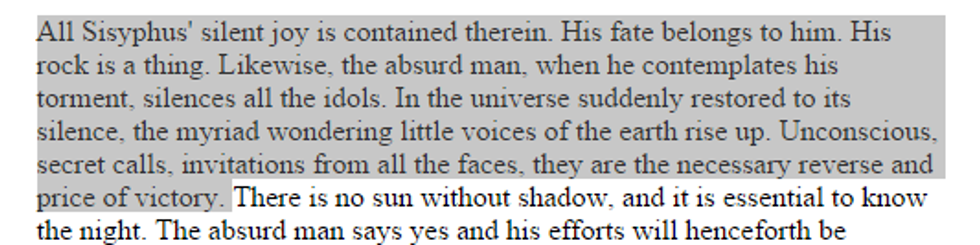
What does this mean? Well, Camus is well-aware and refers to Sisyphus’ eternal punishment as a futile task that is destined to never end, but Camus also suggests something else entirely.
Sisyphus might actually be happy. Despite being destined to a fate worse than death, Sisyphus is happy. How absurd. Although he is forever damned to roll the boulder back up the mountain, Camus believes that he may actually revel in this fact.
And this is where we make the comparison.
As you know, as we all have been, Humans are born, and suddenly thrown into existence. We have our good days and bad days, we have our ups and downs. We cherish happiness, we loathe being sad, we take pride in our work, and we all take solace in our earthly endeavors. Going back to Sisyphus, his contentment, despite the bizarre task before him, could also be said about how we should approach our everyday lives.
We must learn to be content with ourselves and what we have. Whether it’s alot, a little, or nothing at all. We can (and should) learn to be happy and cherish the absurdity of it all, and regardless of what happens, to make the best of it. Just know, that at the same time, as humans we must know when to strive for more. Since we all have the capability to accomplish our dreams. Sisyphus, as he continues to roll the boulder up the mountain, continues to do so because he isn’t currently satisfied.
Looking down the path of uncertainty is tough, but everyone has to make tough choices eventually.
To take a positive twist on Camus' original interpretation of Sisyphus, as the moral of this story: be content and happy with what you have, as we’re all lucky to be alive. But never remain stagnant, and always strive to improve.
Be like Sisyphus, and continue to push that boulder up the hill; regardless of the uncertainty of the future, you will, without a doubt, find happiness.
"The struggle itself toward the heights is enough to fill a man's heart. One must imagine Sisyphus happy" - Albert Camus, The Myth of Sisyphus (1942).