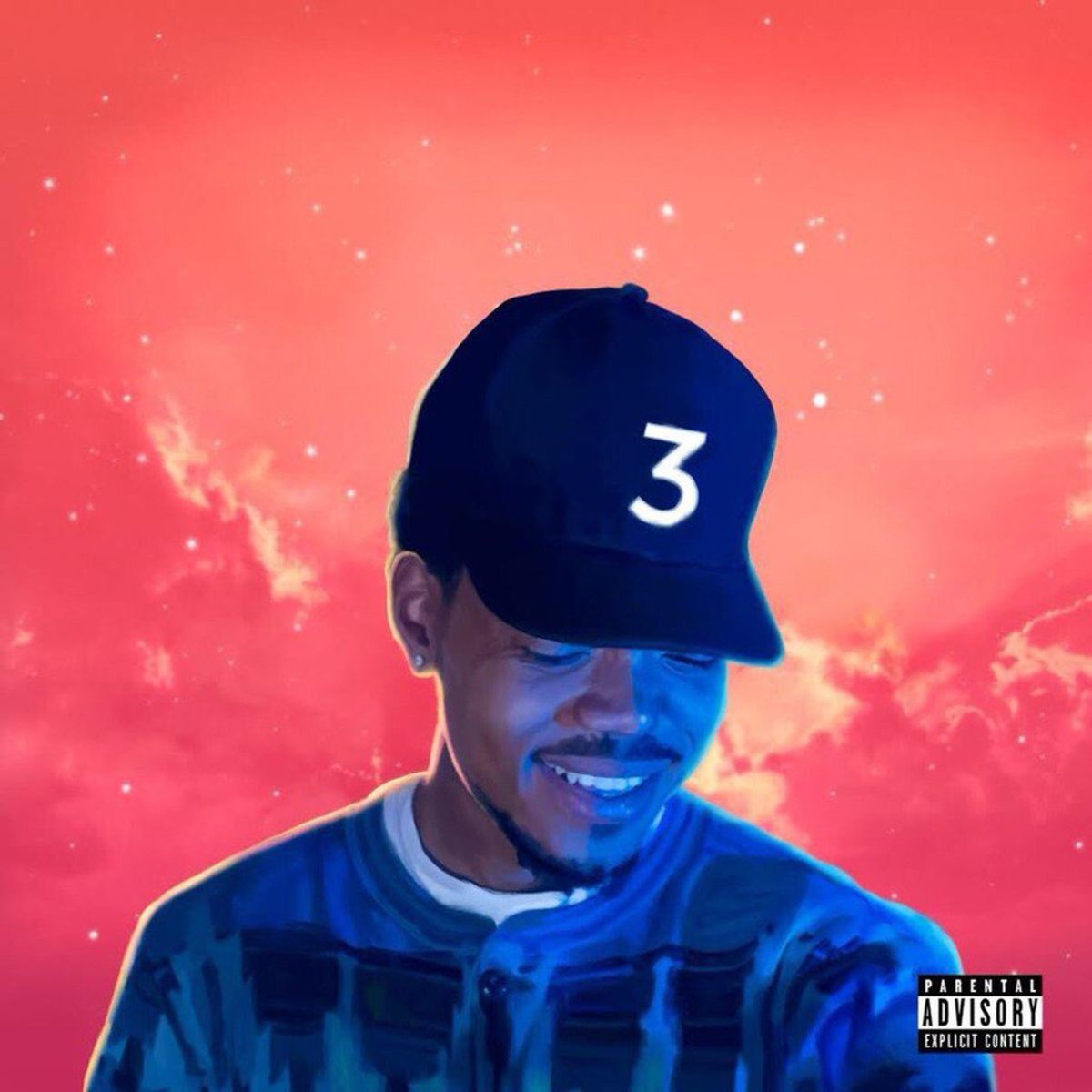
“I don't make songs for free, I make them for freedom," Chance the Rapper states on his latest mixtape. "Don't believe in kings, believe in the kingdom."
Chance the Rapper with “Coloring Book” (changed last minute from Chance 3) in a few moments transports his listeners to a South Side church circa 1965, during the political battles against the deeply entrenched systematic racism of those times. There is no shortage of praise to God across his lyrics, and here Chance shows he has found personal and spiritual freedom and enlightenment in gospel music that goes back for centuries.
The record tells a story not only of a finally maturing man who has found his own answers but of the origins of hip-hop. We hear gospel, jazz, doo-wop and soul -- this is a richly produced and detailed album that fully delivers on the fact it is a gospel album, unlike Kanye’s “The Life Of Pablo” that came and went in spurts. Chance had many a writing credit on Kanye’s record, and had the best verse on the album on “Ultra Light Beam.” That song, while not on this mixtape, personifies exactly what this album is; “Coloring Book” is a god dream of Chicago finally being free.
“Coloring Book” comes at a time when big name stars in rap and hip hop are looking deep into African-American heritage for inspiration and guidance. This is perhaps unsurprising in a country where policemen seem to regularly get away with murder (and in one particular incident in Chicago, the terrifying possibility that local government covered it up) http://chicagoreporter.com/how-chicago-tried-to-cover-up-a-police-execution/, a presidential candidate refuses to disown the KKK and the water is poisoned. Racism is not dead, and our troubles are only just beginning.
The track "Angels" speaks for a desire to "Clean up the streets, so my daughter can have somewhere to play," but it doesn’t look upon the world in dark dredges and weighs heavily on the grit. Even though there is plenty reason to do so, since Chicago is a city with nearly 500 homicides last year. Instead, this album shines through with an aura of warmth, acceptance, and hopefulness. Everyone is welcome to Chance’s church in these times of trouble, and that’s shown by boasting a wide variety of stars like T-Pain, Young Thug, Future, Justin Beiber, Eryn Allen and D.R.A.M. all of which come from drastically different musical backgrounds but somehow come together beautifully. This is not a hodgepodge of random musicians; it’s to make a cohesive statement. “Coloring Book” is not a rallying cry to arms, but a beacon of light to embrace a message of peace that people’s lives do matter. It demands justice like Martin Luther King Jr. does, with love and without violence.
Chance celebrates his city and his friends and family with dusty samples of the heyday of Chicago soul in the 1960s. This is an industry circumventing mixtape that adores its roots and its community. Chance even sings a lot more across this record, and it’s a ridiculously fun album as well. Several personal threads run through the album:the complicated but worthwhile relationship with the mother of his daughter, his concern for the kind of world his child is entering, and his bad relationship with the music industry. Chance trusts it even less now that he can't freely collaborate with friends tied up in label deals, so he took Kanye’s advice and released his latest work for free – and against all odds, it’s working for him. “I swear, my life is perfect,” he says.
So what is a coloring book? Why call the mixtape that? Here’s a theory. A coloring book is a type of book containing line art to which a reader may add color using crayons, colored pencils, marker pens, or paint. People like coloring in different ways, but no one really does it wrong. All colors are accepted because it’s your book. You can mix and mash colors to create whatever you want, which is a lot like music and is precisely what Chance is doing here. Chance declares in the opening track that “Music is all we got”, and with that, he stands up to preach in his sermon of acceptance. Chance uses his prominent and humble voice in hip-hop to bring people together and lift their voices in times of trouble to find solace. Music is Chance’s canvas and through this medium change is coming, hopefully bringing on a brighter, more colorful tomorrow.