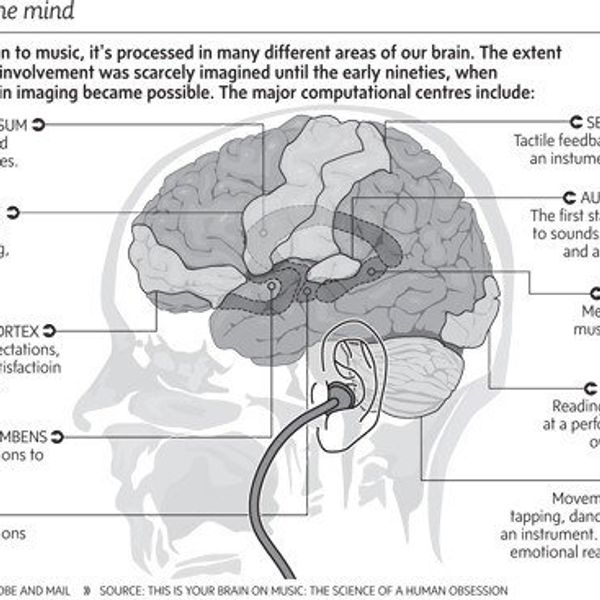
Music is the greatest creation of man. Music touches the soul and helps us sympathetically manifest unspoken desire and humanity. Whenever we want to improve something, we add music to it. A movie, we add music. A dining experience, we add music. A sporting event, music. Political gathering, music again. Music is everywhere – movies, television shows, advertisements, video games, coffee shops, restaurants, stores, on the radio, in the car. Music is the background everywhere we go and in everything we do. Oftentimes the music we listen to fades into the subconscious part of our brains, and yet it still affects us whether we realize it or not. We can not escape music. It is something that every single human being can understand. It has no boundaries and very few rules. It has the ability to communicate with anyone at any time.
Music is an outlet for many, and causes them to listen and to feel things that they would otherwise not have a means of expressing. Life without melodies and harmonies would be empty and, quite literally, silent. Research and new studies have been done teaching us new things about music and how it deeply affects the human brain in ways we never thought possible. Classical music has the ability to help people be visually and mentally more attentive.
Music is not something we think about all too often. We hear it, we process it, we even create music ourselves, and yet we do not take the time to truly understand how music has an impact on us. Music can manipulate our brains into thinking a certain way, or feeling a specific emotion. In fact, a study was done at Heriot-Watt University where they broke down how genre of music and personality is connected. These were some of their findings:
- Blues fans have high self-esteem, are creative, outgoing, gentle and at ease
- Jazz fans have high self-esteem, are creative, outgoing and at ease
- Classical music fans have high self-esteem, are creative, introvert and at ease
- Rap fans have high self-esteem and are outgoing
- Opera fans have high self-esteem, are creative and gentle
- Country and western fans are hardworking and outgoing
- Reggae fans have high self-esteem, are creative, not hardworking, outgoing, gentle and at ease
- Dance fans are creative and outgoing but not gentle
- Indie fans have low self-esteem, are creative, not hard working, and not gentle
- Bollywood fans are creative and outgoing
- Rock/heavy metal fans have low self-esteem, are creative, not hard-working, not outgoing, gentle, and at ease
- Chart pop fans have high self-esteem, are hardworking, outgoing and gentle, but are not creative and not at ease
- Soul fans have high self-esteem, are creative, outgoing, gentle, and at ease
(Cooper, Beth)
Of course it is impossible to make these generalizations from this single study, but it is still interesting to begin to understand how music and personality are related. Another study showed that children who had three years or more of musical instrument training performed better in auditory discrimination abilities and fine motor skills than children who did not learn a musical instrument (Forgeard M). As a young boy, Albert Einstein did extremely poorly in school until he began playing the violin. His wife Elsa once remarked in an interview that:
“Music helps him when he is thinking about his theories. He goes to his study, comes back, strikes a few chords on the piano, jots something down, returns to his study”
(Head, Tom). Music was the key to Albert Einstein’s success because it helped him to focus.
Music is so much more than what is simply heard playing in the background of our everyday lives. I am always shocked when I hear about schools trying to get rid of music in our education system. Music is so vitally important. Music is an extraordinary thing because it cannot be defined by gender, culture, background, or race. Music unites us all, regardless of who we are or where we come from, and it is a universal language shared and experienced across the world. Music is deeply rooted in our past, our present, and our future.
"Without music, life would be a mistake" —Friedrich Nietzsche
Works Cited:

Cooper, Belle Beth. "The Surprising Science Behind What Music
Does To Our Brains." Fast Company. Fast Company, 06 Dec. 2013.Web. 07 Mar. 2016.

Forgeard M, Winner E, Norton A, Schlaug G (2008) Practicing a Musical Instrument in Childhood is Associated with Enhanced Verbal Ability and Nonverbal Reasoning. PLoS ONE 3(10): e3566. doi:10.1371/journal.pone.0003566

Head, Tom. "Six Interesting Musical Facts About Albert Einstein." CMuse. CMuse, 29 Apr. 2015. Web. 8 Mar. 2016.