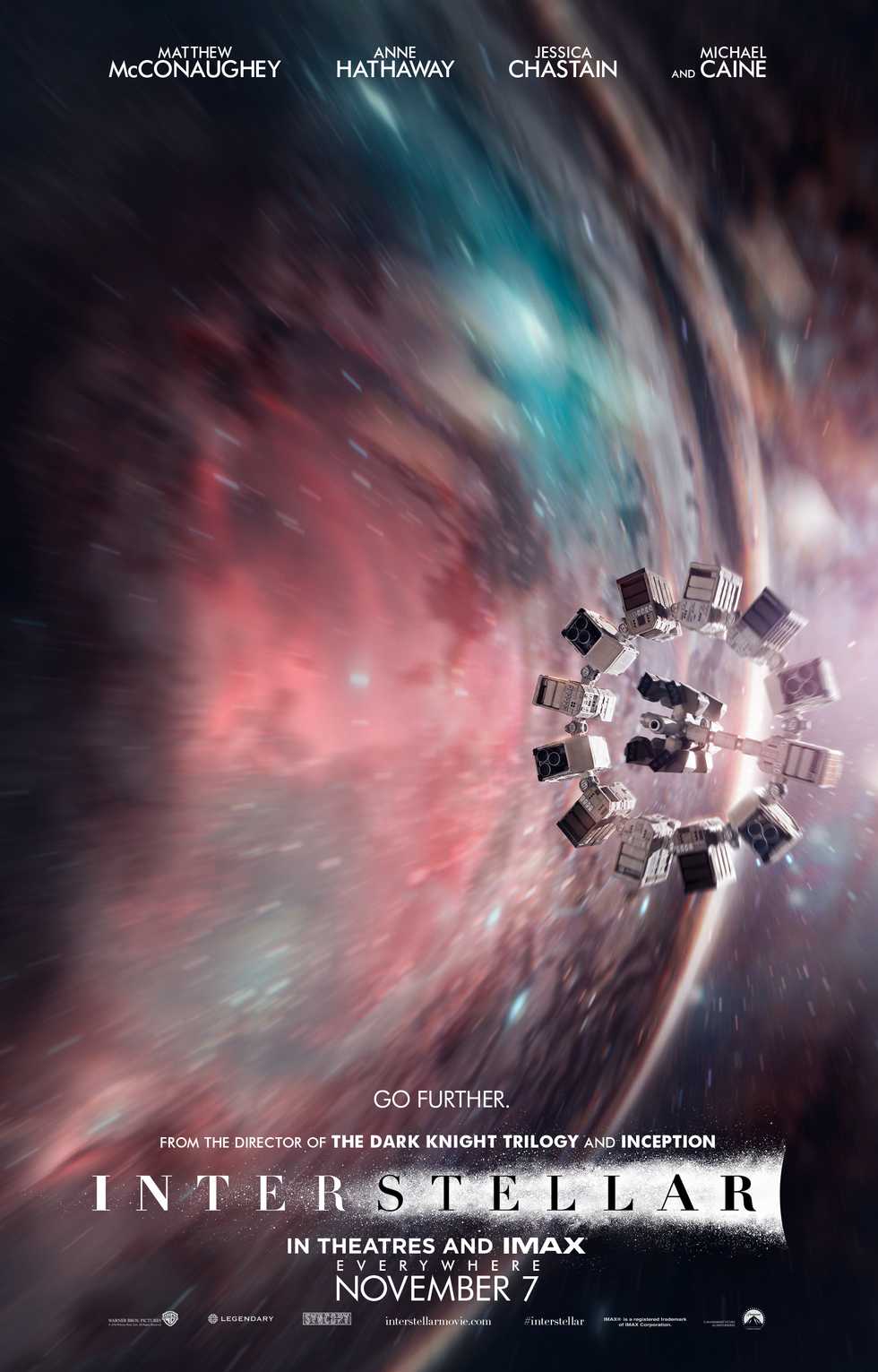
Director: Christopher Nolan
Writer(s): Christopher and Jonathan Nolan
Rating: PG-13
Date of Release: November 7th, 2014
Interstellar, at times hokey
and complicated, is nonetheless a sci-fi epic worthy of its spot in Christopher
Nolan's lauded filmography and a place in movie history.
I’m going to try and keep this review spoiler-free, but if you’re reading and
haven’t seen the movie, just go see the movie.
“Interstellar” stars Matthew McConaughey as Cooper, a former NASA pilot turned
farmer living on Earth at an undisclosed point in the near future. As a result
of a scourge known as “The Blight,” crops are dying out at an alarming rate,
and farmers are in high demand. Humanity’s food supply is scarce, and the entire
species faces destruction by the approaching Malthusian crisis.
Cooper, a widower and former NASA pilot, lives on a nondescript corn farm with
his two children: Murphy (a promising Mackenzie Foy plays 10-year old Murph,
while the consistent Jessica Chastain plays a biting and intelligent older
Murphy) and Tom (Timothée Chalamet and Casey Affleck, younger and older
versions respectively).Through a series of events that I’ll keep a secret,
Cooper is presented with the opportunity to go to space. His mission: discover
planets with livable surfaces where humanity could migrate en
masse in order to save the species. The bulk of the film jumps back and
forth between Cooper’s adventure in space and the lives of his children back on
Earth.
There's a lot going on in "Interstellar." Some of it works,
some doesn't. Let's start with what doesn't. First: the script. Nolan
deserves praise for his willingness to make a big-budget feature with such a
complicated premise, but he comes up short in trying to coherently explain his
ideas. Long stretches onboard the shuttle are cluttered with lengthy,
dialogue-laden scenes that could easily confuse or lose an audience altogether.
The emotional weight of the story, while effective, is a little too simple when
held in comparison to other sci-fi classics like “Blade Runner.” Certain lines
(“Love is the one thing that transcends time and space.”) will make you cringe,
while others will make you scratch your head in confusion. For some reason,
Christopher Nolan and his writing partner/brother Jonathan write certain parts
of the film overestimating their audience’s understanding of advanced
scientific concepts, while simultaneously underestimating their emotional
intelligence. Nolan, a director who doesn’t typically pander to his audience,
oversells the movie’s emotional content and overcomplicates its science.
The movie’s length could also be a turn off some viewers before they even step
foot in the theater. Fans of movies such as “The Godfather” and “2001” can
rightfully maintain that their length is deserved, but at 2 and a half plus
hours, “Interstellar” is chock full of pacing issues. From an overly long
chase-sequence in the film’s first act with a disproportionate payoff, to
certain stretches of dialogue aboard the spaceship in the second act,
“Interstellar” could have benefitted from a more succinct edit. Nonetheless, if
you’re a Nolan fan or just a fan of science-fiction in general, you’re not
going to feel the length of the movie too much. It’s engrossing, and for the
most part the film will fly by.
There’s also a lot about “Interstellar” that works—and works really well. Worth
mentioning first are the film’s various visual effects. Nolan’s decision to
keep the movie’s physics and imagery grounded in reality really pays off. When
a massive spaceship is completely dwarfed by the rings of Saturn, this movie
makes you feel small. When an explosion rips through a vessel, the ensuing
silence of space’s vacuum is unnerving. The production design and overall feel
of the movie owe themselves largely to Stanley Kubrick’s 1968 classic “2001: A
Space Odyssey.” Nolan himself has credited Kubrick’s magnum opus as a major
source of inspiration for the film, and it shows. From the crew’s rotating
space station the “Endurance” to the classical, deep-space music cues, Nolan
channels his auteur predecessor and does so effectively.
Cinematographer Hoyte van Hoytema capably balances the intimate confines of a
small spacecraft with the vast recesses of space. The surfaces of foreign
planets feel remarkably alien, and the film’s psychedelic finale is abstract
and beautiful. The acting in the film is also superb. Young Mackenzie Foy
(little Murphy) has a believable father-daughter chemistry with McConaughey as
Coop, and Anne Hathaway also has a remarkable turn as emotionally-conflicted
astronaut Amelia Brand. Michael Caine is characteristically superb as her
father Professor Brand (reprising his niche role of “the old guy who calmly
delivers sage advice,” with a twist) and Jessica Chastain delivers an acidic
performance as older Murphy. My only complaint with the film’s casting is the
unrealized potential of Casey Affleck, who is in my opinion one of Hollywood’s
most underrated talents. Cooper’s son Tom is one-dimensional, and at times the
sole purpose of his character is to heighten tension or advance the events of
the story. Overall, however, the cast (main and supporting) does a professional
job bringing to life their various characters. By the end of the film, you
can’t help but care about the fate of each individual that Nolan has created.
If a movie can do that, it’s hard to ask for much more.
I like “Interstellar” a hell of a lot more than I dislike it. While I have my
fair share of complaints, they’re mostly nitpicky; the movie still works.
Christopher Nolan deserves a lot of praise for this film, specifically because
it was such a gamble. Mind-numbing, action-packed blockbusters are a dime a
dozen nowadays, and “Interstellar” is a refreshing change of pace. I expressly
avoid saying things “this movie changed my life,” and “best movie of all time,”
which are phrases that Nolan fans (and I consider myself one) are apt to throw
around every time he releases something new. “Interstellar” isn’t a perfect
movie, or even Nolan at his best. But it’s a good movie—maybe even a great
movie—and you’d be doing yourself a disservice by not seeing it at all.
Final Score: 4/5