This semester, I have had the pleasure of taking part in a Fiction genre class that taught me the finer points of what makes Fiction, well, Fiction. From the minor details that make the genre work, to wildly inventive short stories, this class never had a dull moment as far as the content was concerned.
When people normally take classes like these, those with an astonishing amount of reading (also known as English classes), they are often asked which of the stories they read were their favorite. I've been preparing for a question such as this for three months; and, although the question is much harder than I originally imagined, I think I've arrived at the one story we read that impacted me the most. That story was Ray Bradbury's "The Veldt."
Many may have heard this author's name in the past; you have Fahrenheit 451 to thank for that. And while there's a lot of book burning in that specific text, that was the last thing included here. Although, to be fair, Bradbury's case for the importance of books and literature still manages to shine through.
Maybe I've peaked your interest? Regardless, let's dive into the specifics. For those of you who haven't read it, I'll give a brief summary.
In the near/distant future, families have these "smart houses" that do everything for them. Think somewhere between The Jetsons and that one Disney Channel Original movie called, Smart House. You know, the one where the futuristic household that does great things like make smoothies and has the ability to transform rooms into any location on earth, breeze and weather included, goes haywire and attempts to have a computerized Mother figure become a surrogate for the motherless family residing? No? Oh, well, stop what you’re doing and go find it, immediately. It’s one of my favorites.
Now that I think about it, forget The Jetsons. Disney really hit the nail on the head here. This movie is almost a retelling of Bradbury's 1951 short story. Only, not at all. The least of these reasons being that there isn't a happy ending. It's actually more of a nightmare really - for parents anyway.
The futuristic house in "The Veldt" does everything for this family, but it's most distinct feature is that of the nursery. Like the rooms in Smart House, this nursery can transform into whatever the children of the family want it to be. They spend countless amounts of time in there. So much so that the parents, George and Lydia Hadley, begin to worry about them.
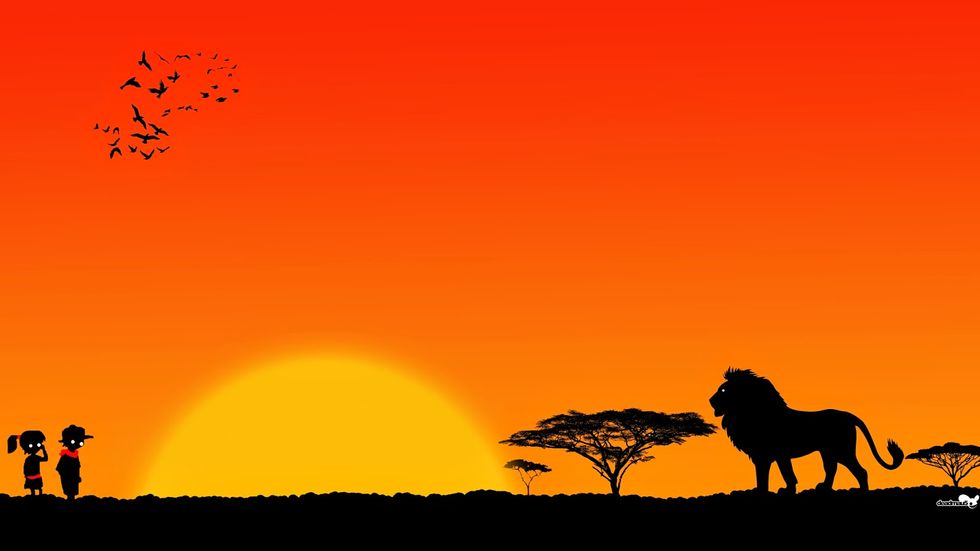
Their reasoning for this centers on the fact that, recently, the children have been transforming the room into an African Veldt - which, for those of you who have absolutely no idea what that is, it's like a Safari. There are lions, antelope - although, no Simba or Mufasa unfortunately. You may be wondering why this troubles George and Lydia, and that, my friends, is a rather complicated issue. For the sake of time, I'll focus more on the fact that it's a Veldt and lions eat people. If you weren't aware, now you know.
Lydia voices her concern to George and, at first, he's a bit apprehensive. He doesn't see a problem whatsoever. He thinks his kids are fine. That's until Lydia takes him into the nursery and they almost become lunch.
This brings George to change his mind on a whim, going on a rant about how technology is controlling all of their lives, like a bitter elderly person who just doesn't understand kids these days. He makes the decision that they, as a family, are going to "go off the grid."
He informs his children of this fact when they arrive home, acting like a bunch of sociopaths and ordering their parents around. They are heartbroken to hear of their father's intentions; they resort down to their childlike state once more. In case you were wondering, the same happens when you threaten to take an iPad away from a toddler for punishment. Fits are thrown and, instead, the nursery is taken from them. Ironically, for punishment. And they say literature isn't applicable to modern day...
Anyway, in response, George and Lydia attempt to take the Veldt away from the two, but, for some reason, it doesn't actually get taken. Maybe that's their problem - no follow through. George and Lydia start having these horrifying dreams about the Veldt after that. Dreams that include much screaming and a sense of unease and dread, although there is no explanation as to why.
In short, they bring in a psychologist to look at the Veldt, seeing as the minds of their children control it. During this meeting, George plans to forcibly take the family away to wherever one goes to hide from technology. The children end up finding out about it and... well, George and Lydia's dreams become reality. Like they were somehow prophesying their demise, the children feed their parents to the lions. What's even worse is that the story ends abruptly. The children invite the psychologist to have tea with them in the Veldt following the murder of their parents and the curtain draws to a close. That’s the story.
Although, I have kept the worst part of it all, at least in my opinion. Remember how I said this story was a continuance of Bradbury's case that books and literature are important? If you'll notice, I didn't include the children's names. That's because they are essentially the greatest maneuver Bradbury makes, one that relates to children and literature, but also the fears of parents everywhere all while relating to the backstory of the characters themselves. That is because the children are named Peter and Wendy. Yea, the boy that flies around whisking children off to Neverland? The most famous of these children being Wendy Darling? Only, here they are psychopathic killers who commit parricide? It's troubling to say the least. The original Peter Pan story isn't much better, but I digress.
Remember when I said that would be brief? Ha, English Major's disease, my apologizes. To be fair, this was the bare bones of plot. This story is crammed with possible points of discussion. There are so many directions one could go with their analysis, but the main point I would like to focus on would be the effect of technology on Peter and Wendy, and how that relates to the reader.
George spends countless amounts of time talking about the effect technology has had on his children. He believes it to be negative; otherwise, he would not be attempting to protect his family by running away from it. I jokingly said earlier that George was like an elderly person who hates change. They think technology is ruining humanity, etc. We all know or have interacted with someone like this. That person may even be yourself; I'm not condemning you or those you know if any of that happens to be the case.
This mentality is all well and good, but think about the effect that this cushy technology has had on the two. Even from the first time the audience is introduced to them, they speak like adults. George thinks their behavior unacceptable, because it is. He's losing his children to technology, and too soon. Peter is only ten. That cannot possibly be a comforting feeling.
It's easy to see that the impact of technology is a substantial one. The children's lives revolve around it. They become violent when presented with the idea of its disappearance. Murder aside, who's to say that this brand of technology doesn't have a negative effect on them. In fact, that is exactly what I think Bradbury is saying here. This is an issue we can understand in present day, perhaps better than society could in 1951 because it's so much more evolved.
We live in a world where we can not only communicate with others in a split second, we have the ability to access every bit of information on our wrist if we so choose. Toddlers are soothed with iPads and teenagers with Twitter. Middle-aged women play pointless games on Facebook to pass the time and many believe those black mirrors we carry around with us to be rotting our brains.
This is exactly the kind of thing Bradbury is conjuring for us, only about sixty years in the past. To him, it's a bit of a dystopia, but to us it's our livelihood. I, of course, am not condemning technology. I think it's a valuable resource if not abused. With great power comes great responsibility, all that Voltairean nonsense.
However, my opinion is not absolute. What I want to do is leave you with a question or two to ponder over for the next week: How do you use technology? Do you abuse it? Or is it a resource? Could we live in a world without technology or would we metaphorically end up eaten by rabid lions?
Think about it, and I’ll see you next week!