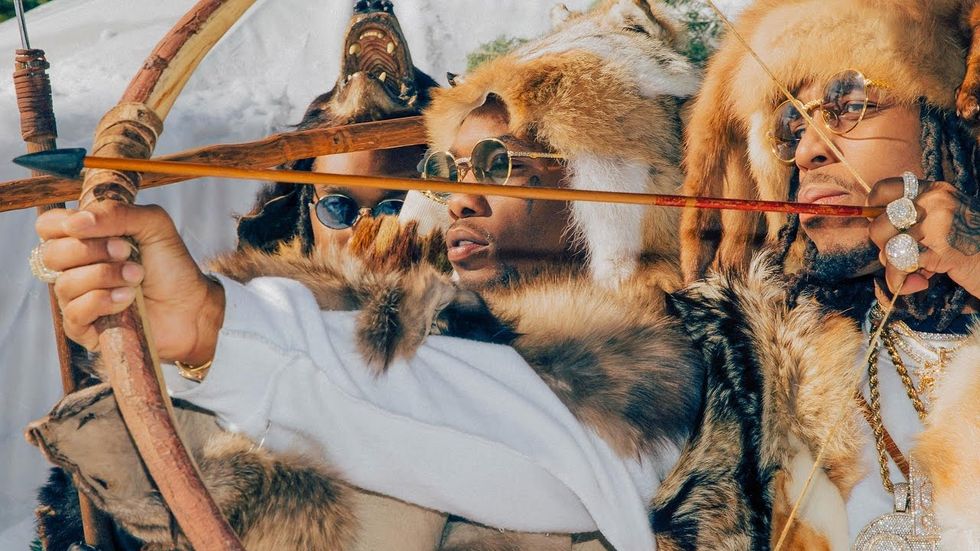
When Quavious Marshall, Kirshnik Ball, and Kiari Cephus uploaded their debut nineteen-track mixtape, entitled Juug Season, to the newly budding online rap scene in 2011, they seemed to be the only ones who believed in their ability to craft influential art. The trio, who originally went under the moniker Polo Club before later changing their name to Migos, had deep musical roots with one another. All three members (who rap under the names Quavo, Offset, and Takeoff, respectively) are related, and as a result grew up together in Lawrenceville, Georgia. The three bonded at a young age over their love of other Georgia-based hip-hop acts such as OutKast or the Dungeon Family. Music was an integral part of the trio’s adolescent lives, as they started to make music as early as seventh grade, and continued to keep music their priority. Quavo, despite having a fairly successful high school football career, dropped out in 12th grade to pursue rap full-time. Juug Season wasn’t a commercial smash hit by any means; but Migos had the kind of insatiable work ethic that is commonly found in the Atlanta Hip-hop scene. Less than a year later, the group would come out with the first of what would become a career-defining series of mixtapes: No Label. The group strayed away from the more generic trap beats and synth melodies that were present on Juug Season. Instead, Migos kept their same melodic, intoxicating flows, and rapped over beats with woodwind melodies; such as on the most popular track off of No Label, Bando. It didn’t take long for Bando to blow up in the Atlanta scene, catching the ear of superstar producer Zaytoven, and eventually hip-hop deity Gucci Mane.
Never ones to let an opportunity pass, the group would in 2013 release their third mixtape in three years. The group saw another viral hit with their song Versace; which was only further popularized when Drake added a verse of his own the song, and put it on his 2013 album as well. By then, Migos’ rise to the top of the Atlanta rap scene was meteoric, and with the consequential release of numerous albums, mixtapes, and features over the next four years, the trio had solidified its place at the top of the Atlanta Hip-Hop scene.
However, regional popularity is the ceiling for many artists; and the hip-hop industry is no stranger to chewing up and spitting out artists who swear that their rise to fame is more than just timely hype. For every hip-hop superstar we observe the growth of, there exists a plethora of acts who’ve fell from heights just as great: from Fetty Wap, to Chief Keef, to Chamillionaire. It seemed this was the path our dreadlocked heroes were going down for the majority of 2016. Despite the viral explosion of the Dab, Migos did not have any songs off of their 2016 mixtape make the billboard charts. But then, just as the year was winding down and rap fans were beginning to entertain the thought of closing the book on Migos; Bad and Boujee was released.
Bad and Boujee wasn’t an immediate chart-topper. The song was originally posted on SoundCloud in the late summer of 2016 as a preview for a mixtape that has still yet to be released. However, on October 28th, it was repurposed as the first single off of their new album, entitled Culture. Less than three months later, the song would go on to become the biggest song in America, reaching number 1 in the billboard charts. Migos were officially back. But what gives Migos their ability to stay consistently relevant, while rappers of a similar ilk fall by the wayside?
This song, and Culture in general, is a microcosm of what makes Migos so unique compared to their peers, and so apt for this generation of rap fans. At first glance, one could, if they were lame, dismiss the song as another club banger that does nothing new. However, that would be doing a disservice to Migos’ constant reimagining of their own style. Despite the lack of a Takeoff verse, the song serves as an exploration and homage to the breadth of different cadences, flows, and styles that Migos bring to the table. Right off the bat, before even pressing play, Migos re-appropriates Marxist vernacular, shortens it into a slang term, and then intentionally misspells the word. Boujee, typically spelled Bougie, is short for Bourgeoisie, a term used to describe the upper middle class in reference to its obsession with materialism. By going, Migos is piquing the curiosity of those who aren’t especially familiar with the Atlanta dialect. In other words, here they are targeting the same demographic of people who would google things like “How do I do the Dab Dance?” or “What is a Nae Nae?”. The timing of the re-release also played heavily into the popularity of the single. Despite its popularity in the party scene, make no mistake: Bad and Boujee is a dark song, and did not fit well as with other bubblegum summer anthems. The song begins with an intro section, kicked off by an ominous and dissonant droning, preparing you for the debauchery to come. During this section, we are also greeted by Offset, who gives a brief monologue on the concept of Old Money vs. New Money, all while sounding like a supervillain revealing his plans to take over the world. From there on, were greeted to a sampler of Migos’ diverse array of styles: beginning with a syncopated, choppy flow that transitions into their signature triplet style of delivery that initially thrust them into the public consciousness on “Versace”. Throughout the group’s two verses on the song, we’re also treated to some dark, melodic R&B that serves to further the group’s lavish, yet stoic aesthetic.
But the transcendent popularity of Bad and Boujee, and Culture as a whole stretched beyond just its musical composition. What sets this album apart from previous efforts by the trio is its ability to fully integrate the audience into the experience. For example, in Bad and Boujee, Offset employs the use of call-and-response elements and melodic onomatopoeia in order to create a memorable verse that naturally lends itself to crowd sing-alongs. Additionally, Migos are no stranger to sparking an internet meme; as is illustrated by the online frenzy generated by songs like Look At My Dab or Hannah Montana. The opening lines to Bad and Boujee, “Raindrop, drop top…”, quickly became a popular template for jokes on twitter, as people would then finish off the quote with a third, rhyming line that often had little or nothing to do with the song itself. Because of the many, many different words one could use that rhyme with “top”, this trend spread astonishingly quick, and furthered advanced the song’s craze. The hype and popularity surrounding the song and the group itself are not just products of the luck of a one-hit-wonder; but rather a demonstration of all the different ways Migos can keep you captivated, and further their stranglehold on popular culture.