Find part one here
A double major in cognitive science and human-computer interaction, Carnegie Mellon sophomore Avi Romanoff isn’t your typical hacker. Frequenters of hackathons are stereotypically computer science nerds, and subsequently the charismatic and outgoing Romanoff, having a primary major in the department of psychology, is no less than a standout. One will note the incredible skill that this individual has cultivated in the areas of programming and all things technology, having proved himself by winning PennApps, the largest national hackathon, at the beginning of his freshman year, and the invitation-only Facebook Global Hackathon this fall.
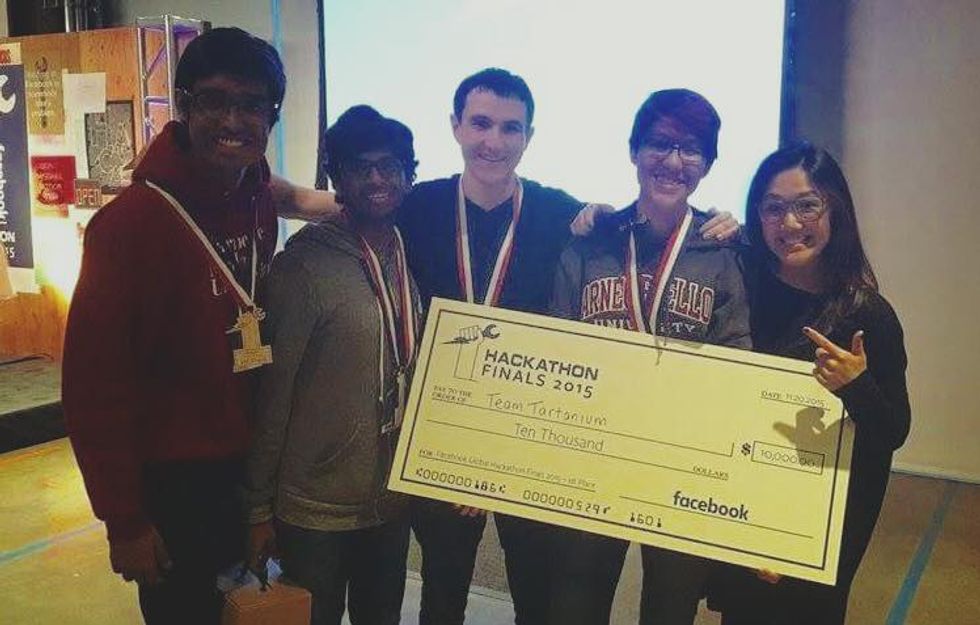
Facebook Global Hackathon Winning Team 2015. Courtesy Avi Romanoff
MellonHeads is the brainchild organization of Romanoff, whose goal is to expand the hackathon even into other less traditional fields. “The challenge,” he states, “is to take a cultural phenomenon that works for one subgroup of people, one subculture of people, and not bring more people into that existing culture, but to take the model and give to other cultures in hope it replicates itself in a way that is uniquely idiosyncratic to that group”.
The success of MellonHeads rests on the assumption that people of all passions will benefit from an event where participants come together to revel in their shared and unshared interests to exchange ideas and ways of thinking. They hope then to turn all that into something useful and creative.
However, Romanoff’s approach to changing the world’s view of hackathons and increasing inclusivity to disciplines not traditionally involved in these events isn’t merely progressing the hacker culture; in his words, MellonHeads isn’t about “bringing more people into an existing culture” or scaling up in any way, he envisions taking “this subgenre of event and scal[ing] it to way more genres and get[ing] way more subcultures involved”. Romanoff and the board are taking the organization and moving off the grid into entirely unexplored territories. Though in some cases tossing a bunch of disciplines together and calling it “revolutionary” is considered shallow, the MellonHeads' approach is completely untraditional. He isn’t creating a new culture, or adding people to an existing one to progress it, instead, he’s asking “how can that culture, that has been created around hackathons, be applied to other disciplines?”.
In order to attain his goals of a “big meta hackathon, where people from all these different disciplines can come together,” Romanoff plans on organizing a series of “prototype hackathons” where it’s not “‘Hey you should come to a MellonHeads event,’ but let’s create an even for you [the major or discipline]”. By targeting students by their major and advertising to their strengths, Romanoff and the MellonHead board are performing the cognitive science equivalent of a head fake. The key, he says, is that “the fact that it’s by MellonHeads is beside the point … they don’t even know they’re going to a hackathon, or that they’re part of MellonHeads, they just know they had a good time”. Avi Romanoff is advertising his organization by not explicitly advertising. His style of directing advertising to specific disciplines increases awareness and acceptability of hackathons in demographics that don’t generally attend nor even know about hackathons.
The first of the prototype mini events will be “Hack-a-Song”, a collaboration with the Independent Musicians Organization (IMO). Proudly proclaimed as “the first event of its kind at Carnegie Mellon,” the event promises, “A 10-hour event where teams of 3-5 student musicians write new music and show it off to an adoring crowd”. According to Varun Gadh, president of IMO, the organization carefully designed their advertising campaign to attract people who had no idea what hackathons are. “The first round of posters…didn’t really tell you much about it [hack-a-song], they defined the name, but that’s it…then we increase from that to the creation of the Facebook page and the website”.
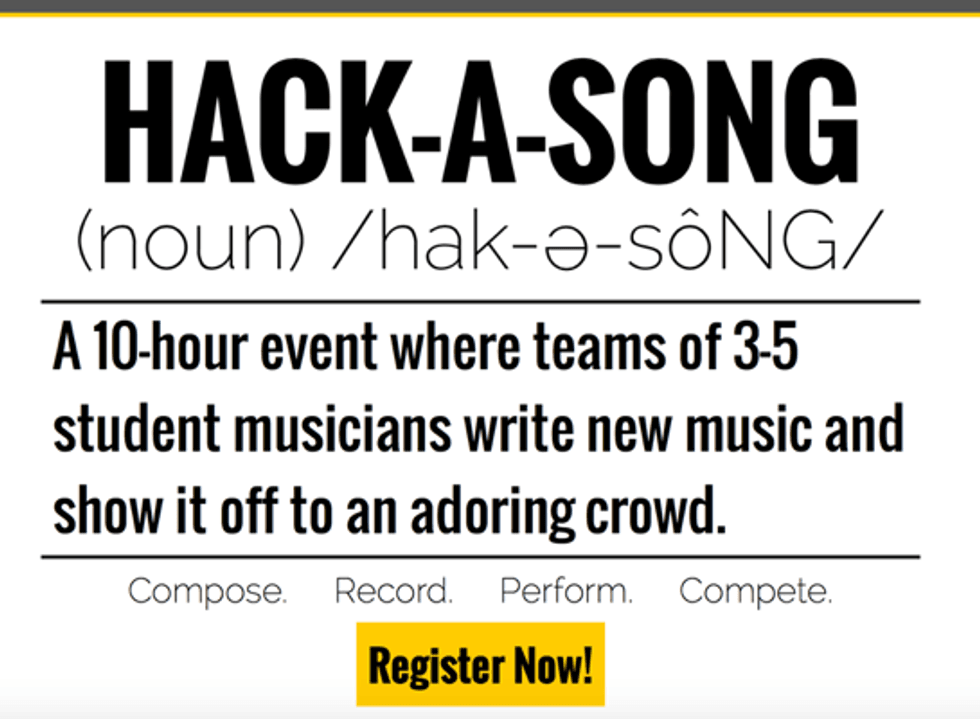
Hack-a-Song
Bolded on the page are the words “perform” and “collaborate”, further indicating the type of environment the organizers hope to create. In fact, while the page includes a “What is IMO?” section, the only MellonHeads reference is a logo is neatly hidden at the bottom of the page. As the first mini-event, Hack-a-Song will provide a launch pad and model for a future event. Romanoff’s envisioned series of such events will depend on tailoring language and outreach to suit each targeted demographic of students.
A perhaps somewhat unintended benefit of opening hackathons to non-computer science and electrical and computer engineer students will likely be the increased presence of women at such hackathon events. The low enrollment of women in “hard-core” technology fields combined with a general aversion to sitting in front of a computer in a room full of guys means that female involvement at traditional hackathons generally hovers around 10 percent. By expanding hackathon involvement to other majors, the gender gap will likely decrease. In fact, one non-coding hackathon, ProtoHack reports a gender breakdown of 62 percent male and 38 percent female, significantly better than the average coding hackathon. Though the MellonHeads are not attempting to create a completely code free event, it’s quite probable that similar effects will be noted. Of the 10 interim board members of MellonHeads, 4 are women. More overall female involvement will likely result in more computer science female participation as camaraderie among women increases. The MellonHead’s hackathon will introduce non-traditional participants to the event via ideas they are already comfortable with.
Furthermore, MellonHeads embraces the idea that “when we say hacker culture, we’re not talking about not showering, eating pizza, drinking red bulls, and sitting in front of a computer. It could be the total opposite, like super artsy-fartsy kids maybe writing a script or sculpting something. It’s about the creation and the passion, showing the world why your particular approach to seeing something, and making something, is awesome”. Hacking, they propose, isn’t about the creation itself, it’s about meeting new people and learning from them. Romanoff excitedly described how “it’s so cool that we, as the hacker community, have events where we can come together and build shit and all that stuff and celebrate why we’re into it and everyone gets it and you can just go to this event and enjoy the electricity of everyone doing this and they’re so passionate.” Furthermore, “The Hackathon Phenomenon,” a research paper that delved into the cultural potential of hackathons, identified learning as the main reason people attend hackathons at 83 percent and networking a close second at 82 percent. By involving even more people from a wider range of backgrounds and interests, MellonHeads will facilitate learning and the exchange of ideas.
While currently, only about 23 percent of participants identify themselves as non-software developers, the inclusivity and long-term goals of Romanoff and the board of the MellonHeads are moving their subculture in a new direction percent. Though Romanoff explicitly stated he isn’t out to change hacker culture, it’s inevitable that he will as he moves lines drawn by previous generations and acts an evangelist for his belief – that hacking is for everybody. While some may argue that non-technical majors lack the skill necessary to create revolutionary technologies, already the popularity and early success of MellonHeads is proving otherwise. Teams featuring a designer often submit projects with entrancing and stunningly easy to use interfaces. There are at least a dozen other ways a new major can contribute to the technology revolution and no one better to promote this idea than a non-computer science sophomore having already received internship offers from the likes of Apple.
Romanoff’s approach to spreading MellonHeads and the largre scale hackathon they have planned is the belief that people respond to things they are familiar with. By reaching people on their terms, the MellonHeads are able to appeal to a larger audience than otherwise possible. The MellonHeads seek to herald in a new age of hacking, founded on insane amounts of learning and interdisciplinary collaboration.
Special thanks to Avi Romanoff and Varun Gadh for personal interviews