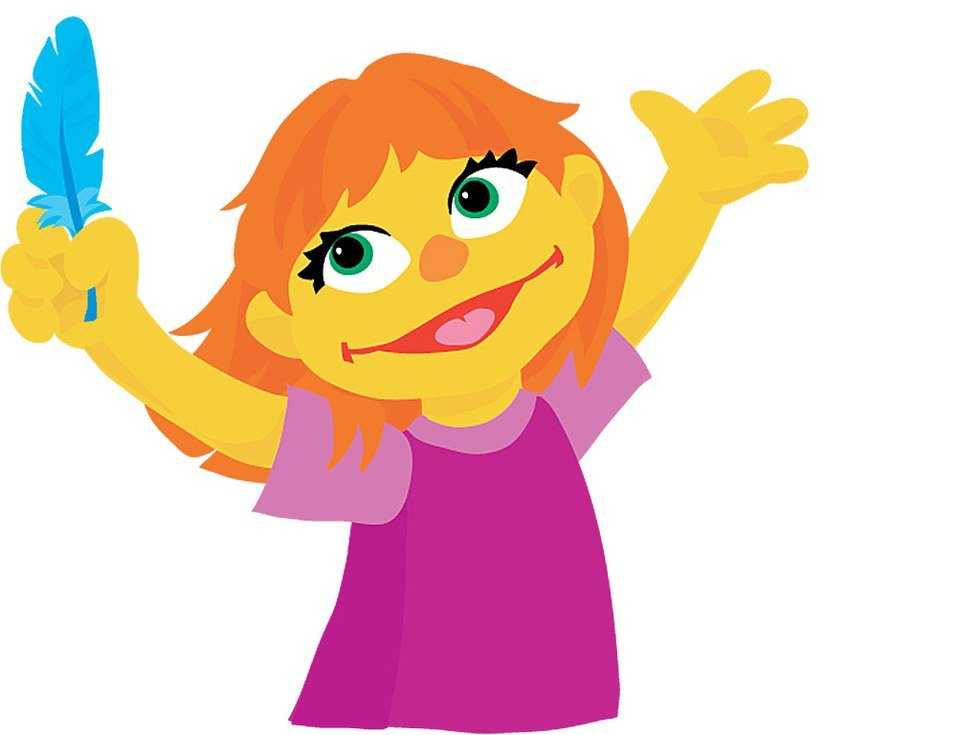
There is a new face in the world of Sesame Street. Her name is Julia and she has bright orange hair and green eyes. What makes Julia so important is that she is the first Muppet to be introduced with autism. Julia is a part of Sesame Street's new program called "Sesame Street and Autism: See Amazing in All Children". She makes her debut appearance in a free digital storybook entitled "We're All Amazing, 1, 2, 3!" In the short book, Elmo helps Abby understand Julia's differences while also maintaining that they, as children, are still the same.
According to the website of Autism Speaks, 1 in 68 children are born with autism. Additionally, autism is five times more likely in boys than girls; 1 in 42 boys and 1 in 189 girls are born with autism. It is also the fastest-growing developmental disorder within the U.S. Despite the growing number of children being diagnosed, the disorder is still not well-understood or accepted by the general public. This is a growing problem, especially within schools, since many children with autism are shunned or bullied for their differences. "Children with autism are five times more likely to get bullied," Dr. Jeanette Betancourt, the senior vice president of U.S. Social Impact at Sesame Workshop, told People.
It is with all of this in mind that the Sesame Workshop began to develop the "Sesame Street and Autism" initiative as well as Julia's character. By introducing her to the world of Sesame Street, they are hoping to break down the stigma associated with autism. "We are trying to spread the story about the theory behind this whole thing – love and acceptance," Dr. Betancourt told People. If they can help younger children understand the differences of children with autism, it will help them to love and accept them. This is definitely a step in the right direction because hopefully, as a result, more children with autism will be loved and accepted by their peers instead of bullied.
I fully support this movement by "Sesame Street" because I believe it can make a difference. My youngest brother has autism, and while he was not bullied (to my knowledge), he was sometimes treated as an "other" or "different." Due to this, he didn't have many friends in school. I know it was especially hard on him some days and it was hard for me to see people treat my brother like that. Therefore, I would like to see a change in the way people view autism because it is more than a disorder. Children with autism deserve to be treated with the same love, respect, and acceptance as everyone else. I have hope that Julia will be able to help children better understand autism so that they can understand their differences, as well as similarities, in order to love and accept one another.