
Recently I was having a conversation with a friend about not liking a movie because it portrayed a certain culture in a negative light and they said "It's just a movie." This made me think though, because although it may "just be a movie," media has a strong impact on those who consume it. Our nation has debated how much of an influence violence in video games and movies has translated to violence in real life. On the other hand, media is an art form and it shouldn't be taken as a guide to reality. So how much should media be held accountable for its influence on those who watch it?
Hollywood has been under fire recently with #OscarsSoWhite. People were upset because the nominations for the prestigious awards were noticeably lacking any sort of diversity, especially when there were other actors who deserved nominations. The late night comedy show, Saturday Night Live, even got in on the issue with a sketch calling out the Oscars. The issue is an important one for several reasons. The first being that we do not live in a country entirely made up of white people, therefore our media should represent that. The other reason that it is so problematic is that individuals of other races do not get to see people like them on screen. They are made to believe that they can't be actors in those big roles. The other concerning issue that Hollywood has is portraying cultures in an incorrect and harmful light. They so often stick to stereotypes of certain groups that do not correctly portray them and in turn reinforces the wrong image. In J.K. Rowling's new play based off of the Harry Potter series, Hermione Granger is played by a black actress. Many people were upset by this because she is played by Emma Watson in the films, but when questioned Rowling responded with this tweet.

,_Hermione_Granger_(Noma_Dumezweni),_Rose_Granger-Weasley_(Cherrelle_Skeete)-large_trans++qVzuuqpFlyLIwiB6NTmJwanvEx60GDKHt8thW94NfqQ.jpg)
The Granger/Weasley family in the "Cursed Child" is just one small step in the right direction toward better media portrayal.
The issue of media portrayal is not just a race issue, but also an issue of gender and sexuality. The classic movie "Ghostbusters" was remade this year with an all female cast. Many fans of the original film were upset by this change, but others were excited. The film showed little girls everywhere that they can be strong too.
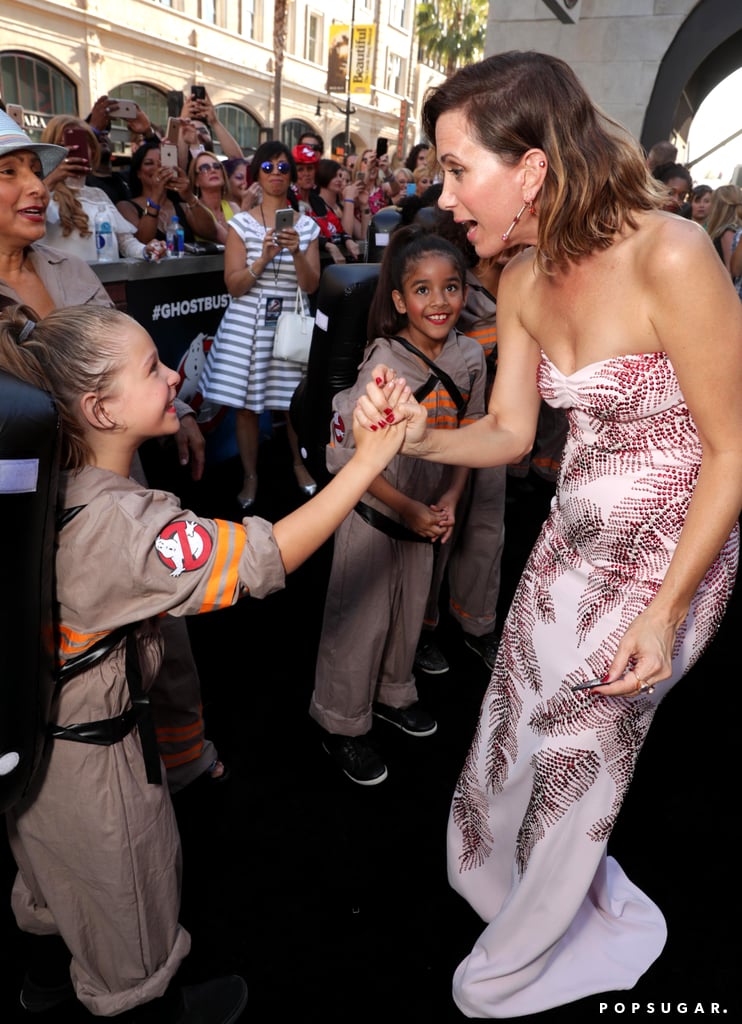
In this image, two young fans of the new "Ghostbusters" film are seen admiring one of the stars, Kristen Wiig. This image alone shows how much of an impact representation in media can have. Most leading ladies in major films are only portrayed as a counterpart to the male leader. They are usually shown in revealing outfits and do not have any strong personality traits, as that would threaten the male. In this summer's "Suicide Squad," Harley Quinn is the female lead and is a strong feminine presence, but wears the smallest clothes possible and her power mostly comes from her sexuality. It is not a bad thing for a woman to be shown owning her sexuality and wearing whatever she wants, but it becomes problematic when this is the only image available of women. Media is moving in the right direction, but there is still a lot of room to grow and to correct the representation of all races and genders in media.
While at the movies this summer, a Coca-Cola commercial came on right before the beginning of the film. It's the commercial about "the movie move" of putting your arm around your date at the movies. When watching it this time, I was struck by how heteronormative the commercial is. It shows three different couples, all of which are heterosexual. The LGBTQ community is one that is seriously underrepresented in the media, and when it is represented it is usually incorrect and stereotypical. With popular series such as "Orange is the New Black," "Modern Family," and "Glee," the LGBTQ community is beginning to be portrayed more frequently. However, these portrayals typically consist of white actors.
It is 2016 and we live in a nation that is very diverse, so it is time that our entertainment accurately portrays that.