


It was only decades ago that scientists scoffed at the idea of transplants. It took awhile for the public and scientists to warm up to the idea of giving someone another person's organ. Now we not only accept that transplants can be done but they are fascinating topics of conversation.
But what about a head transplant? Is the world ready for that?
According to one scientists, it is not possible only in science fiction. Dr. Sergio Canavero is an Italian neurosurgeon who says he has the ability to sever a head and re-attach it to a healthy body. He believes the procedure will revolutionize medicine, providing paralyzed people the ability to walk again and give old people younger bodies. His partner is a surgeon from China named Xiaoping Ren.
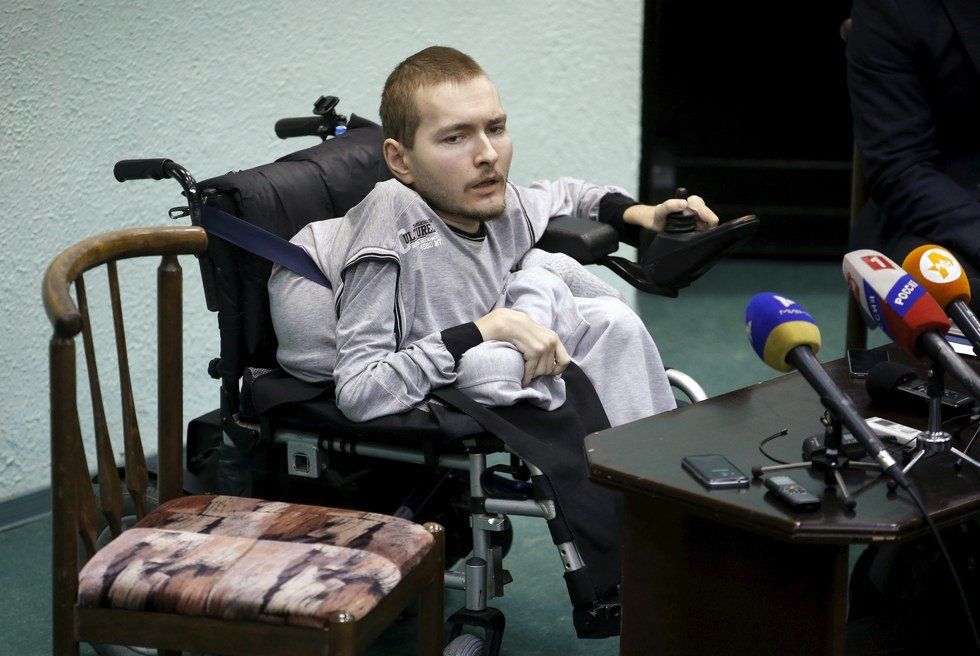
The first man to volunteer for this extraordinary procedure is Valery Spiridonov, a 31-year-old computer scientists from Russia. He runs an educational-software-company from his home. He has Werdnig-Hoffmann disease, a degenerative disease that causes muscles to atrophy, meaning to waste away and also causes motor neurons to die. He has the head of a man but a child-sized body, has no memory of ever walking, and his movement is limited to feeding himself, typing, and steering his wheelchair with a joystick. Doctors are amazed he stayed alive this long and do not give him much longer to live. That is great motivation for Spiridonov to volunteer for the operation.
However, Spiridonov and Canavero has a ton of obstacles to overcome. One huge problem is money. The Russian government has not agreed to pay for the surgery and China, where Ren is based, has yet to approve of it. The scientists and the volunteer need all the help and money they can get because the procedure is expected to cost between $10-$100 million!
Canavero, Ren and the rest of the team are doing their best to raise money. Canavero hopes to partner with American researchers to win a grant worth $100 million from the MacArthur Foundation, an organization that supports creative people, institutions, and networks building a better world. Spiridonov, meanwhile, is seeking donations and selling hats, mugs, T-shirts, and iPhone covers online to raise money.
Of course it will be hard to obtain money due to doubts from the scientific community. People have dubbed Canavero "Frankenstein" and believe the transplant is impossible, feeling the state of technology and medicine is not advanced enough. There is also the obvious fact that it is impossible to removed a head without causing death or being able to revive it. Will the spinal cord in the body be able to attach to Spiridonov brain? There is also the question of, if it's successful, how well will the patient be able to function afterwards?
Some scientists have accused him of seeking fame and glory. After all, if the surgery is successful, he will go down in history.
There is also the question of ethics. Is Spiridonov capable of volunteering for such an operation? Doctors point out that since he has a terminal disease and is desperate for a cure, he might not be in his right mind, not thinking logically. Is he aware of all the risks? Does he really understand the procedure?
Well, Spiridonov says he understands the risks involved with the surgery and can change his mind at any time. Canavero has explained how the procedure will work in great detail, boosting his confidence. He also reminded his colleagues and the rest of the world that it wasn't long ago that people doubted that hearts, lungs, and other organs could be transplanted.
If he gets the money and approval, will Canavero succeed? Will he come out a foolish failure or an amazing innovator?
We have to wait and see for now.
Have something to say? Join me and the other students creating content on Odyssey and request to be a part of Kean's Odyssey team!

















