I recently came across a study regarding the potential for
economic growth in a green economy. I found this especially interesting since
one of the key components of the anti-green argument has been that economic
growth is not possible in an economy shifting towards sustainability. The
argument usually goes that we are too dependent on fossil fuels, and renewable energy resources are still too expensive for them to be economically
viable. This line maintains that the only way for the economy to continue to
grow is to use fossil fuels. This new study argues that shifting
to a green economy feasible, and also necessary.
During the strong growth of the world economy before the
2008 financial crisis, greenhouse gas emissions surged. This came largely from
fossil fuel emissions along with deforestation and industry. On its current
trajectory, the average global temperature could increase by four degrees Celsius,
which could have disastrous effects. It could result in increased frequency of
natural disasters, severe pressure on water, and loss of ecosystems and species.
The economic costs of just an increase of two degrees Celsius could be even
greater. According to the IPCC, it could result in the loss of 0.5-2 percent of global
GDP. The question here is not the correctness of global climate change, but is
it possible to move to a more sustainable economy without jeopardizing growth?
It seems the answer is yes.
The commission points to three possible solutions to moving
towards a green economy.
The first potential solution revolves around using land more
efficiently. The first point addressed in land use is more mature urban
planning. The study focuses on cities becoming more compact and reducing urban
sprawl. To do this they point to using buildings more efficiently and increasing
public transport infrastructure. Cities, like Atlanta, that are sprawled over a
large areas lead to increased driving and fossil fuel emissions. Curtailing the
size of cities is possible. In comparison, Barcelona contains the same
population size as Atlanta, but covers a much smaller area.
Additionally, agricultural land needs to be used more
efficiently. Currently, the focus by policy makers is on agricultural
inputs such as fertilizer. Countries provide funding for inputs to increase
productivity, but they can also lead to waste and environmental damage. The
commission recommends that, “governments should phase out direct agricultural
input subsidies, and redirect the savings to pay for the provision of social
goods and provide more direct supports to low-income farmers.” They also
suggest increasing funding to research and development for more efficient
agricultural methods, as well as halting land degradation.
Nearly one quarter of
agricultural land in the world is severely degraded. There are methods to
reverse this. The commission points to the Loess Plateau in China. Between 1994
and 2005, China mobilized $491 million in funding to curb land degradation. The
projects increased grain yields and lifted more than 2.5 million people out of
poverty.
The commission recommends shifting energy policy away from
fossil fuels and towards renewable resources. They say that policy makers
should only allow new coal construction if all other options are ruled out and
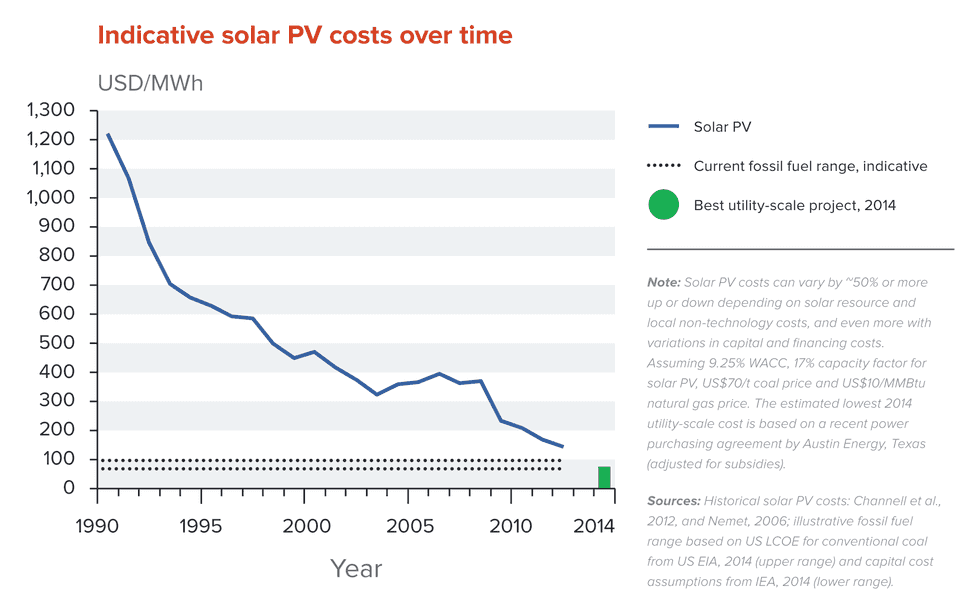
the benefits of oil outweigh the costs. Renewable energy resources have emerged
as economically viable options. Over a quarter of the growth in electricity
generation, between 2006 and 2011, came from renewables. These methods are
becoming increasingly affordable and need to be emphasized as an energy source.
A first step could be the ending of direct subsidies to fossil fuel
production, which has been estimated to be as much as $90 million per year.
These subsidies are costly and could be used more efficiently to achieve the
same social goals.
The commission also recommend that “governments develop
comprehensive plans for phasing out fossil fuels.” They recommend a
carbon tax, possibly through a cap-and-trade program. They claim that this will tax, "an ‘economic bad’ and
raise revenue for governments. With smart recycling of revenues they also have
the benefit of being relatively non-distortionary in the short run and
providing an effective signal to reallocate resources over the medium- to
long-term.” These methods could curb the amount of carbon dioxide in the
atmosphere, curtailing the increase in temperature.
Overall, the commission has put together an economically feasible
strategy to a more sustainable future. Achieving this will not be easy. Climate
change deniers, and other vested interests, are sure to resist and have the funds
to influence politicians. The key is to continue to push.
Last week hundreds of thousands
of people flooded New York to raise awareness for climate change. Politicians
cannot continue to ignore demands for a better future. It is key that we make
sure that people understand what is at stake and that we need to change things.
We only have one planet, one chance.
Politics and ActivismOct 03, 2014
Making Growth Sustainable
The possibility of sustainable growth
13