
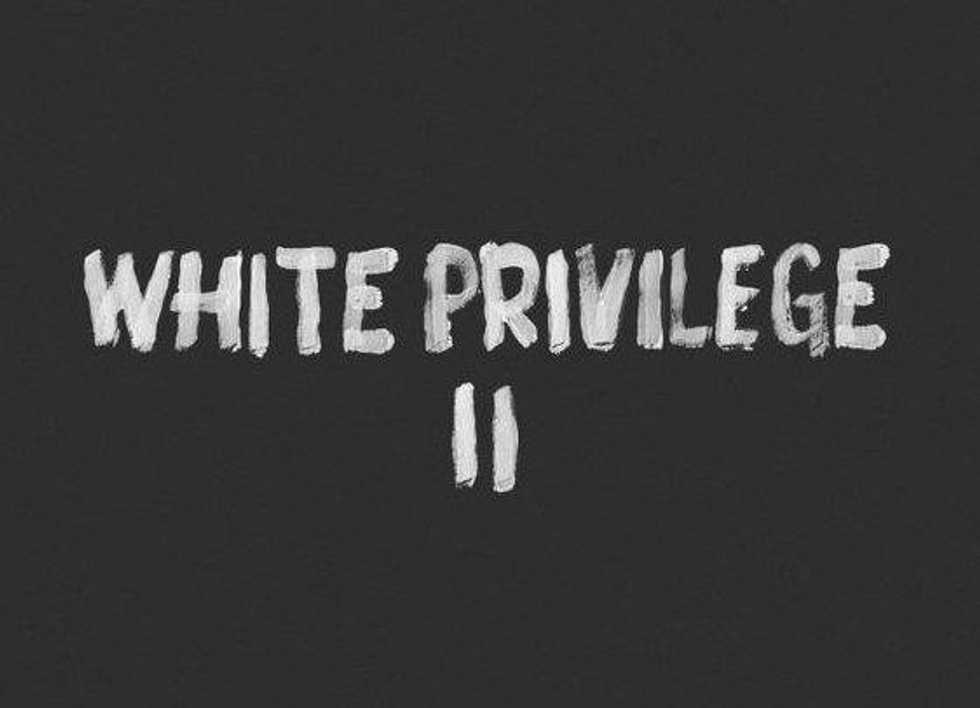
Macklemore and Ryan Lewis recently released a new song titled "White Privilege II," a piece commenting on today's racism juxtaposed with Macklemore's own position of white privilege. While it has received criticism as a piece of music (many people believe Macklemore's rapping just isn't good) the message behind it is much more important.
On their website, they explain their commitment to anti-racist education and the four organizations they are engaging with, including Black Lives Matter. In an interview with Rolling Stone, Macklemore says, "The question is, What type of human do I want to be? How do I want to use my platform? Do I want to be safe, under the umbrella of my white privilege? Or do I want to push back and resist? There's not a right or wrong answer for any human out there, it's just an individual question, and I think that, for a long time, we were safe. It's easier, as a white person, to be silent about racial injustice."
Macklemore has been known for speaking out in political conversation, and has received both praise and controversy for commenting on issues where he is on the outside looking in. He begins the song by saying,
Pulled into the parking lot, parked it
Zipped up my parka, joined the procession of marchers
In my head like, "Is this awkward?
Should I even be here marching?"
Thinking if they can't, how can I breathe?
Thinking that they chant, what do I sing?
I want to take a stance cause we are not free
And then I thought about it, we are not "we"
Am I in the outside looking in, or am I in the inside looking out?
Is it my place to give my two cents?
Or should I stand on the side and shut my mouth?
"No justice, no peace," okay, I'm saying that
They're chanting out, "Black Lives Matter," but I don't say it back
Is it okay for me to say? I don't know, so I watch and stand
In front of a line of police that look the same as me.
While Macklemore has been quick to stand up for Black Lives Matter, he addresses that he does not know if it's always his place to do it. In a People interview, he explains, "It was important for me in this song to come from a real place. I think that if I just got on the microphone and started talking about white privilege like, 'Yo I've read this book and that book and I know what's up, I've had these conversations,' that's not inviting. I need to come to that conversation how I felt, which was hearing black lives matter chanted for the first time and not knowing that that was okay for me to say."
He also points out that white artists, such as Iggy Azalea, have been rightfully critiqued for appropriating black culture and benefiting from it. In the song he states, "We take all we want from black culture, but will we show up for black lives?"
Macklemore collaborated with a variety of musicians, writers, philosophers, activists and, most notably, vocalist and poet Jamila Woods, to create this dialogue. Macklemore also asked himself, "'Is this record, with all of the inherent flaws in it, is it better in the world, or not?' And I couldn't answer that just by myself. Ryan couldn't answer that just by himself. We had to work with other people in the community, we had to play it for other people in the community. We had to play it for people that have been at the forefront of this work, have been at the front lines, have committed their lives to changing the systems." That's what this conversation is about.