When I was 7, my mom would spend the two hours before hauling me to the salon untangling my hair. And, yes, it would take the full two hours. My thick Indian waves that were not-quite-curls usually went unmanaged for weeks on end, to my mom’s displeasure. But what did I know? Everyone around me either had straight hair or tight curls. I liked to think mine was somewhere on the spectrum known as tumbleweed-esque.
When I was 11, I wore my hair up everyday in a tight ponytail because I thought my hair was too big—it just puffed up on either side of my head, and out of frustration, I gave up on it. I told everybody that asked that I wanted to keep my hair out of my face while I worked.
When I was 16, I got my first straightener. It was a beautiful ceramic thing—one of the ones that were actually powerful enough to tame my hair. It would take nearly 30 minutes every time I blow-dried and straightened my hair, but I would try to make it “look OK” as often as I could manage for the next school day. Every time that I styled my hair, I got compliments—“Your hair looks amazing,” “You look really good today,” “Wow!”
When I was 17, the summer after high school, I cut off my long hair. The heat-induced split-ends and the inevitable frizz gave me headaches.
When I was 18, I entered college, and I no longer had time to straighten my growing hair. Angry and tired, I stuffed the tendrils into messy buns while my confidence was slowly shredded off, day-by-day.
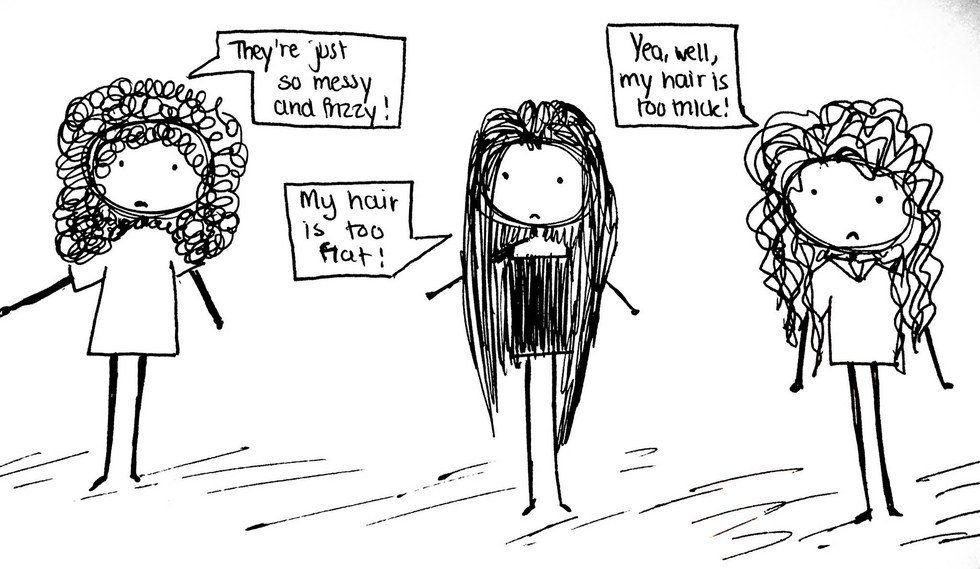
For much too long, I hated my hair. I wanted what everyone around me had—especially straight hair. I was so envious because, as it seemed to me, it was so easily managed. My friends would complain about their hair being too straight, and I would tell them, “At least when you wash yours, you don’t have to worry about it being bigger than your head.” I suppose that what I didn’t realize when I said these things was that everyone came with their own set of problems. I’m sure that if I had naturally straight hair, then I would see flaws in it, too.
However, I think that for me, especially, it was hard to move past the simple idea of “we always want what we can’t have.” Because this issue is more than just hair. It is a media and an oppressive system failing to encourage a sense of beauty in all forms—particularly when they deviate from the norm. No one on TV had my hair or my skin while I was growing up. Even today, there aren’t many Indian-American females in the American public eye for me to relate to. It has taken me a long time to see the beauty in myself (my hair included) because it took me a long time to understand that I did not have to follow Western standards of beauty. Straightening my hair should have been a choice, not something I felt was an obligatory prerequisite to achieve daily confidence. I am the one that defines beauty for me, and no one else should ever be able to tell me that I don’t fit the standards.
If we are going to battle an age-old system, though, we need to look to the sources that are giving permanence to the problem. For many, this is the lack of diversity in the media, as well as the promotion of stereotypes. However, I know that I cannot change Hollywood overnight. But, I will say that as individuals, we can make a difference. One of the hardest parts about understanding my own natural beauty was that I would get such a positive feedback on my appearance when I did try to look like the standard. This perpetuated a cycle of straightening what I saw as crooked.
I encourage anyone and everyone to make a change in the way they view difference. I encourage them to look with an open-mind as opposed to viewing the world with a set of standards influenced by a culture that told them what should be beautiful. This is a difficult task. I know that many of the people that complimented my straightened hair did not mean to enforce Western standards of beauty. But they did, nonetheless, because they failed to recognize me when I looked any other way. I am not asking for compliments, nor am I asking that the world become a cycle of required external validation, but I am asking for the acknowledgement of diversity in beauty. I think that if everybody understands this, the world can become a much happier, more positive, more self-loving place.
Now, I am 19, and I love my natural hair. I let it free almost every day, and when I do wear it up or straighten it, it’s because it is a choice. More often than not, however, I let the waves loose, permitting their chaotic manner, because I truly believe in their wild grace.