
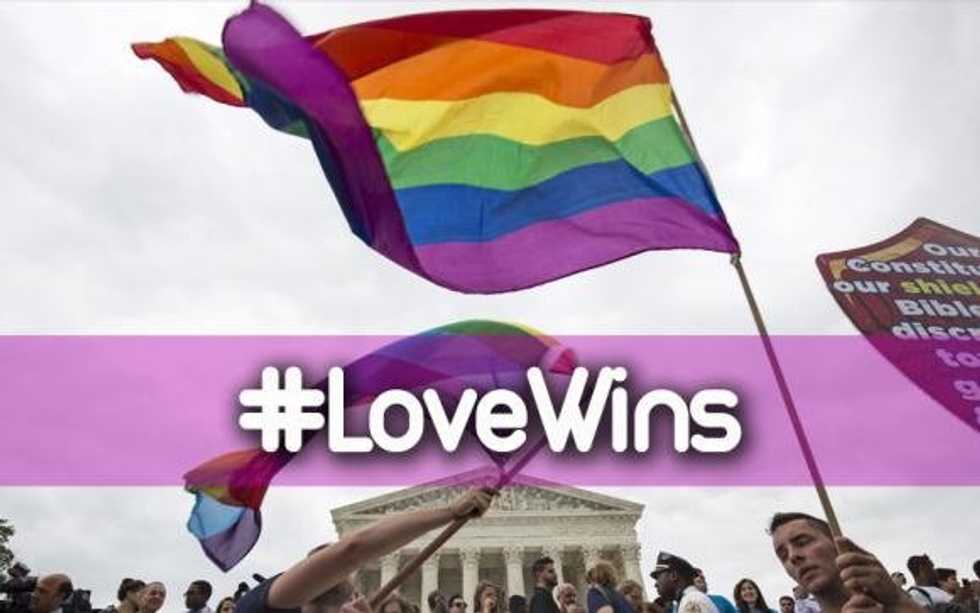
For many people, myself included, social media has become the primary outlet of news. Looking on Twitter this morning to the reaction to the Supreme Court’s 5-4 decision to legalize same sex marriage was overwhelming: Fortune 500 companies changing their logo to integrate rainbows, the hashtag #lovewins on nearly every tweet on my feed, the occasional dissenter talking about moving to Canada. My initial reaction was excitement. As a supporter of same sex marriage, I obviously see this as a huge victory for LBGT allies. But as I researched a little more, I felt a bit irked.
CNN has a pretty cool widget where you can read the Obergefell v. Hodges opinions written by the Justices. The majority opinion was written by Justice Anthony Kennedy, a practicing Catholic who was appointed by Conservative golden boy, late President Reagan. Kinda weird, right? A Catholic, (somewhat) Conservative in favor of gay marriage? Kennedy writes, “No union is more profound than marriage, for it embodies the highest ideals of love, fidelity, devotion, sacrifice, and family. In forming a marital union, two people become something greater than once they were. As some of the petitioners in these cases demonstrate, marriage embodies a love that may endure even past death. It would misunderstand these men and women to say they disrespect the idea of marriage. Their plea is that they do respect it, respect it so deeply that they seek to find its fulfillment for themselves…”
*woah*
So yeah, that’s a beautifully written closing paragraph, Justice Kennedy. And I agree with everything you said. But I have to side with Chief Justice John Roberts here. "Understand well what this dissent is about: It is not about whether, in my judgment, the institution of marriage should be changed to include same-sex couples. It is instead about whether, in our democratic republic, that decision should rest with the people acting through their elected representatives, or with five lawyers who happen to hold commissions authorizing them to resolve legal disputes according to law," Roberts wrote.
My issue with the Supreme Court’s ruling really has nothing do to with same sex marriage. And Justice Kennedy is right in pointing out in his opinion that families with same sex parents are unfortunately seen as less valid in some eyes. But it is not the Supreme Court’s job to legislate our nation. The only job of the Supreme Court is to say what the law is under the Constitution.
Justice Kennedy’s majority opinion in the Obergefell case is particularly interesting when you consider the opinion he wrote just two years ago in 2013’s United States v. Windsor. There, Kennedy wrote that DOMA (Defense of Marriage Act) violated federalism: “The State’s power in defining the marital relation is of central relevance in this case quite apart from principles of federalism. Here, the State’s decision to give this class of persons the right to marry conferred upon them a dignity and status of immense import. When the State used its historic and essential authority to define the marital relation in this way, its role and its power in making the decision enhanced the recognition, dignity, and protection of the class in their own community.” Kennedy clearly says the power to define marriage goes the states. He goes even further writing, “For same-sex couples who wished to be married, the State acted to give their lawful conduct a lawful status. This status is a far-reaching legal acknowledgment of the intimate relationship between two people, a relationship deemed by the State worthy of dignity in the community equal with all other marriages. It reflects both the community’s considered perspective on the historical roots of the institution of marriage and its evolving understanding of the meaning of equality,” (United States v. Windsor 570 U.S. 307 (2013)).
Think about it. You’ve got nine unelected, tenured lawyers calling the shots with their particular interpretation of the Constitution. Having these decisions run through the States is, in my mind, a better (not to mention democratic!) way to evolve the definition of marriage. Will it take more time? Absolutely. But as of May 2015, Gallup reports 60% of Americans think same sex marriages should be seen as valid. True change in opinion towards same sex couples will be slow. But look at the speed it’s gained in the last decade alone! Honoring the authority of the States to define marriage will allow for a much less tenacious opposition. Even the Bible Belt will eventually have to acknowledge that marriage is not necessarily a religious construction in many people’s eyes.
"Stripped of its shiny rhetorical gloss, the majority's argument is that the Due Process Clause gives same-sex couples a fundamental right to marry, because it will be good for them and for society. If I were a legislator, I would certainly consider that view as a matter of social policy. But as a judge, I find the majority's position indefensible as a matter of constitutional law,” Chief Justice Roberts wrote in his Obergefell opinion. "If you are among the many Americans -- of whatever sexual orientation -- who favor expanding same-sex marriage, by all means celebrate today's decision. Celebrate the achievement of a desired goal. Celebrate the opportunity for a new expression of commitment to a partner. Celebrate the availability of new benefits. But do not celebrate the Constitution. It had nothing to do with it."
I celebrated the Court’s decision. I still do. I just wish the decision had come about in a different way. Love will win; it always does. It just won the wrong way.