The Baroque period in art was seen as the complete opposite of the “pearl” that was the Renaissance due to the heavy use of emotions and drama in the aesthetic, instead of the rational. The term "Baroque" was used as a derogatory term to further enhance the distain for this style, which was known as the “distorted pearl,” since it was not scientific like the Renaissance, but rather favored emotions. One of the aspects of the Baroque style was the open compositional configuration and the use of space which tried to bring picture planes into the three-dimensional world––or to draw the viewer into the picture plane, playing on the other signature aspect of the Baroque aesthete, the drama.
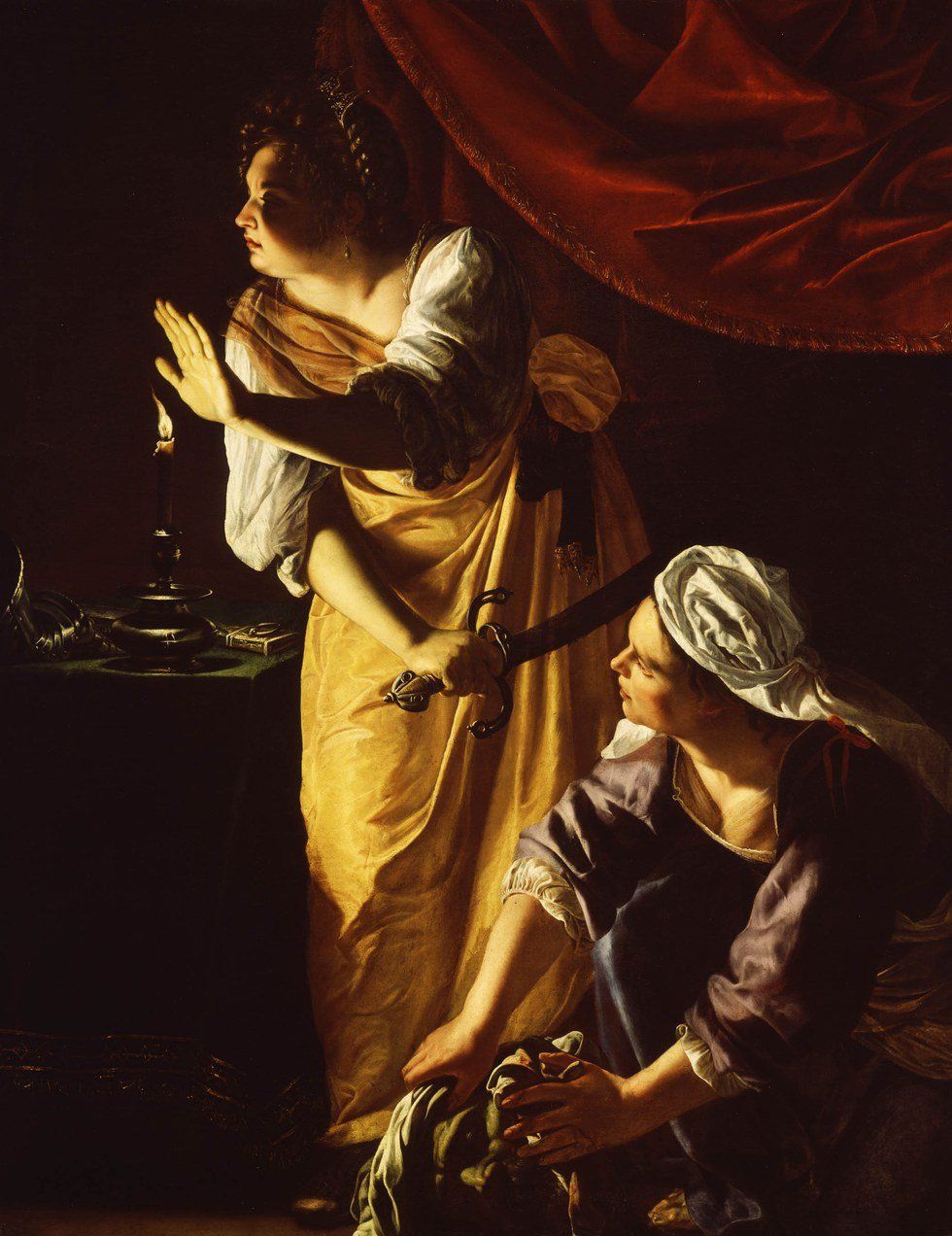
The painter Artemisia Gentileschi used the method of picture plane interpenetration to draw the viewer into the scene of Judith and her maidservant planning an escape. The use of Tenebrism (dramatic illumination with strong contrasts of light and dark,) brings forward the anatomy of Judith and highlights the sword in her hand and the head of Holofernes at the base of the picture, all while being cast in a light that sets the scene with a sort of psychological intensity. Although Artemisia Gentileschi’s painting Judith and her Maidservant was considered a controversial painting due to a woman painting what was at the time considered a "male” subject matter, her depiction can be viewed as far more successful than any of the others.
Judith and her Maidservant is a painting that interprets the biblical story of the remarkable heroine Judith. The Book of Judith tells the story of a Hebrew woman going against the Assyrians, who were after world domination. By the act of this woman decapitating Holofernes, the Assyrian general, the army retreated and Judith became a political savior of Israel.
Unlike Gentileschi’s other painting depicting the same subject matter, Judith and her Maidservant portrays a different point in the story, as to Judith slaying Holofernes, with a different theme and emotion. In this particular point in time the emotions are not intense, but cautious, and there is a psychological tone rather than an intense and forceful one as is shown in Judith slaying Holofernes. The main goal for Judith and her maidservant is to get out of the tent without the head of Holofernes being noticed. The body of Judith being in a “c-shape, one foot thrust to the front limits of the canvas, neck stretched, shoulders obliquely positioned” are all bodily tells of psychological stress . These aspects bring the story to life and the makes Judith and her Maidservant feel realistic to the story and their characters, portraying them as the capable women who saved Israel from the Assyrians.
When compared to other famous (male) artists that were prominent at the same time as Artemisia Gentileschi, the works that were produced by her had far more feeling and sense of belief than those of men who produced works on the same subject matter and content as hers. One of the many artists that Gentileschi’s works are compared to is of Caravaggio, who in fact trained her father in painting. However, when the paintings are placed side-by-side, the ones of Judith from Artemisia Gentileschi come off as far more successful in telling the story and in the portrayal of the Savior of Israel.
Judith and her Maidservant portrays all the characteristics of the Baroque through the use of the open composition configuration drama, expressions, and the interpenetration of the picture plane. The use of Tennebrism to draw out details, and contrasting colors and lighting, bringing to forefront the faces, sword, and curtains paired with the curvilinear shapes, play up the emotional theme more prominently than the harsh lines and angles seen in other interpretations. The central focus of the painting is the sword hilt and the strong hands. Judith’s strength is being reflected in the exaggeration of the hands and the gestures which lead upwards toward her face and her expression of tense determination.
Even though the controversy that surrounded this piece and Artemisia Gentileschi was strong, her determination and her overwhelming talent brought her work to the forefront and portrayed well capable, strong women ready to defend their home at any cost necessary, a theme with many pieces she produced. Through the execution of all the stylistic elements of the Baroque and her favorite subject matter of strong women, Judith and her Maidservant is riveting painting which The Detroit Institute of Arts is lucky to have in its collection.
__________
Bissell, R. Ward. Artemisia Gentileschi and the Authority of Art: Critical Reading and Catalogue Raisonné. University Park, PA: Pennsylvania State UP, 1999. Print.
Branch, Robin Gallaher. "Judith: A Remarkable Heroine." Biblical Archaeology Society. Biblical Archaeology Society, 30 July 2012. Web. 10 Mar. 2016.