As I walked up the steps of Alcatraz with foggy skies overhead the cool, crisp air brushed up against my face. I was completely perplexed as to what I would be taking away from a field trip at Alcatraz Island of a collection of “site specific” pieces done by Chinese Contemporary artist and activist, Ai Weiwei. Being fairly knowledgeable about the “school to prison pipeline” system as well as the well-known fact that UC Merced is surrounded by prisons in almost every direction, I was skeptical of this experience because of the negative connotation I see associated with prisons in relation to education. At the same time it was also a little hard to fathom that the National Parks Services supported such a controversial collection of art to be featured because of its negative affiliation with the government. What would follow, would pleasantly surprise us as students and challenge the notion of the “status-quo.”
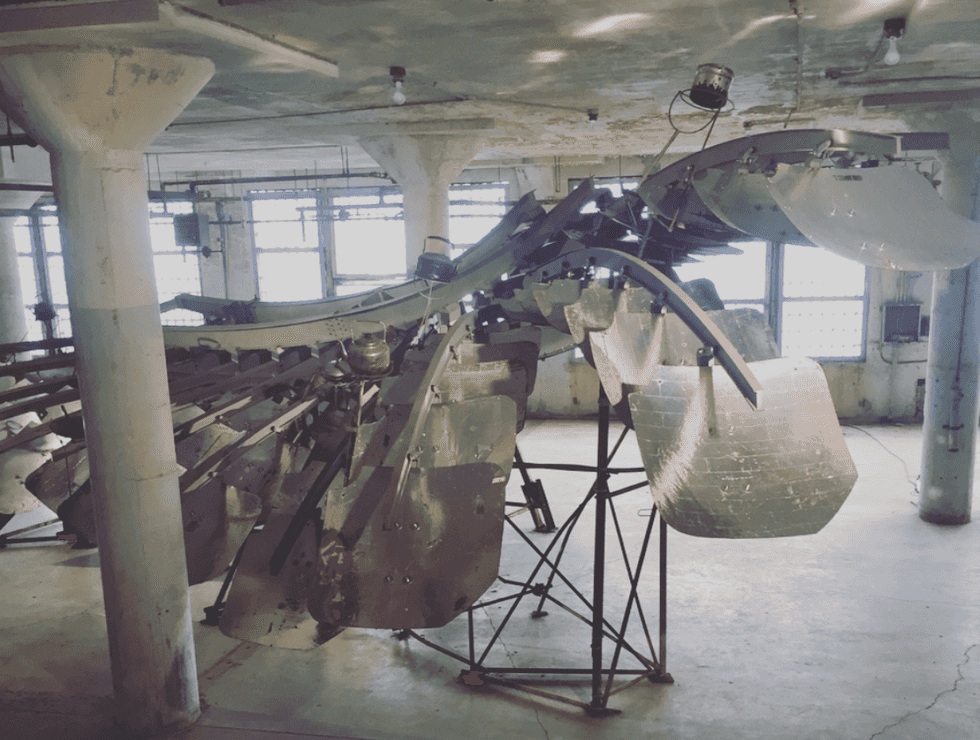
We followed the National Park Ranger along a brisk walk up to the New Industries building that served as a labor facility for inmates of Alcatraz. Along the way, he shared fun facts about the restoration and maintenance of the Island, setting the stage for the art piece’s significance. As we made our way towards the repurposed gallery space, we came face to face with an enormous metal wing that had been composed of reflective panels in place of feathers. The materials used to make the piece, having come from a heavily oppressed region in the world, in juxtaposition with the physically situated gaze of the viewer, created a powerful and eye opening experience. In that moment, I realized that I was standing in a space where only armed guards had once roamed throughout the day supervising prisoners at work. I stood there, peering through rusted and cracked windows, some shattered, others sprinkled with old bullet holes. I was overcome with tension between the tenets of physical freedom and confinement. Here was this giant wing that looked eager to take flight, held down by the constructs of heavy metal materials and restricted by the walls that encased it. Yet, as a viewer I was situated in a conflicting position of power and control because of the gun gallery’s historical context.
To add to the “wow” factor of this piece, contemporary Chinese artist Ai WeiWei—well known for freely speaking out against the Chinese government—had created the piece itself. As a result of his ideals of free speech through art, he has been arrested and jailed several times. During the creation of these site-specific pieces for Alcatraz, Weiwei was under house arrest—meaning that he was not allowed to leave China. This meant that he had created these large-scale site-specific pieces for Alcatraz Island without having physically visited the premises. The hairs on my arms stood up as I began to think about how oppression is a universal language; it is because of this that Weiwei had been able to create work for a space he had never visited. While it was a rather heavy feeling, continuing through the rest of the collection that teetered between the notions of physical, political, and creative freedom—or lack thereof—throughout different regions of the world.
Without a doubt, this was one of the most transformative experiences that I have ever had with art. I was so intrigued by the way that Weiwei’s work challenged the entire notion of Alcatraz Island, as well as the general prison dynamic. I had never known art to be so explicitly political, but experiencing such politically driven work was refreshing especially within this setting.