


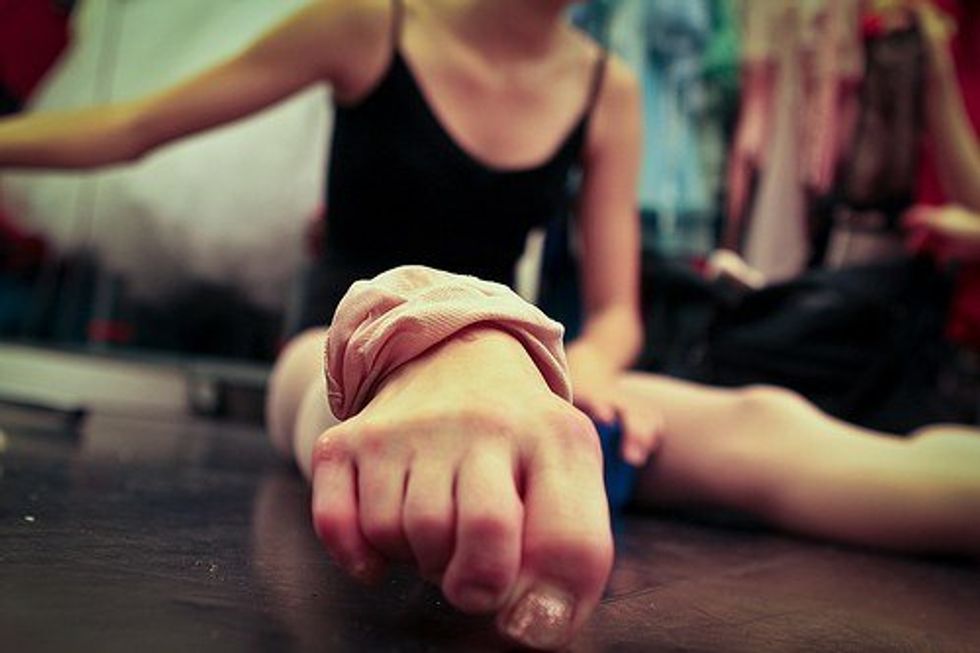
In William Butler Yeats’ poem, “Among School Children” the reader is left to ponder topics regarding life, love, and the creative process--themes that pay tribute to the work as well as Yeats' existence. These are all areas that cannot be fully answered or figured out while on earth, and it is perhaps the reasoning as to why the author leaves his conclusion with a question posing, “How can we know the dancer from the dance?”
The punctuation observed throughout the poem also plays an important role as often there are semi-colons or commas that connect and link stanzas together instead of the common period. A period puts an end to a sentence or statement none of which are included neither in life nor in the art of dance. In an attempt to “answer” or provide rationale to the question he asks I can only put thoughts to what it might entail. On the one hand, there is no dance without the dancer as they ultimately dissolve into one similar to the internal reflection found incorporated in the second stanza where the yolk and white blend mend within a shell — a powerful expression I viewed as innocence of the child amongst a dark world filled with condemnation or “mothers and nuns” who teach fixed ways. Together they mix in combination forming what is portrayed as the uncomfortable or out of norm. For the dancer, this refers to passion, and for the mocker, it is only but a labor or unforeseen task.
When it comes to dancing or fulfilling this field, one must accept that their work will truly never be complete. There has to be a sense of knowing that you will not be able to converse the words “I have finished” or “I am done.” It is the ability to thrust forward despite the immeasurable result. We are taught to grow up with the mentality to conclude what we begin, but this is the exception. The challenge is to level set, and be content with the cycle. An audience member can only try and pinpoint the dancer in a dance through her artistry and physicality. The dance is not limited to steps, but tells a story in words not spoken. When an outsider sees a dancer, he sees someone so enthralled in their craft that they begin to see their narrative as well. It is nothing sort of a love story — you find a person who may or may not share parallel interests in either music, movies, or books, but it was physical and after time it becomes something more- it merges and becomes a single unit. This is why breaking down the dancer from the dance is more a rhetorical question as it can be judged on multiple accounts. What makes a dancer? Who is the dancer and what is the dance? If life is a performance in itself are we not constantly “dancing” and writing our story? Would this thus make the dancer each individual here on earth or would one simply have to put on music and display choreography to be considered a mover?
The definition of dance is elusive, as is the depiction of love, which is why it is a discussion by no means closed or replied. It is an act that is commonly overlooked as it is more a kept secret of human love where love is received verses, given a much scarier and threatening portion not talked about. Love in dance is given in bruises, sweat, time, dedication, wisdom, mistake, and above all the infatuation to repeat it all over again the following day. In summary, I believe we are all dancers- in and out of each others’ minds without any effort- but it is how we present our dance that makes us each individuals.
















