When I think of the show “Gilmore Girls,” variations of several phrases occur to me: coffee-toting, fast-talking, quipping, pop-culture-reference-dropping. Having seen every episode of the show at least twice, I can attest to these labels’ accuracy. Having recently seen the first trailer for the upcoming four ninety-minute sequel episodes, “Gilmore Girls: A Year In the Life,” I choose to focus on the last one right now: pop-culture-reference-dropping.
See, the trailer alone featured two major pop culture references in its one minute and twenty-nine seconds, in which main character Lorelai Gilmore asks “Do you think Amy Schumer would like me?” and “Do you think John Oliver would find me hot?” These allusions startled me. It took me a moment to pinpoint why, but I realized these references are to people I’ve not only hear of, but people intertwined with my concept of the now, 2016, the millennial world. This is not an experience familiar from watching the show, in which at least one pop culture reference per episode whizzed over my head. After all, the seven seasons of the show aired between 2000 and 2007, a period during which I still did not have a full set of adult teeth.
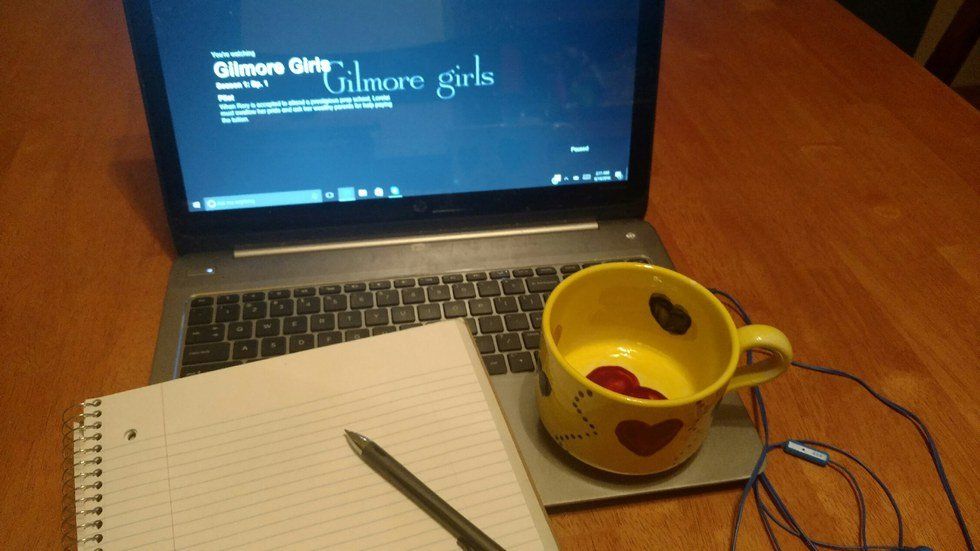
I decided to conduct an experiment. I would rewatch an episode of the show on Netflix while maintaining a tally of pop culture references. This way I could determine exactly how much of the show remained opaque to me.
I chose “Pilot” from season one, my logic being that this episode marked the show’s farthest away point in time from the now. At the end of the forty-two minutes, I had nineteen references recorded. I even turned on the captions to guard against fast-paced dialogue getting away from me. The list reads: Jack Kerouac, RuPaul, Macy Gray, Officer Krupke, Eminem, “Huckleberry Finn,” Britney Spears, Stephen King, Zsa Zsa Gabor, Ruth Gordon with tannis root, Oprah, Moby Dick, Madame Bovary, Flo-Jo, “Mommie Dearest,” “The Little Match Girl,” Menendez, “Nick at Night.”
Jack Kerouac, RuPaul, Macy Gray: so far, so good (coincidentally, I just started “On the Road” for the first time this week). I ran into trouble at Officer Krupke. A hasty Google search conjured up a YouTube clip from “West Side Story” that revealed Officer Krupke to be an angry officer wielding a rolled-up newspaper and spouting “You punks!” To be fair, “West Side Story” is a void in my cultural literacy that I have no desire to fill, but a decent amount of my peers must be familiar with it. Okay, nothing too obscure yet.
Eminem, “Huckleberry Finn,” Britney Spears, Stephen King: outlandish juxtaposition, commonplace references. Zsa Zsa Gabor gave me pause, so I resorted to Wikipedia, which informed me she is a “Hungarian-American actress and socialite.” Ruth Gordon with tannis root threw me for a loop, although a character clarified it to be from “Rosemary’s Baby,” a reference that comes laden with Satan’s spawn. Another hasty Google search confirms Ruth Gordon to be the actress playing half of the couple with sinister plans for Rosemary’s eponymous baby, the tannis root an herb with occult uses, snuck into Rosemary’s prenatal regime.
Oprah, “Moby Dick,” “Madame Bovary,” once again a run of familiar references. Funnily enough, I’m probably least familiar with Oprah, having read Moby Dick in my class The American Novel and read about “Madame Bovary” in countless critical essays. Now, Flo-Jo I only recognized because I have been avidly watching the Olympic Games the past week and my parents told me about Florence Griffith Joyner, or Flo-Jo, the fastest woman of all time, as we watched the women’s one hundred meters. So serendipitous timing intervened on that one.
“Mommie Dearest” and “The Little Match Girl” were both givens to me. It occurs to me the former, the film about Joan Crawford’s sadistic parenting, is only known to me because my parents explained the plot to me at a young age and most of my peers probably are not familiar with it. The last-name allusion “Menendez” rang zero bells, so yet another hasty Google search informed me Lyle and Erik Menendez were convicted in 1994 for shotgun-murdering their parents for their wealth. Lorelai employs it by telling her daughter Rory she “can pull a Menendez” after dinner. Lots of laden parent-child humor, jives with the central relationship of the show but contrasts with its feel-good tone. And finally, “Nick at Night” proved to be “Nick at Nite,” a cable network that I have never heard of in all my life.
So I consider five of the nineteen references completely alien to me: Officer Krupke, Zsa Zsa Gabor, Ruth Gordon, Menendez, and “Nick at Nite.” Of course, others were known to me through snippets of conversation and random happenstance. And some of the unknowns could well have simply represented inexplicable holes in my cultural knowledge.
It strikes me, though, at the end of this experiment, that of these references resonated with me in quite the same way as those in the trailer. The literary references such as Kerouac and Melville, being timeless, came close. I much appreciated Stephen King, as an avid devourer of his books. These instances represent the intelligence and literary bent that I so love about “Gilmore Girls.” But they do not speak to the nowness that John Oliver does, a nowness displayed when Oliver proclaimed on “The Late Night Show with Stephen Colbert” that he does, indeed, find Lorelai hot. Furthermore, I see the incorporation of this nowness into the trailer as a good sign. The upcoming episodes understand they take place almost a decade after the series finale. Ideally, they will not fall victim to retreading old ground, and recombine much-loved elements into a new, now, 2016 product.