"I am beginning to learn that it is the sweet, simple things of life which are the real ones after all."
- Laura Ingalls Wilder
A dark-roasted aroma stimulated the awakening of my senses. My father handed me a coffee mug and a print-out of “Today’s Puzzle”. Ever since I reached the maturity of Piaget’s “formal operational stage” (the most developed stage of adolescence), my dad and I completed the New York Times daily crossword puzzle every morning before school. After performing this morning ritual for nine solid years, we had solved every single daily puzzle solely with the aid of our own intelligence.
We thought of ourselves as the “dynamic duo of cruciverbalists.” My dad threw me a pen and I began to tackle the first word on the “across” list. Fifteen minutes of frustration passed and I forced myself to face the chagrin of asking my father for help on a five-letter crossword meaning “the end of a shoelace.” Wikipedia teased both of our extirpated egos as the sentence “aglet (or aiglet) is a small plastic or metal sheath typically used on each end of a shoelace, cord, or drawstring” escaped her conceited lips.
At the age of three, my dad made sure I knew how to tie my shoes before I started pre-school. He used to tell me that it was because he didn’t want me to be one of those kids who was always frozen in a game of freeze tag because their untied tennis shoes hindered them from running at their optimal speeds. I later discovered the real reason was that the sight of the light-up, velcro shoes that every other child wore at the time made him nauseous. It was clearly the early nineties.
“Think of them as rabbit ears. You’re going to tie the ears together in a knot,” my father said as he placed his finger on the center of my laces. “You have to tie the ears tightly around your hunting pole as if you’re going to carry the rabbit back home to make rabbit stew,” he explained as I used all the strength in my tiny, feeble hands to tie a knot around his finger.
The first time I managed to tie my shoelaces without his help, he rewarded me with French fries and a French vanilla cone from the French gourmet restaurant itself; Le McDonald’s. Little did we know how fitting our French celebration was for the plastic ends of my “rabbit ears” originated from the Old French word aguillette, and its root word aguille, meaning needle.
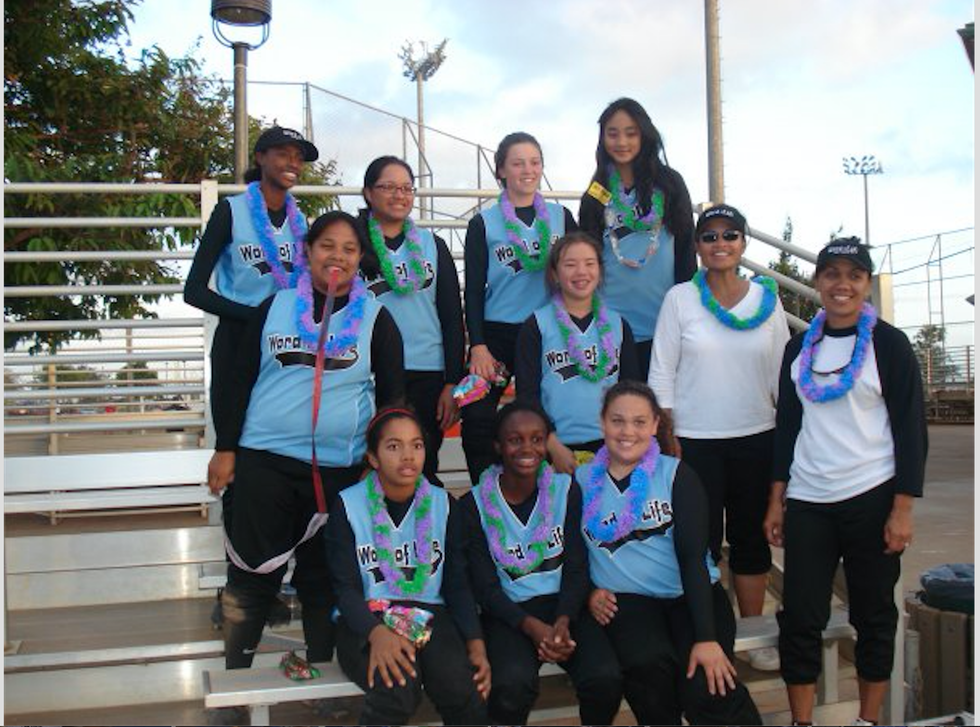
Eleven years after I learned how to tie my shoes, I learned how to play softball. During my freshman year, my high school decided to form its first softball team. My mother, a lifelong baseball fan, was ecstatic when I told her that I was trying out for the girls’ softball team. I, on the other hand, detested the sound of rusty metal bats, the smell of sweaty helmets, and the sight of spewed sunflower seeds. However, I concluded that I would rather have my mother undergo her midlife crisis by vicariously living through my softball games than by driving a convertible as red as her favorite “very cherry” lipstick. After catching her admiring convertibles on her laptop for the second time, I did everything I could to make the team.
It was our opening softball game and my nerves seeped through my visor as I saw that my entire school, the smallest private Christian school on the island, had filled the bleachers. I tried to hide my fear while I listened to my coach read the batting list.
“Leahna, you’re the fourth batter,” he said as he looked me in the eye.
To avoid prolonging the awkward eye contact with my coach, I looked down at my cleats. For some superficial “good luck” sort of reason, my mother insisted that I wear her decade-old pair of Nike softball cleats from college. However, due to my disbelief in luck, I found that one of the aglets of my shoelace escaped from the eyelet (the hole of the shoe where the shoelace goes) of my cleat and had unraveled into tentacle-like shreds of thread. In order to make a new aglet, all I needed was thin plastic tape, acetone, a heat applicator, scissors, and some time for it to cool. Unfortunately, I only had a bottle of acetone on me and two minutes to spare before the game started.
“Are you freaking kidding me? Stupid son of a Nike dinosaur piece of shit!” I cursed.
Thankfully, my Bible teacher, as if she were my guardian angel sent from heaven, came to my rescue with a piece of tape. She was able to construct a makeshift aglet stable enough to weave the lace back through the eyelet of my cleat. My previous words of condemnation were forgiven after I scored the first home run in the history of softball at my high school.
About two years later, the same Bible teacher who had helped me with my shoelace crisis, was the same woman in the black knit sweater giving a few words of respect at my best friend’s mother’s funeral.
“She was a strong woman. She was a strong woman of God. After four years of fighting breast cancer, she is still a strong woman, but she is no longer fighting. She is at rest in His sanctuary,” she said as she closed her eyes.
After the funeral, I locked my best friend into a warm embrace and lent my shoulders to her for her grief. I felt a flow of tepid tears stream down the side of my arm.
“Time. More time. I just wish I had more time,” she whispered to me in between her gasps for air.
The Sunday following the funeral, the church conducted a fundraiser for the Susan G. Komen for the Cure foundation. Tables were set up in the courtyard to present items such as t-shirts, keychains, jewelry, socks, and shoelaces for sale. Preventing shoelaces from unraveling is important, but it’s not the only purpose of an aglet. Aglets are also used to provide a colorful or decorative finish to laces. The aglets of the shoelaces that were on sale for the fundraiser were painted pink.
On April twenty-second, almost two years after the funeral, I was back at that same church with my family on the day before of my eighteenth birthday. Although it was rare to find my family at the Sunday church services, my great-grandmother made a special request for my entire family to attend church with her the day before her eighty-ninth birthday. It was simply a coincidence that I shared the same birthday and same taste of cake with my great-grandmother. My eighteenth birthday was the last time we blew out the candles on our favorite chantilly cream cake together.
My great-grandmother and I were very much alike, for we both fancied William Shakespeare, the greatest writer in the English language, who happened to be born on the twenty-third of April as well. During the Shakespearean era, which was before the advent of buttons, aglets were not yet used for shoelaces. Instead, they were featured on ribbons and cords used to fasten clothing together, and were sometimes formed into small figures called “aglet babies”. Shakespeare even mentioned them in his comedy, The Taming of the Shrew, when Grumio tells Hortensio to “give him gold enough and marry him to a puppet or an aglet-baby,” (1.2.60).
“What are the plastic things at the ends of a shoelace called?” is a question that has dumbfounded me, my father, and a substantial majority of the human population. In fact, due to its unfamiliarity, this exact inquiry is commonly featured on many trivia and crossword puzzles. Therefore by society’s standards, I should not feel ashamed for my ignorance and submission to the aptitude of Wikipedia. However, my demur can’t help but sulk in guilt.
A life without aglets is like a rabbit stew without rabbits. Aglets may be little and plastic, but they are also the little and plastic things that hold the fate of our shoelaces in their hands. Therefore, I am ecstatic when I tie my shoes. I am blissful when I spit out wads of sunflowers seeds like a barbaric llama with my mother. I am overjoyed when I listen to my father hum to Michael Bublé every morning. I am excited when I order a happy meal (prepared by a gourmet chef). I am grateful when I think about the eighteen times I blew out birthday candles with my great-grandmother. I am running at my optimal speed. I am never wishing for more time. To be or not to be the pitiful pre-schooler who remains frozen during an entire game of freeze tag: that is the question.