


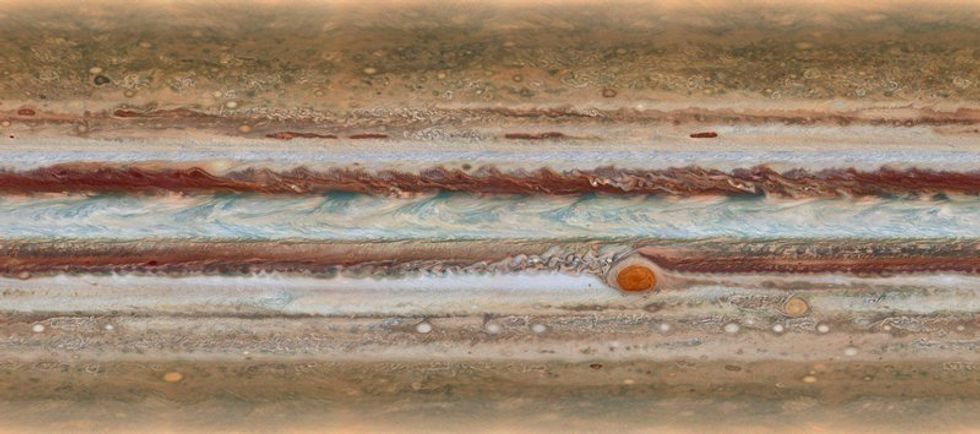
New photos of Jupiter’s Great Red Spot show that the storm is shrinking. Using Hubble’s Wide Field Camera 3, scientists can tell us that the spot is about 240 kilometers smaller than it was in 2014. The shrinkage has been attributed to climate change in Jupiter’s atmosphere. This spot has been shrinking for years, though is not expected to completely disappear any time soon.
The Red Spot in Jupiter’s atmosphere is similar to hurricanes on earth, though much larger. Three earths would fit inside the storm, and it has been raging for at least 400 years. The anti-cyclonic storm is thought to be driven by Jupiter’s heat, though the exact cause is unknown. The red color of the storm is commonly attributed to the phosphorous based compounds found on Jupiter (though this is also speculation).
Jupiter’s climate went through an intense period of climate change between 2005 and 2007. The period of climate change actually spawned the smaller storm, The Little Red Spot.
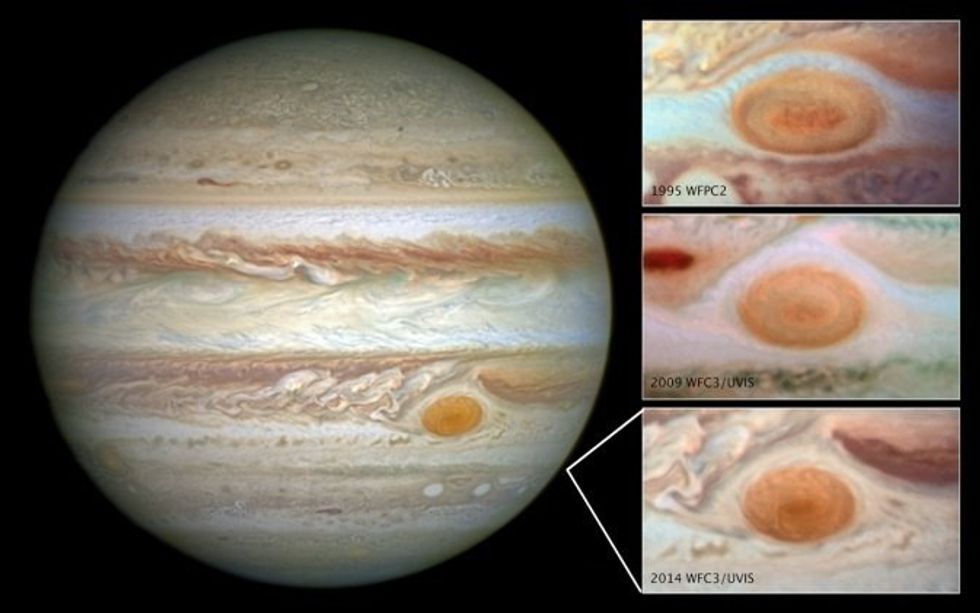
As this large storm shrinks, others are threatening to take its place. A similar storm discovered in 2006, The Little Red Spot, has winds almost the same speed as Jupiter’s Great Red Spot does. Both storms clock in at approximately 384 mph. For scale, a category 5 hurricane on earth has wind speeds of 156 mph. "In terms of maximum wind speed, the Little Red Spot as measured in 2007 and the Great Red Spot when last measured in 2000 are just about the same," said Andrew Cheng, physicist at Johns Hopkins University Applied Physics Laboratory.
Scientists have used thermal imaging to help determine the size of the storms: "In the infrared, which sees deeper beneath those clouds, the Little Red Spot appears to be part of an interacting system that is actually larger than the Great Red Spot," according to Cheng. Using infrared to determine the size of storms can be tricky, though. It is difficult to find the edges of the storms in images given by infrared technologies.
Alongside providing new data surrounding Jupiter’s storms, photos captured show a strange new phenomena. At the center of the storm, a strange wispy filament is visible. Scientists do not know what this is, though now they question if it is related to the slowing of the storm.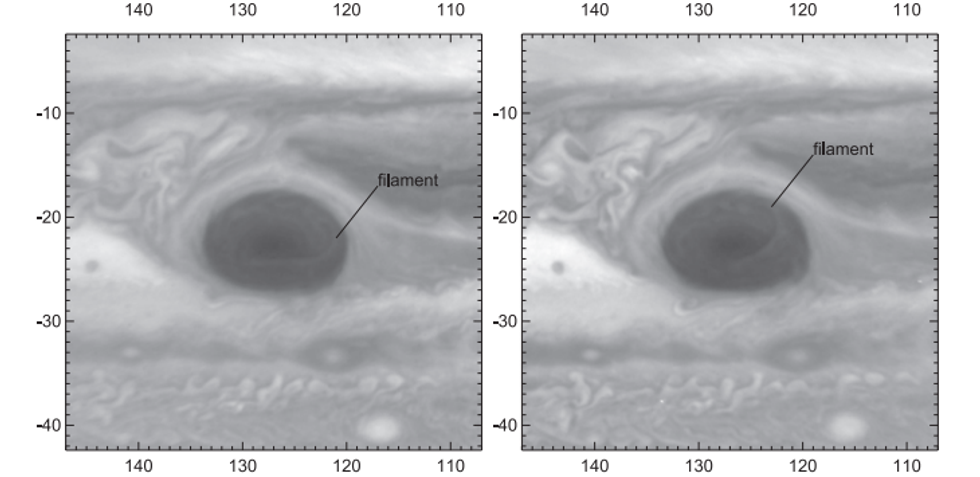
Though the storm is steadily slowing, scientists do not believe it is in any major danger of disappearing. Scientists have been tracking the wind speeds of this storm for years, and it actually seems as if the rate of slowing is decreasing. Also, anti-cyclonic storms sometimes have energy imbalances that affect their size. Since this storm has been raging for at least 400 years, this recent decrease in size is most likely not a sign that the storm is disappearing entirely.

















