Fun fact: Origami is traditionally associated with the Japanese culture, often introduced as the “Japanese art of paper folding.”
However, the delicate craft originated in first century AD with the Chinese and the invention of paper. While we currently use origami today for a myriad of purposes, it’s function first started, as, well, a functional one. Instead of making paper cranes with flapping wings or impressive red paper roses for sweethearts, the people of China would create useful commodities like vases, bowls, and boxes from folder paper.
In all actuality, it was 500 years after the invention of paper that the Buddhist monks brought the secret craft to Japan.
After that, it hit the fan, so to speak— in the best way possible. The Japanese integrated the geometrical shapes and lines in everything from architecture to ceremonial functions. Its survival can be awarded to the women of the culture, who passed it down orally from mother to daughter and then onto her daughter and so on.
As the craft became more playful and complex, the traditional title (orikata— folding exercises) slipped into something more comfortable (origami— to fold paper).
This is how we’ve gotten to what we know origami to be today: making paper cranes out of our notebooks during class or making cootie catchers to tease our friends with on the playground.
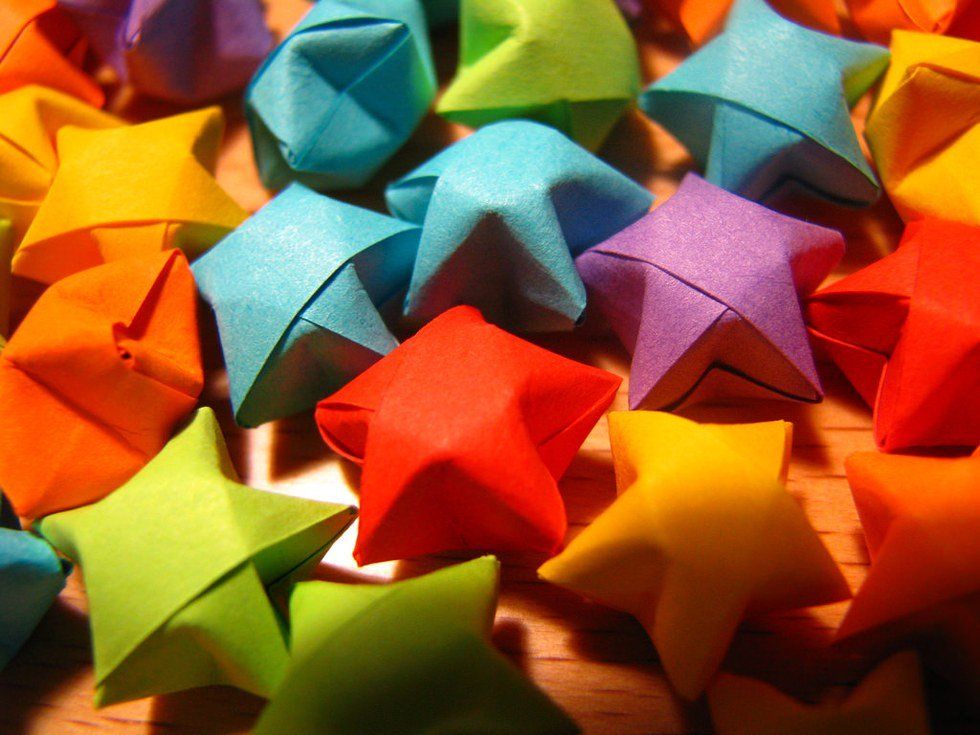
Origami was introduced to me through a best friend of mine who was enthralled with making tiny lucky stars, or what I call puffy stars (since you have to puff them into shape at the last step). I’ve been making them since sophomore year of high school as a coping mechanism to stress and nervous fidgeting. My record, the last time I had counted, was 5,400 lucky stars of varying shapes, sizes, and colors.
Now, I’m going to teach you how to make them, too!
Step 1: Start with strip of paper or ribbon. To cut out a straight strip of paper, first fold a small strip and then cut with scissors.
Step 2: Cross strip with a small ribbon at one end.
Step 3: Tuck the small flap through the hole made by the ribbon. Pull through carefully. You have a knot!
Step 4: Tighten the knot and flatten it into a pentagonal shape, with a small strip hanging out of one side.
Step 5: Fold the small strip along the edges and tuck it in, if needed.
Step 6: Start to fold the larger strip around the pentagonal shape you made in step 4. As odd as it sounds, the shape guides you which way to fold.
Step 7: Tuck in the loose end, if applicable. If the strip is too short to go around once more and is too long to tuck in, (while not in true nature of paper folding) feel free to rip it to suit your needs.
Step 8: Gently push in the sides between each of the points, in whatever order feels comfortable. Or pink the corners to achieve the same affect. The star should inflate, or “puff” up!
Step 9: Congratulations!! You’ve make a lucky star!