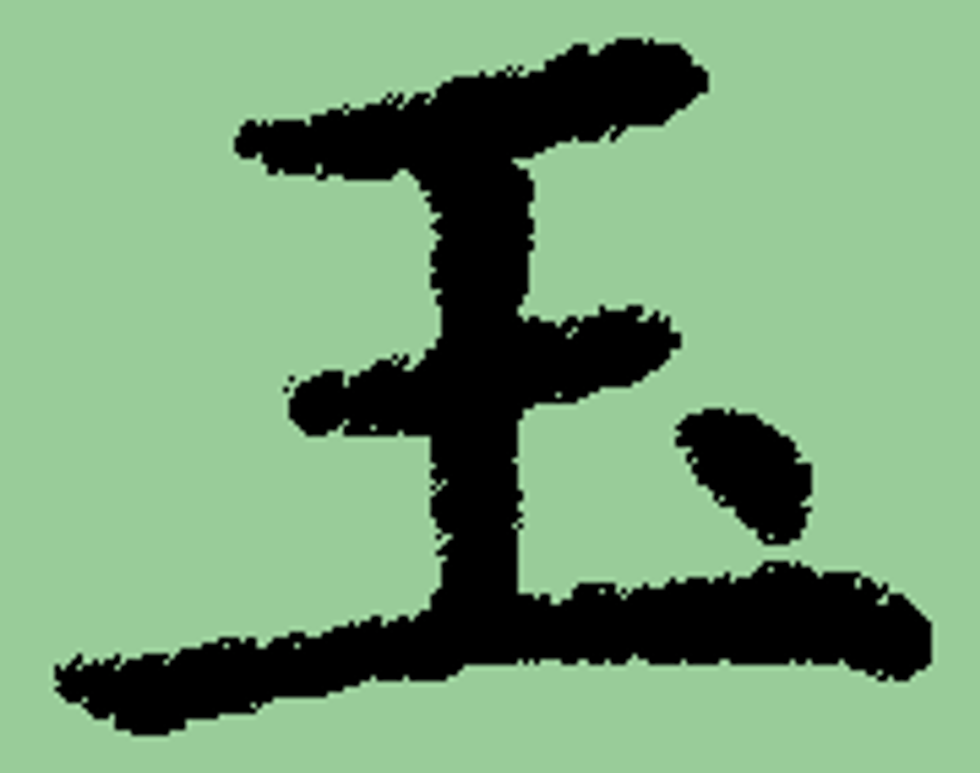
My mother gave me a jade necklace for Christmas. And for some reason, it feels like a transgression.
I must have made a face, because you showed me the generous gold pig inlay and told me that it was my animal. And I suppose that was convincing. By dint of being born in 1995, my station in life is best represented by this noble “boar,” the last animal to have joined this mythological zoo after having taken a liberal nap during the race for glory. I can’t say it’s quite representative of who I am (don’t think I’ve ever been able to simply sidle through the finish line with a full belly and ample sleep), nor can I venture to believe that all individuals born in this year are destined to be, according to Wikipedia, “fine artists in their lovemaking,” or are most competent in “sleeping and enjoying the sweet life.” But it had felt less of an astrological imprint of my destiny than something I had ownership of because it wasn’t chosen—a real spirit animal, a patronus. Something handed down, but also something I made into my own.
It looked like a threat in a tantalizing shade of ancient green. It seemed less of an expensive metamorphic rock and more of an amulet of which the bearer should be honored of—something I could not accept without taking on a responsibility that I cannot bear without feeling like an impostor. For what does it mean to wear a piece of rock endowed with a meaning that has been passed down since the prehistoric origins of a line of people that holds claim to my existence? A meaning that I don’t understand, cannot see beyond the fact that many people with black hair and yellow skin choose and cherish like the home they’ll build a family in? Crawling up my throat was a desperate howl: I do not belong, I do not belong, I do not belong.
But I’ve never seen you looking so nervous, so earnest—a woman who would gladly take the hangar out of the closet and wield it like a belt, who would stubbornly stand her ground in any and all circumstances. You showed me the certificate that proved that it was real jade. Told me that my father wears his jade every day. That this is for good luck, that it would protect me if I fell, break in my place. I asked if it would take a bullet for me, and you pulled the red string apart, carefully pushed it over my protruding ears (it means I’m rebellious), the round tip of my nose (it means I’m going to be successful). You tucked it into my shirt, and it felt cold against my chest. I became aware of the haze from the incense in the family shrine.
You smiled hesitantly, told me to always wear it. I asked you to give me the box. You told me not to lose it.
It hung heavy on my neck, this chain to a culture that I have so wish to spurn. For this cold rock resting on my chest signifies nothing but a home build upon toxic collectivism (of dysfunctional families being forced to stay together, a sanctioned greed, glorified isolationism), pathological hierarchy (of demanding a respect that cannot be given, an arrogance to the point of irrationality, justified estrangement), selfish restraint (do not give, do not be duped, do not be taken advantage of). It bears not luck, but tears open scars of self-righteous alienation. It is a cursed manifestation of all that I am/do not want to be. I refuse to allow this cold rock to sap away the history and values I have built for myself, to bury it under this amount of melanin, this body structure, this brain chemistry.
But here I am reading online about the history and meaning of jade, frantically trying to understand why. I find a condensed and simplified version for foreigners like me, written by a white man with a degree East Asian Studies. He knows all about the political development and topographic range of each dynasty, the Opium Wars, Mao Zedong, and the First Transcontinental Railroad. He’s read the Buddhist texts explaining why my father kneels and bows four times with incense held lightly in his hands before a decorated, things they never bothered to explain and I never bothered to ask why. He speaks Mandarin fluently. He probably loves dim sum and boba, and gives away self-made calligraphy prints to his friends.
I can’t treat this jade necklace like some sentimental trinket. But I can’t endow it with vicarious meaning.
What you have given me is guilt—for feeling more at home with Camus and Nietzsche than Kong Fuzi and Zhuangzi, unable to read Chinese characters but able to translate French texts. All I know about our history are from the period dramas you put on full blast every hour of the day; and even then I can only critique how Chinese Idol cannot compare to the contestants on The Voice, how our rom coms and rappers and Ray Ban sunglasses are just imitations. But I know I don’t understand, know that I am not trying to understand because I can’t bring myself to understand. I am blind, biased, bigoted—and I don’t know if I can ever call proudly call this blood and skin my own. I don’t trust myself to wear something so valuable.
I ended up taking it off when I left home. I put it in the box, stowed it carefully away.
What is home is the exaltation of the power of the individual, of self-sacrifice for one’s community and world, of instigating conflict in the name of justice, of giving yourself to others not of your own blood, of being equals with all, of having an independent sense of self, of independence, of self. No piece of rock can persuade me to believe in a meaning passed down by default.
But when a friend invites me to a Buddhist ceremony and tells me the story behind the incense stick to me (of dying every day, being united with the sky and the earth), the smell of incense mixed with cigarette smoke that wafts thickly into the night, these deep red pinpricks of light that burn between the fingers of friends and strangers who don’t understand, those lilting chants of “Namo Amituofo” and clarion bells and hollow wooden drums suddenly bears a meaning that transcends prejudice and history—a meaning that is just as intimate and my own as my aunt who goes to a temple to murmur prayers for love and peace, my mother who placed this necklace around my neck.
I am asked to join this time-honored chain of meaning that I do not understand. This jade only feels like a stone, lying cold against my chest. But perhaps all it takes it some time for it to become warm, to become as much a part of me as the tears that roll down my face, the smile on my lips. Home.