
In a time when most massively multiplayer online games are hemorrhaging players faster than Justin Bieber's fan base and the once standard pay-to-play model is seen as ridiculous by almost every MMO developer in the business, one game is bucking the trend. "Eve Online" has been continuously growing its player base since its release in 2004 and, perhaps even more impressively, continues to charge players $15 a month for access.
To put that in perspective, the previous top dog of
MMOs, "World of Warcraft," went to a hybrid free-to-play model in 2011
and has dropped from a record-breaking 12 million subscribers in
2006 to just short of 5.5 million today. Whereas Netflix,
considered by many the most successful of the subscription-based
online content services, charges only $8 a month or nearly
half of a what an Eve Online subscription, for on demand access to
tens of thousands of movies and TV shows. What makes "Eve Online" seemingly impervious to the market trends that plague so many other
MMOs, and what makes their fan base so rabidly dedicated to a game that
not too long ago celebrated its eleventh birthday? To find out, let's
hop in a ship and explore the wild, paranoid and often cruel world
that is "Eve Online."

Besides, you know the little kid in you hasn't totally given up on being an astronaut yet.
A Player-Driven, Persistent Universe
The basic formula of "Eve" isn't really that different from most online games: you control a single player in a fantasy universe where you level up your character to get more powerful; where you can team up with or battle against other players; and where you score loot by defeating computer-controlled enemies either to keep or sell. However, that's where the similarities end. Crowd Control Productions realized early on in the development of "Eve" that they simply did not have the manpower to compete with the developer-curated content like quests and dungeons that comprised the majority of other MMO's game play.
To solve this problem, they settled on an idea that challenged the entire concept of MMO design; instead of creating stories for players, they let players become the story. CCP, as Crowd Control Productions is more commonly known, quit scripting experiences for their players and instead built a massive sandbox governed by a lassiez-faire approach to game design and moderation. One of the best examples of the is "EVE's" economy, which is entirely player-driven; every item in the game starts as ore that a player mines from an asteroid that is refined into items by an industrialist based on blueprints from a researcher. Once the items leave the factory, a trader usually contracts delivery out to a hauler who brings them where they need to be, unless pirates blow up the hauler, so a trader will often hire mercenaries to protect their trade routes, causing battles and accordingly, losses, that fuel more demand for items.
This example illustrates the interconnectedness of "Eve Online's" universe, somewhat ironically named New Eden which creates ambition and intrigue-based game play on a scale rarely, if ever, seen in another game. Keeping in mind the basic formula of the earlier example, which is what should happen if everything runs smoothly, let's hear a true story of what happens when players get competitive.
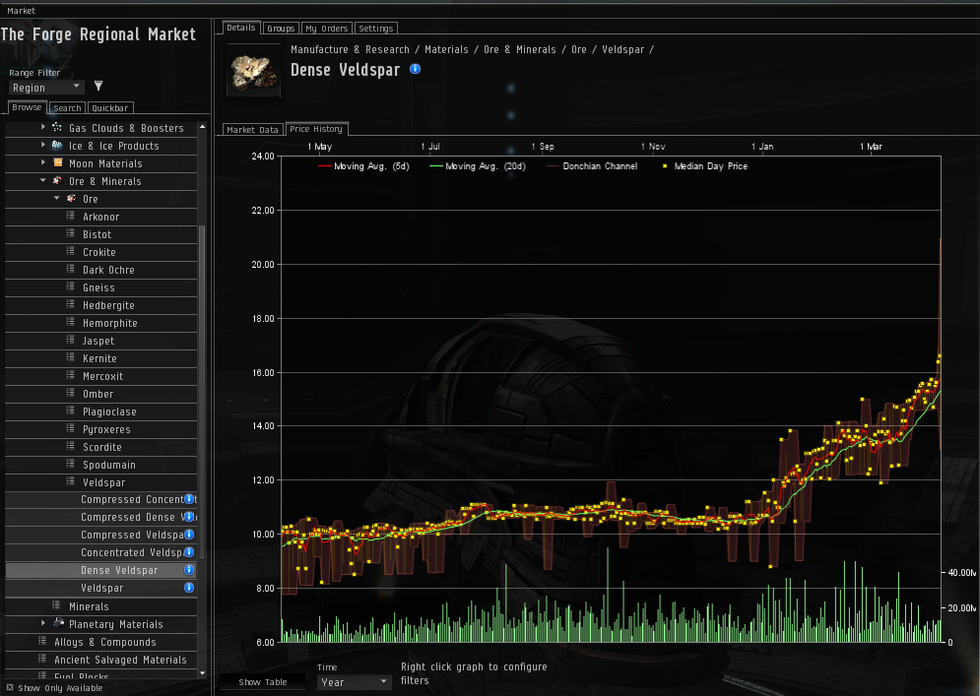
A twenty million dollar economy with 14,000 different goods and $15,000 worth of virtual currency changing hands daily calls for a lot of graphs.
A player's mercenary corporation (corporations are "EVE's" guilds) gets a contract from a trader to escort a freighter full of trade goods to a market system through a few known pirate systems. Soon after the corporation's CEO is contacted by a rival trader at the destination market, who offers corporation the a similar amount of money to let the pirates blow up the freighter. So when the freighter enters pirate space the mercenaries blow up a couple cheap pirate ships but ultimately lose the freighter. The merchants aren't paid by the first trader, but they are paid by his rival and split the freighter's load with the pirates so it's a net gain, meanwhile the loss of the freighter drives up prices in the market system the rival trader operates out of in addition to eliminating some of his competition because the freighter's owner is forced to return to bounty hunting until he raises enough funds to go back to trading. That a single player is able to have an effect beyond clearing out a room of reappearing monsters, the fact that your actions create ripples that change how tens, hundreds, even thousands of other players play the game is why "EVE" has the highest player retention rate of any triple-A MMO as well as the main reason that new players will pay $15 a month to experience.
However, not everyone has to pay $15 a month for the privilege to play, and it's one of the reasons "EVE" is so competitive, even cutthroat. If a player can manage to make enough money, they can buy another 30 days of game time with in-game currency, essentially meaning that if you're good enough at the game you can play it for free. However, the price of game time, like everything else, is determined by the market. Since everyone wants to play for free, supply and demand dictates that a month of game time is one of the more expensive items in the market. For the majority of players, scraping up enough money every month is challenging but not impossible. However, few are in a position
A crucial facet of this approach was to have every player playing together on the same server; whereas most MMOs distribute players across multiple copies of the same game world to avoid competition for content and account for players of different nationalities, "EVE" has a single, persistent game world that incorporates players from San Francisco all the way to Vladivostok. In World of Warcraft, though there are 5 million subscribers, each copy of the game world can only contain 10,000 players, while "EVE's" single server plays host to all 500,000 subscribers. While having hundreds of small copies of a game world has its benefits, it limits the scale and makes it impossible for any player or group to have any in-game effect on World of Warcraft as a whole. This is one of "Eve's" biggest advantages, it makes New Eden one big community, gives players a powerful sense of unity and allows for legends to be born.
Want to learn more? Part two coming soon!
COUPE DE DEUXIEME PARTIE
I Was There
Due to the
scale of "Eve," there are times when a player or a corporation will do
something that effects the rest of the world in a really big way and "EVE" players will tell you it is one of the coolest feelings in the
world to be part of an event that every other person who plays the
game will be talking about for months, if not years to come. Some of
these events make it on to gaming news websites and magazines, a few
have even found their way into Time Magazine, the Wall Street
Journal, the International Business Times and Wired; in fact, there
are even some players who have had interviews on NPR and the BBC.
These events run the gamut from player rebellion to battles to
espionage and scams, but are essentially just large-scale versions of
the stuff that takes place in New Eden everyday.