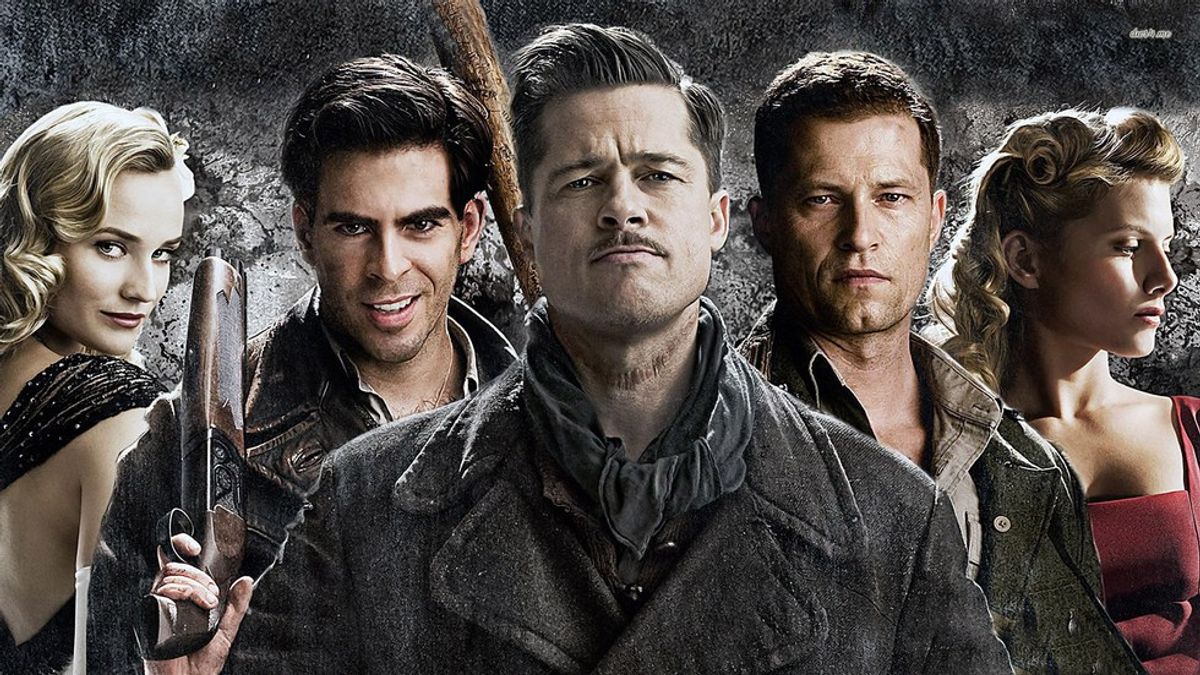
"Inglourious Basterds" is the sixth film written and directed by Quentin Tarantino and, on the surface, it is a revenge story about two separate plots to assassinate the leaders of the Third Reich at the premier of a Nazi propaganda film being held in German-occupied France during World War II. One conspirator, Parisian theater owner and Jewish escapee Shosanna Dreyfus, plans to burn down the theater where the premier is being held, which she owns and operates; the other plan is a joint operation between the United States and the United Kingdom, and involves a group of undercover Jewish American commandos infiltrating the same film premier to plant explosives and end the war in true Tarantino fashion.
But what if the film is about more than Jews exacting revenge against the German war machine, and is actually meant to signify the director’s personal politics regarding violence in films, or more specifically that real-world violence is not caused by violence that takes place in works of fiction?
This interpretation of "Inglourious Basterds" hinges upon the viewer accepting that the Tarantinoverse theory is correct; this means that all eight of the films both written and directed by Tarantino actually take place in the same timeline, with the end of World War II being the point in time at which the Tarantinoverse and the real universe diverge. In this fictional timeline, violence is considered more acceptable as a means of advancing in society and solving problems as a direct result of the "Inglourious Basterds"—the German army is undone not by Hitler committing suicide, but rather by red-blooded Americans wielding dynamite and machine guns in what is probably the most horrifically violent scene in any of Tarantino’s movies so far, culminating in a fantastic explosion as a projection of Dreyfus mocks the dying audience from a cloud of smoke.
The connection to Tarantino’s beliefs about fictional violence becomes apparent when we consider the nature of the propaganda film being premiered at the cinema during the assassination attempt; in particular, the film’s depiction of graphic violence (at least by the standards of the 1940s). The film, titled "Nation’s Pride," is a highly dramatized telling of the wartime exploits of a German soldier named Fredrick Zoller, specifically a conflict between German and American forces that took place in Italy. During the battle, the Germans were routed, and Zoller, cut off from the main German fighting force, took a position at the top of a watchtower with a sniper rifle and hundreds of rounds of ammunition, resolving to hold off the American advance until German reinforcements arrived to extract him. By the time the conflict ended, Zoller had killed 250 American soldiers. The Reich’s propaganda arm asked Zoller to play himself in "Nation’s Pride," and he agreed, even attending the premiere at the cinema owned by Shosanna Dreyfus. So how does this scene reflect Tarantino’s views on movie violence?
The significance of "Nation’s Pride" and the cinema sequence as a whole is based primarily on its potential to be insignificant to history, or, perhaps more accurately, its apparent lack of effect on the audience in attendance. For clarity’s sake, let us look at the consequences if the Bastards and Shosanna Dreyfus had failed to assassinate Hitler that night; if the German leadership had survived, the war would have presumably ended the way it had in reality, and history would have continued along the trajectory that ends in our current cultural mindset, without the focus on violence that is essential to the Tarantinoverse culture. The only thing that would conceivably have changed would be that we would have a different film in our cultural lexicon—"Nation’s Pride." Without the occurrence of a violent catalyst—in this case, the elaborate and awesome demise of history’s greatest monster—society remains the same, and the audience in the theater that night in Paris is unchanged other that having now seen "Nation’s Pride." If the building doesn’t explode in that scene, history continues as normal.
If we accept the cinematic sequence as a reflection of the director’s views on violence, then it would appear that Tarantino has a caveat to this opinion—while a fictional depiction of violence ultimately cannot harm an individual or society at large on its own, it can cause a person to relive previous traumatic experiences, and in this way movies can negatively affect people based on their own memories and previous history. In other words, art can affect change, but only through association with an event on a personal experience level. We see this demonstrated during the screening of "Nation’s Pride" when Zoller, visibly uncomfortable watching as the film depicts him killing hundreds of people, asks the director of the film if he can be excused. After leaving the theater he goes to the projection box and says to Dreyfus that he doesn’t like watching that part of the film. Is it possible that he only leaves the theater at all to visit Dreyfus, and the film’s content is just an excuse? Sure it is, but ruling out post-traumatic stress as the cause of Zoller’s discomfort would be a fundamental misunderstanding of the effects of real-world violence on the mind of an individual, even when they are the one inflicting harm, and Tarantino is more than aware of this fact.
Even if he did not intend for the theater sequence to be a political statement, unlikely as that may be given his proclivity for speaking out about this issue in particular, Tarantino definitely succeeded in tying together his cinematic universe while simultaneously sending a message to viewers about the effects and causes of violence.