
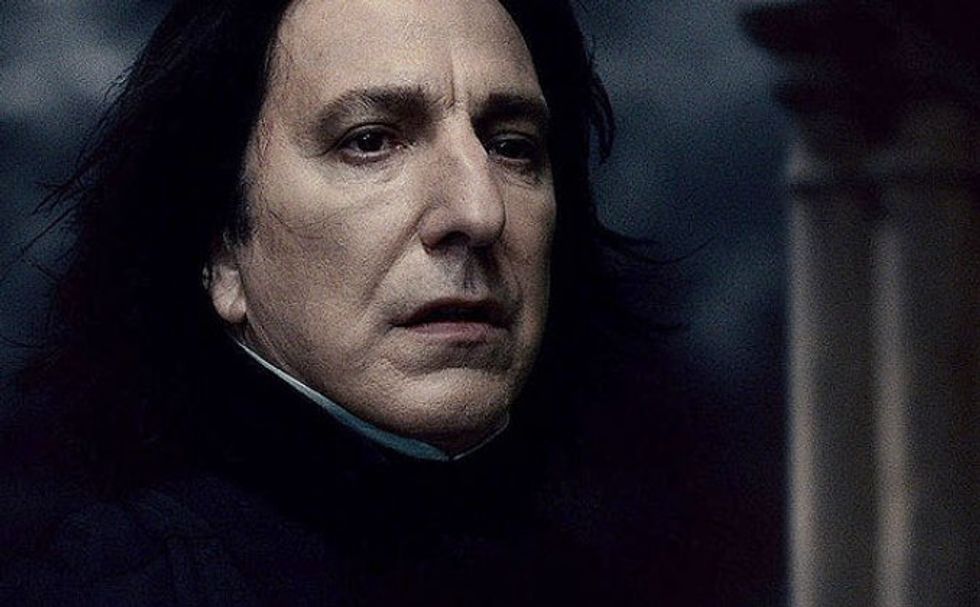
I would be lying if I said I haven't been looking for an excuse to write a long rant about one of my very favorite fictional characters for a long time...I realize that "Deathly Hallows" has been out for some 8 (!) years now, but somehow the debate rages on whether Snape is anything more than a helplessly depressed loser who was obsessed with the only girl who was nice to him.
Many times (God, I spend too much time on the internet reading other people's opinions), arguments against the admiration of Snape as a character, or even as a person, are framed in the context of other characters; this specifically arises when bemoaning the name of Harry's second son, Albus Severus, and questioning why Snape, a person who has certainly tormented Harry and a fair share of his classmates, should get that nod over people such as Remus Lupin or Fred Weasley, who, I will certainly grant you, are much more decidedly good characters and certainly loved Harry more.
However, Snape's story has never been about simply being good, and, I would argue, neither has Harry Potter's. It is about the journey there, and how that journey can be made or broken by the amount of love in one's life.
Let's briefly review what we know of Snape's background: he grew up in a broken home, with a drunken father who abused both his mother and himself. He presumably had no friends until he saw Lily, and while the image of ten-year-old Snape watching Lily and Petunia swinging from behind a bush isn't the most flattering, I cannot fault someone who assuredly felt so lonely and unloved for taking the chance to make a friend.
Here is where someone will say that Snape's childhood does not sound all that different from Harry's, but that Harry didn't end up interested in the Dark Arts, or become in any way as bitter and mean-spirited as Snape clearly did. But if we're going to compare their childhoods, let's also compare their first experiences in the world of Hogwarts: their first train ride.
When Harry comes to the platform, though he is lost and confused, he is immediately the recipient not only of Molly Weasley's help and kindness, but of a ready-made companion and his friendly siblings. While Snape already has a friend in Lily, when he boards the train he is almost immediately accosted and belittled by James Potter and Sirius Black, a pattern that not only continues throughout his life at Hogwarts, but increasingly escalates as he is sorted into Slytherin, the "evil people" house, and the others into Gryffindor, the "good people" house — if we believe many characters' takes on it.
And from there, Harry and Snape's paths diverge; while Harry is headed on a journey — though filled with danger and tragedy — that affords him opportunities to make choices about who he will be, Snape embarks on one that gives him little choice. It seems to be universally believed in the Harry Potter universe, even by most of the staff at Hogwarts, that being sorted into Slytherin is marking you as a bad person at the age of 11. Hagrid flat-out says that "There's not a single witch or wizard who went bad who wasn't in Slytherin." Snape tending toward the Dark Arts is far from unsurprising when people of the house supposedly synonymous with goodness push him, and probably others, towards it. Any hope of Snape making meaningful friendships besides Lily were crushed by relentless bullying; his hanging around with future Death Eaters has much to do with protection from the Marauders.
And so, having been a product of a hateful marriage and surrounded by bullies and "creeps," as Lily calls them, is it any wonder that Snape clings to Lily as the only goodness he knows? Many fans have said that what Snape felt for Lily wasn't a true love; he was obsessive and stalkerish, and his calling her Mudblood is completely unforgivable. And perhaps it wasn't purely romantic love in the sense we are accustomed to, but something rather deeper. Lily was more to Snape than a girl who was nice to him; she was very likely the only source of goodness in the first 18 or so years of his life, the only model Snape had for anything really resembling morality that would have a chance of resonating. One of the many tragedies of his life is that it might have gotten through in an environment devoid of James Potter and creeps like Avery. Instead, the constant tension between having to fit in with Slytherin and wanting to keep his friendship with Lily was broken with his calling her "Mudblood" for his reputation's sake, ending that relationship forever, and simultaneously setting Snape on the only course left to him.
What is amazing about Snape's story is that when he had many reasons to stay on that course which was almost impossible to leave, he was able to do it anyway, because of his undying love for one person. And he not only leaves, but performs an unending multitude of tasks that would leave most other people entirely broken; he dances an impossible double life among Death Eaters and the Order, a dance that must be perfect for Voldemort, one of the world's greatest Legilimens, not to notice. He must abandon the hope of having meaningful relationships with anyone besides Dumbledore, constantly endeavor to protect Harry and his friends, and when Dumbledore dies, carry out those plans as well.
Do not be mistaken: Severus Snape is not a likable, nice, or kind man. In some important ways, he is cruel and vindictive. But under the circumstances in which he had to live, he could have been so much worse. That courage, devotion, self-sacrifice, and goodness still could sprout from him, even in perhaps not the purest form, is one of the most remarkable demonstrations of the power of love in the whole series.
Think on this: one of the memories left to Harry at the end of Deathly Hallows is from the battling of the seven different apparent Harrys, in which the Order had thought Snape to be responsible for the cutting off of George's ear. Snape's memory, however, proved that he was aiming for a Death Eater. This memory could have been easily left out of the collection; Harry certainly had enough to go on to be sure that Snape was on their side and was clear on what he had to do. But I think this reflects that deep down in Severus Snape's heart of hearts, he did not want to be thought of as the cold, awful persona he had portrayed all of his life. At his death, there still remained the little boy who grew up friendless, who wanted to be understood, and to form a connection with somebody. He lived the vast majority of his life without this kind of connection.
Of all the tragedies of Severus Snape, this is perhaps the greatest of all; he saved so many people because of his love, but love did not save him.

















