


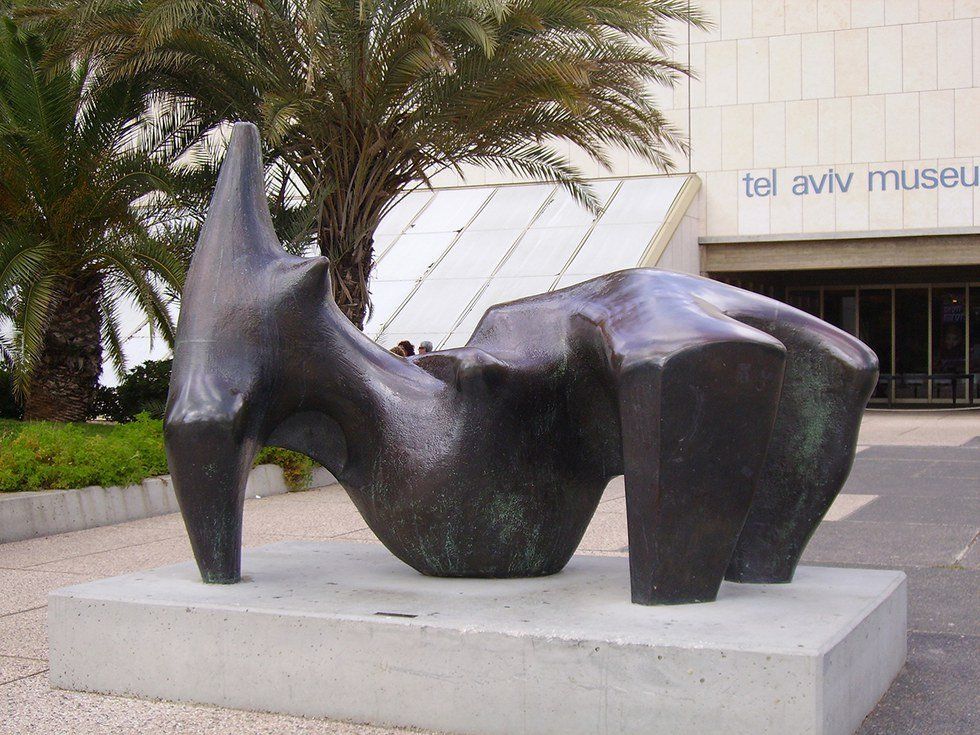
Henry Moore’s Reclining Figure is a superstar on Columbia University’s campus, and she hasn’t even touched down in New York yet. She’s been the subject of multiple campus newspaper opinion pieces, and has even made the New York Times and the Guardian. She’s received 1,200 signatures on a Change.org petition.
Of course, all of this attention is not directed from a place of love, but from a place of deep, astoundingly profound hatred. The message is clear: Reclining Figure is not welcome. A Columbia Spectator article described her as an “idealization of a chewed wad of gum.” The Change.org petition was a request to keep her as far away from campus as possible.
The statue, donated to Columbia by Henry Moore over twenty years ago, is supposed to be placed on the lawn in front of Butler Library. Butler is Columbia’s most oft-photographed location, perhaps aside from Alma and Low Library, which loom directly across from it. The central part of the Columbia campus is an idyllic testament to symmetry and prowess of the Ivy League institution. Butler frowns sternly, its facade proclaiming the names of history’s greatest in all caps. The lawns are kept hidden from the elements in the spring beneath sheaths of white. Low Library casts its shadow and carves its imprint into the sky, and Alma raises her fiery torch above all, as if to light the way for future students. It is a picturesque location of the prowess and power of the behemoth institution that is Columbia University.
There’s no denying the fact that Reclining Figure would interrupt all this symmetry and castle-like fortitude. But would this really be a bad thing? After all, Columbia’s campus a truthful representation of the university it holds?
I believe that most students would agree that Columbia is no paradise. The school has been ranked as the most stressful university in the country, according to the Daily Beast and several other lists. The school has mental health problems, sexual assault problems, financial aid problems, countless other issues that have no doubt been the headlines of many an indignant student-written op-ed. While I won’t go into specific details of these issues, I would wager anyone who attends school here would agree with the fact that the pieces of life at Columbia definitely do not always neatly align.
Reclining Figure would not fix any of Columbia’s problems, but she might be the beginning of a better reflection of them. Breaking up the symmetry of Columbia’s lawns and creating a more expressive, varied facade would better depict the university’s insides - which often resemble a mess of distended organs and punctured nerves, contrary to its pristine outward appearance.
Columbia is undeniably home to countless vibrant, talented individuals. It also houses dark truths that are much less often discussed. Regardless, each member of the community is different from the other in often astounding ways. The days of symmetry are past; Columbia is no longer a salon for rich white males (though it did not start admitting women until 1983, an astoundingly recent date).
Instead of criticizing Reclining Figure, we should embrace her. After all, when we’re dragging our feet on the way out of Butler in the dead of a winter night, a cup of lukewarm Blue Java in our hands, she’ll be a reminder that not everyone is the image of perfect Columbia symmetry. Seeing her triangular head and spider-shaped body will remind us that no matter what we look like, each and every one of us is a piece of art. Her distortion could serve as a reminder that darkness and difficulty are parts of this school, and that these things are equally as valid as all the illusions of success and perfection we build to hide the truth.
I believe Reclining Figure will be a welcome change from Columbia’s sometimes stifling symmetry and uniformity, a needle in the side of the Morningside Heights bubble. She will be a reminder to students, professors, workers, and everyone else who wanders across College Walk that they do not have to be perfectly aligned to be here. She’ll be a nod to the individuals, the freaks, and the creators. She’ll be a representation of the creativity and artistic expression that is a vital part of the Columbia community. Do we want to be embracing conformity or innovation? Ancient tradition or new perspectives? It seems hypocritical to cling to a stately, somber aesthetic in a place that is such a hotbed of artistry and innovation. Ultimately, the truth is that symmetry and perfect alignment will always be an illusion in any place houses the messes and damages that accompany being a human on earth.
And there is a strangely melodic beauty and movement to the statue’s form. She rests on pointed elbows that mirror her pointed head. Her legs dig into the earth with a kind of stoic pride. She even seems to display an easy sort of sexuality, and her (presumably) female presence will provide a welcome change from the row of male names that glare down upon us from Butler’s exterior. Her relaxed stance can serve as a reminder to take a moment to rest and enjoy the view - flaws, cracks, and bulbous masses included.

















