


According to the IPCC, earth’s average temperature has risen roughly 0.74ºC (1.33°F) over the past century. It is predicted to warm 2-3 ºC by the year 2100. This may not seem like much, however, the difference between today’s average global temperature and the average global temperature during the last Ice Age is only about 5 ºC[1]. As a result of the rapid change in climate, earth’s Pokémon are being forced to adapt or face death. Fire and water types, such as Flareon, Poliwag, and Krabby, thrive in warm, moist conditions. However, many grass, ice, and ground pokemon are nearing extinction.
The Pidgey-Rattata Cycle
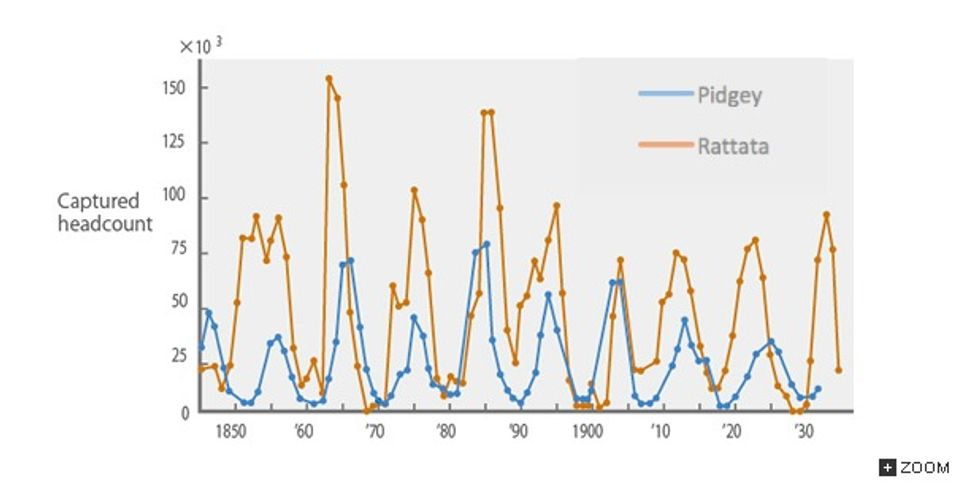
Population fluctuations are inevitable in a healthy ecosystem. But how will the 2-3 ºC temperature increase affect its delicate balance? Mirroring the lynx-snowshoe hare cycle, Pidgey and Rattata populations grow and drop inversely to one another. Because Rattata are a Pidgey's favorite meal, continued predation due to high Pidgey population induces a population decline in Rattata. The Pidgey decline follows the Rattata population crash, and so on. Unusually high populations of both species currently exist. This may be because Pidgeys have turned to the more easily accessible Weedle, which thrives on forest succession.
Climate Change and Pokemon Types
- Fire: wildfires are now more common due to dry weather and droughts. Quoting National Geographic Environment, “on average, more than 100,000 wildfires clear 4 million to 5 million acres of land in the U.S. every year.” Fire type Pokémon do well in these conditions, however, sea level expansion has washed an estimated 30% of fire types from their homes in the past decade.
- Water: most water types are actually thriving due to warming and expanding oceans. That being said, water Pokémon with calcium carbonate shells/skeletons are negatively impacted by ocean acidification.
- Grass/ground: grass and ground Pokemon dependent on forest succession will rise in population preceding forest fires. Due to extreme weather conditions, drought, and expanding sea level, it is predicted that species such as Vileplume will be endangered within a year.
- Ice: dependent on sea ice, most ice Pokemon will disappear as earth's ice sheets melt.
- Bug/poison: longer summers and milder winters allow for insect populations to grow.
- Flying: the warmer atmosphere traps greenhouse gases, creating smog. Polluted air quality threatens avian-type Pokemon, who spend most of their time in the sky.
Possible Solutions
Following the IPCC’s business as usual scenario, by the time I am 55 years old, mean global temperatures will have risen by 2°C. The warmer ocean, coupled with a rise in sea level, will give power to cyclones and hurricanes. Several island nations will cease exist all together, such as the Maldives, Kiribati, and Tegua. Disease will become more prevalent as Pokemon and their trainers crowd inland. If measures are not taken to combat climate change, it is predicted that roughly 40% of all pokemon will be extinct by the year 2100. There are many possible solutions to avoiding this scenario. One of these solutions is to reduce green house gas emissions from carbon sources such as burning of fossil fuels and forests. The largest source of carbon dioxide emissions in the United States is electricity generation. Three essential steps must be followed in order to effectively reduce electricity emissions. The first step involves the conservation of energy. Several ways to conserve energy include turning off lights when leaving the room, line drying clothing, unplugging appliances when not in use, and turning the heat off at night. These factors lead into the second step: efficiency. Energy efficiency differs from energy conservation because energy efficiency is "using less energy to provide the same service". Energy conservation is reducing or going without a service to save energy (Lawrence Berkeley National Laboratory). People can be more energy efficient by replacing appliances with more energy-efficient models, insulating homes, and designing buildings in a way that naturally regulates temperature and illumination. The last step to energy emission reduction is the transition to renewable electricity generation. Renewable or alternative energy is any source that is an alternative to fossil fuels. These sources are widely available and produce little to no pollution. Last year, only about 13% of U.S. electricity was generated by renewable energy (US Department of Energy). Humans are the most powerful species on planet earth. If we do nothing, we will have Pokemon blood on our hands.
[1] McDonald, Hugh. "Overview of Climate Change Research." Global Climate Change: Research Explorer. National Science Foundation, 2002. Web. 11 Aug. 2016.
















