

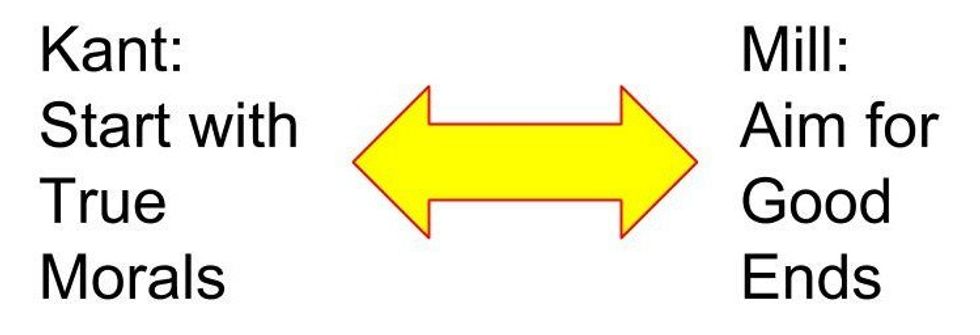
Recently, I was in philosophy class and I was struck by our conversation about two philosophers. It is funny how one can go back and forth between agreeing with one and the other. John Stuart Mill and Immanuel Kant both find that morality is always encouraged by something, but the terms are different.
Kant’s theory, in a more simplified description, could be seen through his hypothetical imperative and categorical imperative. A hypothetical imperative is when one performs an act based on trying to achieve something outside of the act. This is considered immoral. A categorical imperative is when one performs an action without conditions. This, according to Kant, is considered moral. He contends that morality is one’s duty and utmost responsibility, regardless of how one is feeling at the time. Mill’s principle of utilitarianism is defined as maximizing the greatest happiness for the greatest number of people. He believes what motivates human beings to act is the pursuit of pleasure, or the avoidance of pain. This serves as not only the reason for our decisions, but the platform in which we view the world that surrounds us. Everything else, according to him, is rhetoric or nonsense. You can only determine something’s worth based on the pleasure it will bring you. Mill tells the reader that an action that creates more pleasure than pain is morally good, and an action that creates more pain than pleasure in morally bad. The principle of act utilitarianism is when one does an act and then calculates how much pleasure or pain this act caused. This is why some people believe that lying is not immoral, as they do so in the efforts of not hurting a person. This, as far as Mill is concerned, would be considered moral.