


Kidney.
No? How about... lugubrious.
Still nothing? Well, certainly we can agree that "strumpet" is mildly amusing.
Humor is difficult. I can't just write a single word without any context or setup and expect that people will be amused. There are elements of humor that everyone understands, yet that doesn't make it easier to come up with a good joke. The fact that we have good and bad jokes shows that even using a humorous setup won't make something funny. For example, here are two puns:
Why did the stadium get hot? All the fans left.
A boy swallowed some coins and was taken to the hospital. When his friend called to ask how he was, a nurse said, "No change yet."
You may hate puns, but can still recognize that one is clearly better than the other. It's not necessarily because it's longer, but because the setup better justifies the punchline. The first makes some logical sense, but the image of fans leaving a stadium is too silly. Both are double entendres of the words "fans" and "change" and extend from logical setup. The second works better because it's a realistic scenario and that, combined with the length, makes the punchline subtler and less expected.
Humor is the subversion of expectations.
That's a general definition and it's mostly accurate, but I admit it's still somewhat lacking. Sometimes you can expect the punchline and still find it amusing. Pranks are predictable, since they typically elicit one response, yet they're still funny. There are degrees of difference in people's responses, but the humor goes beyond expectations. However, for the purposes of this article, I'll refer to written humor as the subversion of expectations.
Humor is an art — it is subjective and incomprehensibly diverse.
There's no recipe for humor. The closest you'll get to something inherently funny isn't a silly word, but rather puns (double entendre), slapstick, and Trump's hair. Comedians blend natural wit with years of honing their craft. Robin Williams and Louis C.K. didn't crystallize into the comedians they are today. They took time to try out jokes, refine their technique, and observe the world for the things worth laughing about.
Like artists, comedians understand that there are methods to their craft that make it superior. An artist must understand perspective, framing, shading, color, composition, and more. A comedian must understand timing, delivery, irony, satire, setup, controversy, and absurdity. That last element is what the natural comedian can find with ease. They notice the quirks and foibles of life that are inherently silly because they are so ridiculously pretentious, inconsequential, unnecessary, lazy, extravagant or petty.
A good comedian has a good eye. Like an artist, they must be able to observe the things that are worth noting. A death in the news isn't funny, but it has potential if there's enough stupidity or controversy around it, and if it's a gorilla. Likewise, controversial or solemn subjects may not seem ripe for humor, but good humor taps into our expectations of treating grim subjects seriously and subverts that.
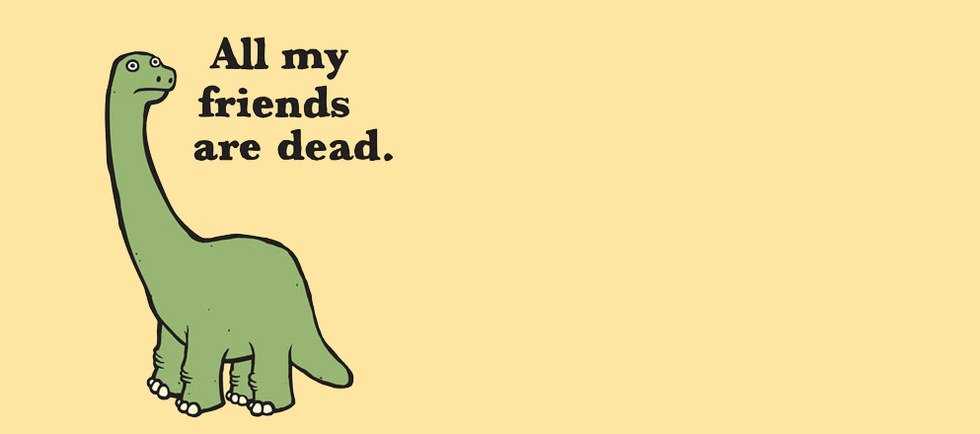
I'm writing this article in response to an essay I wrote about Avery Monsen and Jory John's faux-children's book, "All My Friends Are Dead." The book is what you'd expect: black humor about loss, loneliness, and dinosaurs juxtaposed by simple cartoon characters. The characters all have the same blank, wide-eyed expression as they relay their pain against a background of monotone oblivion. This is a book that shouldn't work, but largely does.
"All My Friends Are Dead" understands enough about humor to avoid being monotonous. The book is one simple punchline extended over 90 pages, but it works because the jokes move quickly and play around with recurring characters, connecting strips, subversions of the title, and ever-worsening situations to lampoon. How's this for a joke: everyone dies. That doesn't work on its own, but with context, setup, timing, and delivery, it's actually still pretty depressing. But it's absurd enough to be funny.

















