
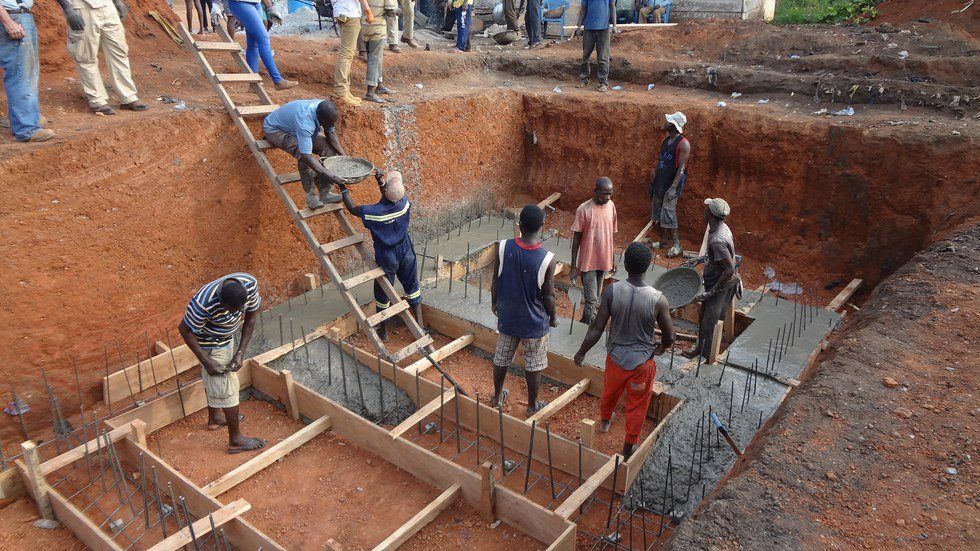
About a week ago, I returned from a trip to Ghana. I went as part of Rose-Hulman’s chapter of Engineers Without Borders travel team to build a latrine substructure in the village of Gomoa Gyaman. Basically, we’ve been constructing communal latrines that seat twelve people total, and have started the second. The substructures consist of the underground chambers that contain waste and can be pumped out as needed, plus a slab on top that eventually forms the floor. The latrines should be serviceable as long as the concrete lasts- simplicity is generally preferable.
But I learned as much as I helped out. Of course, much of this learning centered on technical details- what the materials available are like, how quickly we can get things built, how the project manifests in practice. But more importantly I learned about people. What I most appreciate about the trip, at least from my perspective, is how it gave me an excuse to go to the developing world and not be sheltered from it. So I got a bit of an idea of what people are like there and how they live. There is a no single narrative that can describe everyone; I met a mix of good and bad people, mostly those who are a little of both. Help them regardless.
I may as well start off with a negative anecdote. I brought a camera to Ghana to take pictures of the work, and of the kids because they swarm anyone with a camera. But at one point, I was standing at ground level while watching some of the work going on at the bottom of the pit. Three of the guys down there began enthusiastically asking for me to take their picture. I naively smiled, said “just a minute”, and went to get my camera. But Dr. Richter, our faculty mentor for the trip who speaks the local languages, stopped me and said, “We’re not doing that”. As I learned later, the three down there had been discussing in Twi, their own language, how they would ask for a picture and just walk off with the camera. Fortunately, I hadn’t planned to actually hand them the camera, just take a few pictures. I am not so ignorant. I am not particularly disturbed by the notion of having my camera stolen, but I am bothered by such baldfaced deception. There is something frustrating when the very people you are trying to help lie to you.
Then there were the concrete pouring days. Since there are basically no structural cinderblocks in Ghana, we form the substructure walls from concrete. It’s a hard process, but is the only way to produce a viable structure. There are no concrete mixers in the area, so the arduous task of mixing and pouring it falls to people. So the mixers, inhumanly strong as they are, do what they can to make their lives easier. It is conventional to add way too much water to the dry ingredients, since it makes the concrete easier to mix and handle. But wet concrete becomes weak when it sets, and leaks out of the forms. So we students have all had the experience of shouting “No water! No water!” at the mixers, and being ignored or even mocked a little. Sometimes the concrete came out thick enough, but not always. However, the last day we poured the walls, things changed. For one, our foreman from Gyaman, Orlando, helped mix, and he speaks good enough English that we could explain why we need dry concrete. Dr. Richter also talked to the other mixers before we got started. I don’t know exactly what he told them, but they mixed up the driest batch of concrete yet. Cries of “Too wet!” are meaningless if nobody understands why it matters that the concrete be dry.
The children were easily the most uplifting part of the trip, however. They’re a varied lot: some are barely toddlers, others in their teens. Some of the kids are well fed and their clothes changed every day; others, not so much. And yet they give me hope, especially the older children. Basically the only way to succeed in Ghana is to get an education and, crucially, learn English. While they were out of session during our trip, the kids go to the local primary school, and a secondary school will open soon. The older children, who’ve spent more time in school, speak pretty good English, enough to hold a conversation and even express humor with. They’re hard working, and will carry the future of Ghana.
I’ve barely even begun to describe anyone in Gomoa Gyaman, much less the region or Ghana as a whole. Regardless, the point is that as a volunteer, I am not some sort of white savior lifting up a great homogenous lot of poor faceless Africans. Their lives are incredibly complex as well. This complexity means that there are going to be people who wish you harm, whether they are just desperate or mean-spirited. I understand that it is hard to want to help them. At the very least, let your work help them if it will also help the children,
















