
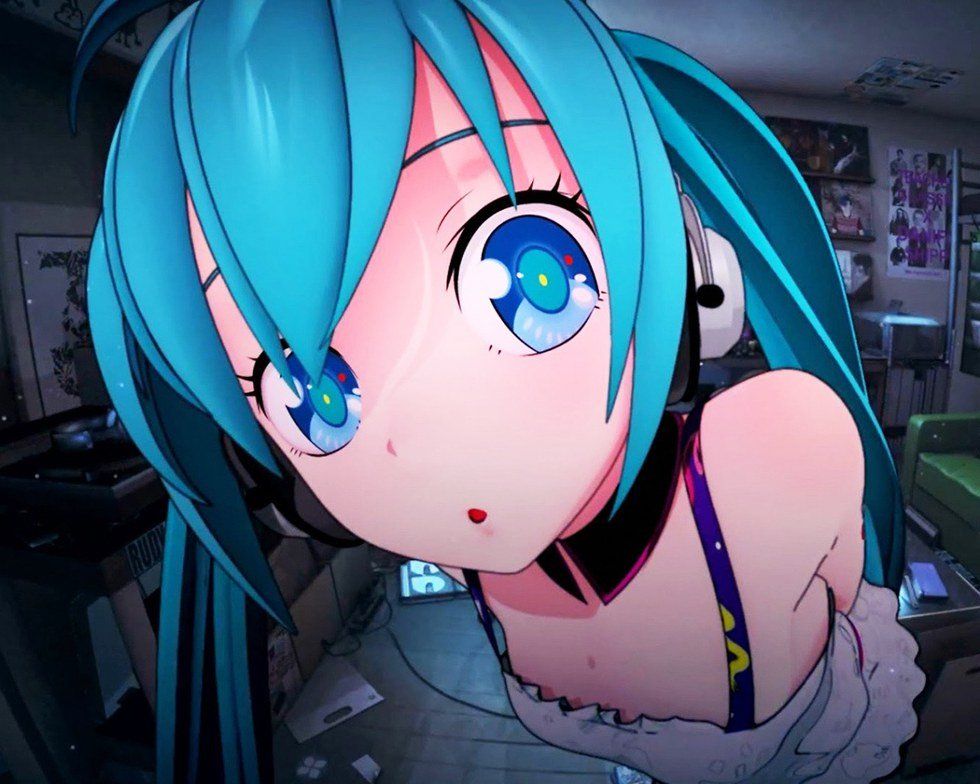
You enter a crowded stadium full of passionate fans clutching glow sticks, hearing their whispers of excitement. The musical accompaniment has set up their instruments, the lights shut off, and rising from the floor materializes not a physical person, but a hologram. While one might think that holographic singers are something from a sci-fi movie, the animation projected before you with sailor uniform and turquoise pigtails is quite real, and her name is Hatsune Miku.
Hatsune Miku is a humanoid singing persona created by Crypton Future Mediausing Yamaha’s voice synthesizing software, Vocaloid 2 and 3. Her voice is made from phonic samples of Japanese voice actress Saki Fujita at a controlled pitch and tone, which then are strung together to create lyrics. Crypton had the idea to release Miku as, “an android diva in the near-future world where songs are lost.”
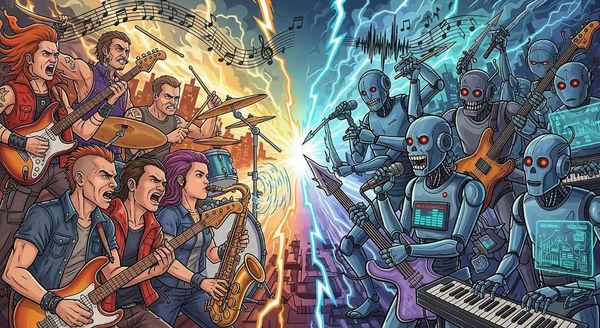
The biggest complaint about this Japanese pop idol is that she is “inauthentic”. Pop music often falls under this criticism. Fans of other genres, like rock, claim that these artists do not write “real songs” with “real feeling”. While rock bands’ authenticity is taken without question, musicians in the electronic genre must fight for acknowledgement by the ever-critical audiences.
Why is the issue of authenticity so important? When discussing music, being inauthentic seems to infer a sort of “fake-ness”. Something inauthentic is presented to us as real in order to deceive, and that can often be upsetting. If, for instance, someone goes to a concert and the singer is lip-syncing, they might feel rather deceived. Simply put, people are angry because of the dishonesty. Whereas other pop stars hide or lie about their histories and motives, Miku’s humble origin is plain and honest. Nobody can claim that she is trying to be something she is not. She cannot feign authenticity because she is presented as exactly what she is — a digital avatar. Contrary to what Western media indulgers might feel, the Japanese do not find this stark unreality to be off-putting.
Hatsune Miku, although manufactured, creates a real connection with her fans. The attractiveness of past musicians might have included fashion or scandal, but people are now placing importance on the relatability of the object rather than the physical object itself. “What makes her so relatable if she is not even real?” you ask. Truth be told, her entire persona was created by her fans. While she first appeared as a mascot for the Vocaloid software, fans quickly made her their own. Anyone with Vocaloid can use Miku as the voice for their music. Crypton Future Media chief executive officer Hiroyuki Itoh estimates that there are 3,000 Hatsune Miku songs on Japanese iTunes and Amazon. This is in addition to the thousands upon thousands of YouTube videos featuring her. Numerous other works of art and fiction starring her and other Vocaloid characters have also been inspired and published on the online world. Basically, her fanbase is hella big.
There isn’t deception, nor reason to argue using vague terms like “real” or “fake”. Rather, it seems that “honesty” — a clear concept universally understood — is what gains wide approval. She is exactly what fans make her to be. Because she is a largely digital existence, as well as an extension of her fan base, Hatsune Miku has become the stepping stone of a new and revolutionary musical movement. Who knows, maybe the future music idol will be a lady robot and Taylor Swift will be part of some ancient, vintage iTunes playlist.






 man running in forestPhoto by