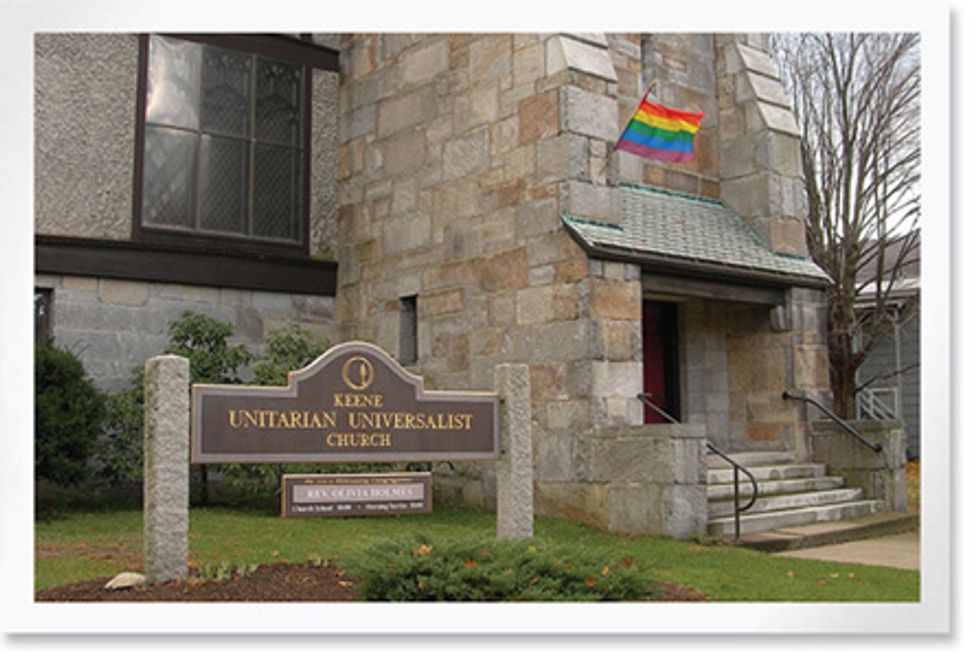
Growing up in the Unitarian Universalist denomination was a fairly unique experience. It felt very different from the stories that my friends tell of their own childhood experiences with religion. Looking back on it, although it was different, there are so many aspects that are similar to those of other religions. The approach may be different, but the elements were more similar than you would think. Unitarian Universalists are quirky, but the experience was priceless.
When I talk about the religion I was raised in, one of the quickest responses I get back is "Does that even count as a religion?" Usually followed by "What do you even believe?" As UUs of all ages can attest to, explaining, describing or rationalizing your faith can get frustrating. In this way, we are not any different from any other religion. While they justify the clothing choice of their religion, we justify why we don't all dress up for church (walk into a UU church and you are bound to see jeans & t-shirts in a Sunday morning worship service). While other religions justify a cross, a star, a moon or a knot, we justify our chalice. While other religions justify a book, decree, list or creed, we justify our principles. Finally, while other religions justify their beliefs, so do we. Throughout a congregation, Unitarian Universalist members individually often have varying beliefs, but collectively they share some common principles.
Anyone raised UU can tell you that we also have the opportunity, or sometimes the curse, of being asked what we believe. A constant across the denomination is that in church school, or religious education (RE), children or adults are presented with information, ideas and concepts, then asked what they think. Sometimes it feels like an analytical approach to the abstract concept of beliefs. Other times it feels a bit too much like school work.
Another unusual aspect of UU religious education is that you spend time learning about other religions. Many middle school-aged groups spend a year participating in the Neighboring Faiths curriculum (a more detailed explanation of this program can be found here). Although I didn't participate in this exact curriculum, I was exposed to the teachings and ideas of other religions throughout my time in RE. When I was in third grade, we spent a year reading and discussing some of the most famous Bible stories. Another year, we discussed myths and legends from across the world. Not only was this a fun class, it helped us to shape what we believe. It's not uncommon for UUs to have beliefs that overlap with those from another religion. In this way, it's common to be sitting in a UU service and hear a Bible story, a Buddhist meditation and an African prayer in the same service.
After talking and learning about all of the stories, beliefs, and ideology of different religions, many UU kids come to the striking realization that all of these religions really are not all that different. This is one of the priceless lessons I am grateful I got growing up because it helps not just to tolerate, but to accept and understand other people's beliefs.
Acceptance is another thing that UU children are familiar with. I was never worried about how my church would view my sexual identity. When I hear stories from my friends about how they grew up in churches that did not accept them for who they are or who they loved, I cringe. It's just something that UUs are so lucky we didn't have to grow up with. Love is something that is a core belief in UU congregations across the country (the UU standing on the side of love campaign). Even though a lot has been done, there is still a long way to go. I've met UUs educating churches on acceptance on account of gender identity, sexual identity, racial identity and different abilities. Regardless of where a church is, they are constantly working on being more accepting, open and accessible.
Another plus of Unitarian Universalist religious education is their comprehensive sex ed program. Although the concept of abstinence-only sex ed is mentioned (briefly), that is nowhere near the end of the conversation. Many UU young adults go through a sex ed program called OWL, which stands for Our Whole Lives. This program has age appropriate curriculum for all ages, although most people only go through it once, sometime in middle or high school. The curriculum includes information about consent, protection, relationships, sex and health. The goal is empowering people to make safe and healthy decisions.
Coffee is a huge staple of UU churches. It seems to be the drink of choice in our denomination. People, including myself, joke about the UU coffee addiction. Any UU kid can attest to the pain of waiting for your parents to finish their cup of coffee before you can go home, or to the horror on the congregations face when coffee does not exist for whatever reason whether the coffee pot broke, no one plugged it in, or it simply ran out. All three are truly tragic instances.
Although this barely scratches the surface of what it is like to grow up in the Unitarian Universalist denomination, I hope I could explain a bit about my experience with religion and some aspects that UU kids can relate to. I am so grateful to have this experience. It has definitely taught me a lot. Thank you.