


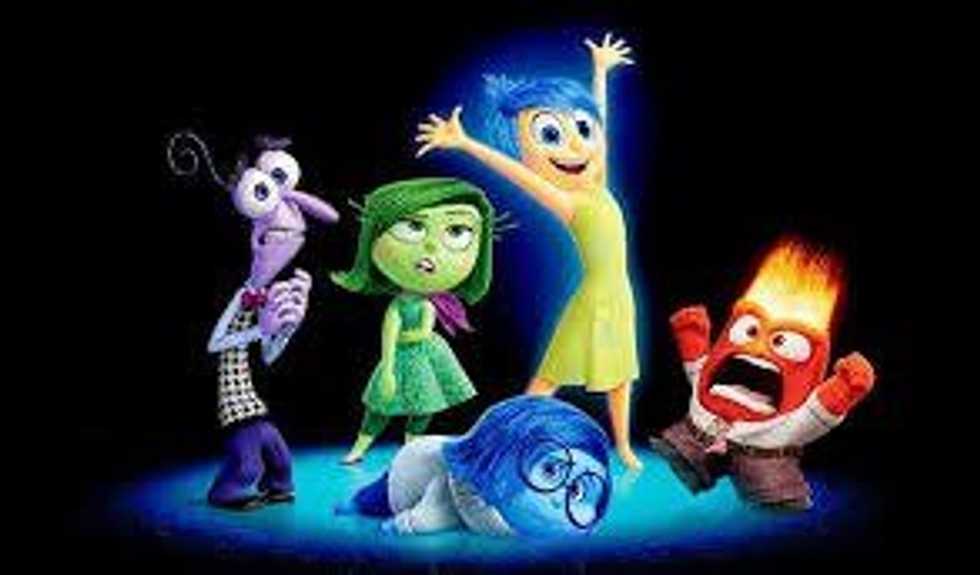
Fear. Sadness. Joy. Disgust. Anger.
According to the beloved movie studio, Pixar, these 5 emotions control all of us, as seen in this summer's hit, "Inside Out." We start off the movie at Riley, the protagonist's, birth and we get to see inside her head, where we meet Joy (Amy Poehler), her dominant emotion. Immediately after Joy's introduction, Sadness appears and tries to take control, as Joy resists. This conflict between joy and sadness bewilders people everywhere, and keeps psychologists in business. This conflict leads Pixar to ask the world the question: what is the point of negative emotions?
While analyzing this brilliant movie, I will discuss important parts of the plot, so SPOILERS AHEAD.
After a beautiful growing-up montage, cut to Riley at age 11, when all is going well in beautiful Minnesota. By this point in her life, which Joy has mostly controlled, all of her important memories are happy ones, as she has mostly had positive experiences. Completely misunderstanding how movie logic works, Joy asks "What's the worst that could happen?," at which point, the emotions react negatively as Riley moves to San Francisco, and we see Sadness taint the happy memories from Minnesota, causing Joy and Sadness to fight over the memories before accidentally sending themselves to long-term memory, away from where they can control Riley.
With Joy and Sadness gone, it is up to Disgust, Fear, and Anger to control Riley. When people do not know how to be sad, because they have tried too hard to be happy all the time, they cannot control their joy and sadness well, leaving other emotions to dominate their personality. Here, Riley's emotional well-being falls apart as the other emotions give Riley the idea to run away from home, going against many of her values, as shown when various islands in her mind crumble. On their journey back to control, which can be interpreted as the journey to emotional maturity, Joy and Sadness end their conflict after encountering Bing Bong, Riley's imaginary friend from many years ago, whose heroic sacrifice has caused millions of tears nationwide. Bing Bong discusses how he feels forgotten, and Joy has nothing to say to help. Meanwhile, Sadness, who gets her first recognition as useful or helpful in the whole movie, is empathetic and consoles him. At this critical moment, Joy, who had previously cast Sadness aside as useless, recognizes the purpose of Sadness: to be able to heal, and to help others heal. Indeed, Joy realizes this further as she sees the hockey memory, where Riley was sad, but others noticed and made her feel better. Further proving this point, the movie shows us inside Riley's mother's head, whose main emotion is sadness, and yet she is not extremely depressed. Instead, she is balanced, as all 5 emotions are together at a large desk.
Riley's parents are very emotionally balanced, as this comes with maturity, and this appears through all the emotions working together at a large desk. Sadness is at the center in Riley's mother's head, and she is the most empathetic and supportive character in the movie, not depressive. At the center inside Riley's father's head sits Anger, yet the father is not an extreme hothead, as his anger manifests itself more as strength or assertion. All of the emotions certainly have a purpose, and there is no such thing as a purely negative emotion. They all have their place.
Why then, do so many of us feel that we have to be happy all the time?
Because our society tells us to. We tell each other to feel better and, as the mother says, to be "our brave happy girl" whom the world needs in order to feel better. This implies that everyone always wants to feel joy. The philosopher Aristotle talks about how all humans strive for a happy life (Nicomachean Ethics, Book 1), and this raises an interesting question: why is Joy named Joy, and not Happiness?
Joy is called Joy, because joy is an emotion, and happiness is a state of being that requires full and balanced development of all our emotions. All our emotions contribute to our long-term happiness. Seeming joyful all the time keeps us from being truly happy. We need Disgust to keep us from sickness and social faux pas, as well as to keep us fashionable. We need Fear so we can stay safe, and we need Anger so we can be strong and assertive when we need to. And most of all, we need Sadness so we can heal ourselves and others, and by consoling and being there for others who then do the same for us, we achieve true happiness.
Sometimes we need to be sad to be happy.
















