
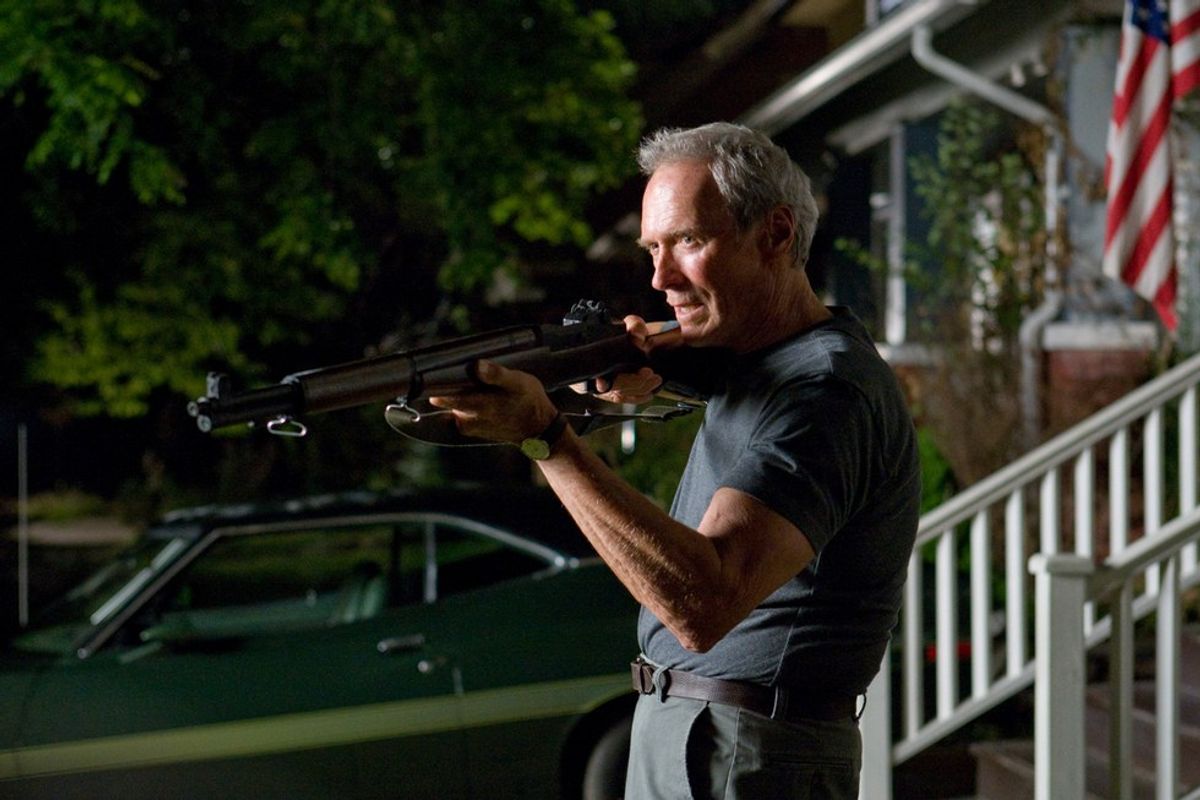
Clint Eastwood is a living legend in the film industry. As an actor and director, he has excelled for over 50 years, winning four Academy Awards, two for direction, and two for best picture. As director and star of "Gran Torino," Eastwood added another impressive film to his incredible resume.
The film opens in a crowded church, organ playing, with a casket in the center of the chapel. The audience then meets Eastwood’s character, Walt Kowalski, standing by his deceased-wife’s side, as we infer he always has, and silently judging everyone in the room. We watch Kowalski’s grandchildren come in, one half-dressed, the other kneeling down and saying “spectacles, testicles, wallet, and watch.” Walt grunts. The screen then shows his two sons, who have obviously been competing for their father’s compassion for a long time, as they define Walt’s character, remarking “there is nothing anyone can do that won’t disappoint the old man.”
It’s true. Walt’s world doesn’t coincide with the real world anymore. His has been gone for a long time, and now he spends most of his time sitting on the front porch judging people and wondering why things can’t go back to the way they used to be. Walt is always watching, either when he’s on the porch, making house repairs, or working on his most valued possession, a 1972 Ford Gran Torino he helped build on an assembly line. He sees a group of Hmong gangstas terrorize his timid neighbor, Thao (Bee Vang), and attempt to make him a part of their posse. They threaten him into stealing the Torino, but Walt and his Korean War rifle catch him red-handed. Soon after, Thao’s sister Sue (Ashney Her) walks over to apologize for Thao’s actions and emphasize the shame he has brought to their family. She then offers Thao’s services to make up for his wrongdoing. Walt reluctantly accepts. It is at that moment that the exposition ends, and the story begins.
Walt calls the Asian family “gooks” and many other offensive names during the film’s earlier parts, but his life becomes increasingly affected by them. He and Thao form a strong partnership and a sentimental friendship neither one could have predicted, and he grows feelings of protection and possession for Sue and Thao. When he sees Sue being bullied by a group of black men, he pulls up on the curb, gets out of his truck, and gets involved. He can’t help it. Though he is the most threatening character in the film, with his extensive arsenal and racist vocabulary, Walt is also one of the most caring.
Eastwood is the only actor who could pull this part off successfully. Walt is not a kind person; neither is Eastwood’s portrayal. He isn’t afraid to tell it how he sees it, and he never apologizes for his beliefs or any of the many racial slurs he throws out there, even after he befriends Thao’s family. And yet, the audience becomes attached to him, a man whom, if he weren’t the principle character in a movie, they would pay no attention to. Why? Because it’s Clint Eastwood.
Gran Torino is a magnificent accomplishment on all floors. The actor and director succeeds once again. Eastwood surely made something special.
















