


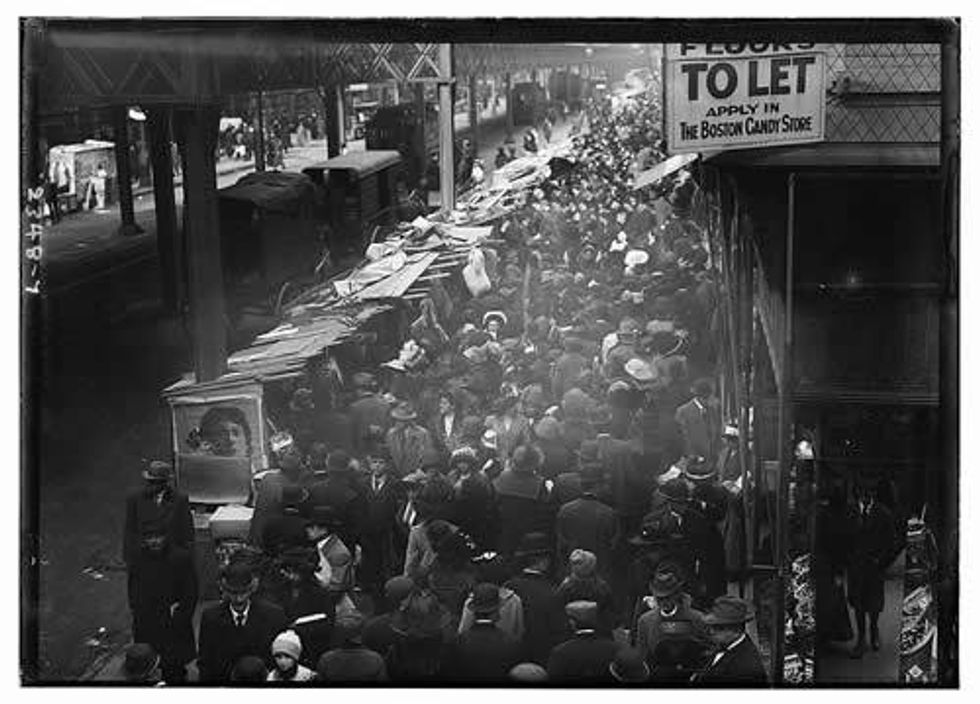
"The apparition of these faces in the crowd;
Petals on a wet, black bough."
Poets are often hailed as human beings with a certain privilege of realizing profound truths about human nature and relaying those truths to the average person. Ezra Pound does so magnificently in “In a Station of the Metro.” This poem is a paragon of the Imagist movement that grasped the literary world in the early 20th century. Pound’s utilization of “more is less” is incomparable as he is able to leave the reader with more vivid images in two lines than most poets are able to provide in twenty lines.
One cannot help but imagine Ezra Pound people watching from a lofty staircase in a French subway station while he wrote this poem. Similar to the work of an artist, Pound painted a vivid picture of what he saw, not with brushes and hues, but with words and punctuations–word art. With the word “apparition,” Pound immediately brings to mind the transience of ghosts in comparison to the concrete world. He then paints the proverbial picture of indistinguishable faces in a crowd. In the next line, these two images are contrasted with leaves sticking to a branch blackened because of the recent rainfall. What does it all mean, though?
The image of an apparition and the comparison of “faces in the crowd” to that apparition shows just how fleeting we are as human beings. Our lives are but insignificant seconds in the grand scheme of the universe’s existence–transient flowers that pass away in a season’s time. Pound then compares us to lifeless leaves hanging onto a branch for some source of stability. At the same time, his use of the word “petal” leaves the reader with a sort of recognition of the beauty of human life. Even the image of wet leaves stuck to a branch and its comparison to human life hints at the natural beauty and the simple marvelousness of the latter. On a more personal note, this poem leaves me wondering, “How can I make my mark on the world and leave it a better place than it was when I arrived within the time that I am allotted?” At the same time, I have realized that in our pursuits of self-fulfillment, many of us forget our youthful pursuits of happiness that make life worth living. These pursuits of happiness are what provide us with the idiosyncrasies that provide each of us with the individuality that sets us apart from the crowd.
Ezra Pound's fourteen-word poem illustrates the economy of language that Imagists so greatly valued. Personally, it creates in me a sense of wonder. Pound’s ability to create such vivid images and relate such profound truths with so few words is the mark of a true poet and a true artist.















