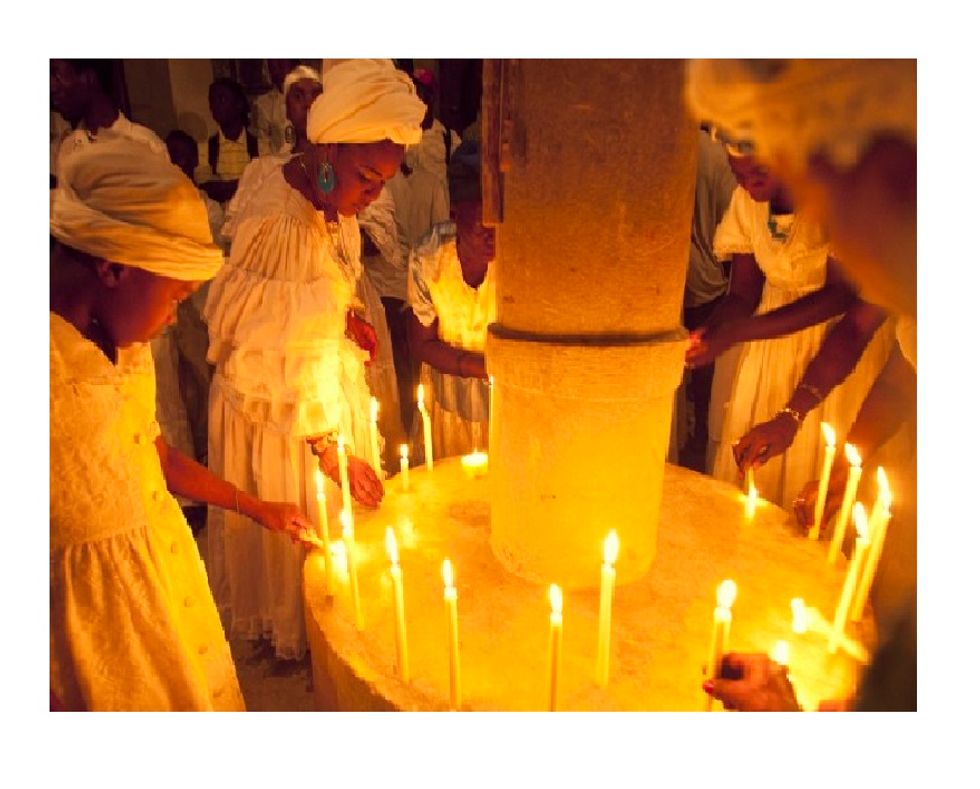
Vodou, or “voodoo”, as it is referred to in western culture, is a pagan religion based in African culture, which made its way to the Caribbean and US through slave trade. Not to be confused with Santeria, though both began in the Northern part of the African continent, in countries such as Benin and Nigeria, the “Orishas” or, Yoruba gods, were eventually given French Catholic identities, in contrast to Santeria gods, which were given Spanish Catholic identities. The true origin of Vodou is Ouida, a mountain range of Benin, the capital of Africa’s slave coast, where slaves were transferred mainly to the Caribbean, Brazil and US mainland. Benin is believed to be the birth place of formal vodou practices. These included blood sacrifices, singing, dancing and time frames of isolation and purification through strict diet. It was believed that in these periods, individuals would suffer a “ritualistic death” to then be reborn as “Vodunsi”. Like many of Africa’s religions, this religion is animistic, meaning that everything on this Earth has a spirit, including the rocks, the plants and the water. But, the spirits of our ancestors are the most important of all, because they protect their families as they walk the Earth (Krutak, 2008).
As slave trade grew in times of colonization, so did the increase of Vodou practices. In fact, African slaves turned to their ancestors’ spirits and Yoruban gods in times of peril. They asked for protection, guidance and strength, especially when the time to revolt finally came. A mass Haitian Vodou ceremony, famously named “The Ceremony of Bois Caiman” was held by slaves of multiple plantations before they revolted against their owners to gain their freedom and independence from the European government. Members of the Catholic church demonized Vodou practices and associated them with the devil, to create a negative stigma surrounding the religion. The reason Vodou god figures were altered to fit Catholicism, was to hide the pagan religion and protect its cultural and spiritual significance, because slave owners felt threatened by the foreign practice (Polyne & McAlister, 2017).
This stigma arose once more as Haitians fled their island home in diaspora, escaping economic crisis. As they reached the US mainland, in great numbers, toward Louisiana, misrepresentation of the Haitian adaptation of Vodou continued to be demonized, especially through the Hollywood film industry. One such example is that of the movie “The Serpent and The Rainbow”, where a white man goes to Haiti and faces his darkest fears, witnessing sacrifices and zombification, powered by a drug created by a Vodou shaman. Although the movie is based off of a real journey a man took to Haiti and his experiences with Vodou, the movie is only loosely based on the encounters, as Hollywood films often are. Still, it was enough to cause mass fear, stigma and discrimination against Haitian immigrants, as they made their way to the US mainland (Polyne & McAlister, 2017).
New Orleans actively celebrates voodoo and its Haitian and African history now, although it still holds a stigma in many parts. Festivities are held yearly, in honor of the religion and Marie Laveau, the New Orleans voodoo queen, depicted in American Horror Story’s third season “Coven”. It is said that she bridged the gap between black and white individuals in the region, as a hair dresser, who would help her clients with supernatural powers. New Orleans has a number of hotels, museums, restaurants and festivals, dedicated to the influences voodoo has brought to the South. Although many rumors regarding Marie Laveau and Voodoo in general exist, involving snakes, sacrifices and zombies, people travel from all over the country to get a taste of African vodou and its controversial history (New Orleans Official Guide, 2017).
References:
Krutak, L. (2008). Scarification and tattooing in Benin: The Bettamarribe tribe of the Atakora mountains. Retrieved from http://www.larskrutak.com/scarification-and-tattooing-in-benin-the-betamarribe-tribe-of-the-atakora-mountains/
New Orleans Official Guide. (2017). New Orleans Voodoo’s African Origins. Retrieved from http://www.neworleansonline.com/neworleans/multicu...
Polyne, M., & McAlister, E. (2017, March 17). Haiti and the distortion of its vodou religion. Retrieved from http://www.cnn.com/2017/03/17/opinions/believer-ha...