Free College: Words students have deemed essential, liberals are calling the phrase revolutionary and tax payers cringe at.
The phrase is a catchy one; it’s earned multiple headlines and has probably been plastered on every Newsfeed available but how free is free? As someone who doesn’t deeply follow politics, Andrew Cuomo’s enactment of the Free Tuition Program seemed a bit farfetched. Considering nothing in government is truly free, I felt that the strings attached would be a bit tougher than what appeared on the surface.
First off, the most commonly voiced issue is the cost of the bill. The cost of the first year alone would average New York State about 163 million dollars, the source of which claims it’ll be money funded into higher education. This is based on a scale considering the free tuition is only currently allowed to students under a 100k family income in the fall, in the following years, the eligibility will increase to $125,000 by 2019. As the eligibility increases, so will the budget needed to fund it by the state government. SUNY and CUNY schools are also not responsible for issuing any cuts to students within the first four years of this process; leading New Yorker’s to go to those two dreaded words: higher taxes. Nothing I could find necessarily specified what the amount would be which is rather unnerving to a tax payer.
Though realistically, the amount that may be “freely” given may be drastically lower than estimated. New York is nowhere near cheap to live in; even those considered wealthy by a national standard may be broke by a regional standard like Long Island or the city. One of the strings attached to the payment is completing school on time within the four or the two years allocated or it will turn into a government loan. As an honors graduate of a fantastically shitty community college, I personally would have had my free tuition turned into a loan. Even as an undergraduate at SUNY Binghamton, the likelihood of being a super senior is relatively high. This particular string has caused a bit of a stir, with fellow Facebook buds referring to it as a bear trap. Personally, I think it is understandable, even if it wouldn’t have benefited me had I been eligible. Free tuition is seen as a right by some or at least one of the foundations of a first world country. But considering the vast difference in size between countries like Germany who offer free university, I personally find a slower, safer pace in enacting it far more reasonable for America. Limitations like this aren’t as offensive to me as they may be to others.
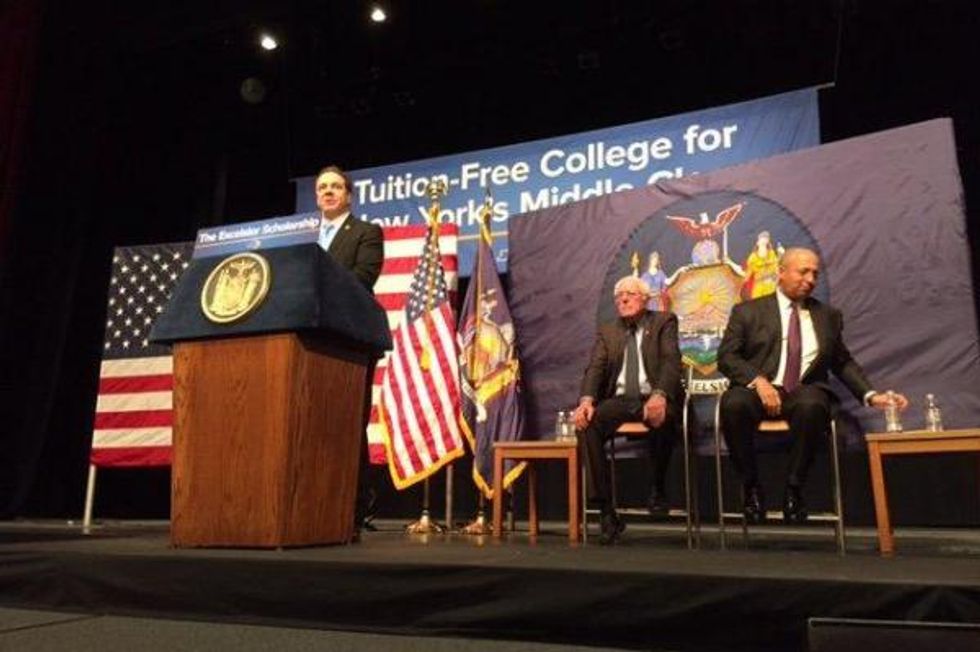
The most controversial aspect of Cuomo’s bill is the consequences of free tuition. From my personal experience, a majority of young New Yorkers have the similar sentiment of wanting to get out of New York. The cost of living surpasses the majority of the country with no real benefit unless you’re blessed with one of the few remaining careers available. Despite even that, the pay usually is not enough to cover the desirable locations like Long Island or the city. And prior to this, education of some sorts is required by employers to even begin the application process so naturally, many people move out of state or go to upcoming, more affordable cities like Austin, Salt Lake City or the easiest, Pennsylvania. If one takes advantage of the free education program, they’re locking themselves into staying in New York for two to four years depending on what degree they pursue. Should someone choose to leave New York or transfer elsewhere to pursue graduate work, their tuition would turn into a loan immediately. This addition was added rather last minute by weary Republicans and Cuomo has voiced his support of it. The rush to add it is pretty easily spotted. The enforcement of it is unspecified, perhaps it’ll just add students to a parole officer’s check list. Has the cost even factored in keeping track of students post-graduation? Regardless, students would most likely be looking at four years of not utilizing their degree or bunking with their parents till their mid-twenties.
The idea of keeping students within New York seems like a good idea on paper considering it keeps the intelligence within the local economies but it simple doesn’t hold up realistically. The lack of availability for careers, housing and any kind of growth is the reason that businesses leave New York rather than stay. Students will also still be on the hook for extra fees like board and textbooks. Thought you might be free from loans? Unless you’ve got $12,590 for board and an extra $1,000 for pocket change, you’ll still be attached by the wallet at a SUNY school.
Overall, the intention behind the bill seems like a good one but realistically doesn’t seem very well thought out. It seems more like a romanticized loan with consequences that offer little specifics to clarify how it’ll play out. In a sense, this isn’t necessarily a bad thing but considering the bill is being deemed as revolutionary, the advertisement is leaning more on the side of falsehood. If anything, I think the term ‘free’ seems like an exaggeration and the government will see more students as debtors rather than contributors.