

Free college - if you haven't been living under a rock for the last year, chances are you've heard the idea being thrown around, so now seems like as good a time as ever to take a closer look at the issue. Just what could we expect to happen if the government were to completely fund all four-year institutions of higher learning?
Since regularly taking money from another entity creates dependence, making four-year colleges government-funded will eventually land them in the same place as public secondary schools in terms of government control. Therefore, it seems appropriate that we consider the government’s track record with education.
Firstly, without even diving into numbers, the very fact that we are asking for free higher education makes it quite apparent that the government is doing an inadequate job of educating the masses. Hidden behind our pleas is the complaint that the thirteen year period of government schooling that most of us have received has not prepared its recipients to take their place in the world. What we're essentially telling those in power is this: “You've had thirteen whole years to prepare us for the world and you've failed. Now give us four more years of education and everything will be better.” The plea for entirely government-funded higher education strikes at its own foundation.
Let’s move on and have a quick look at government education spending by the numbers.
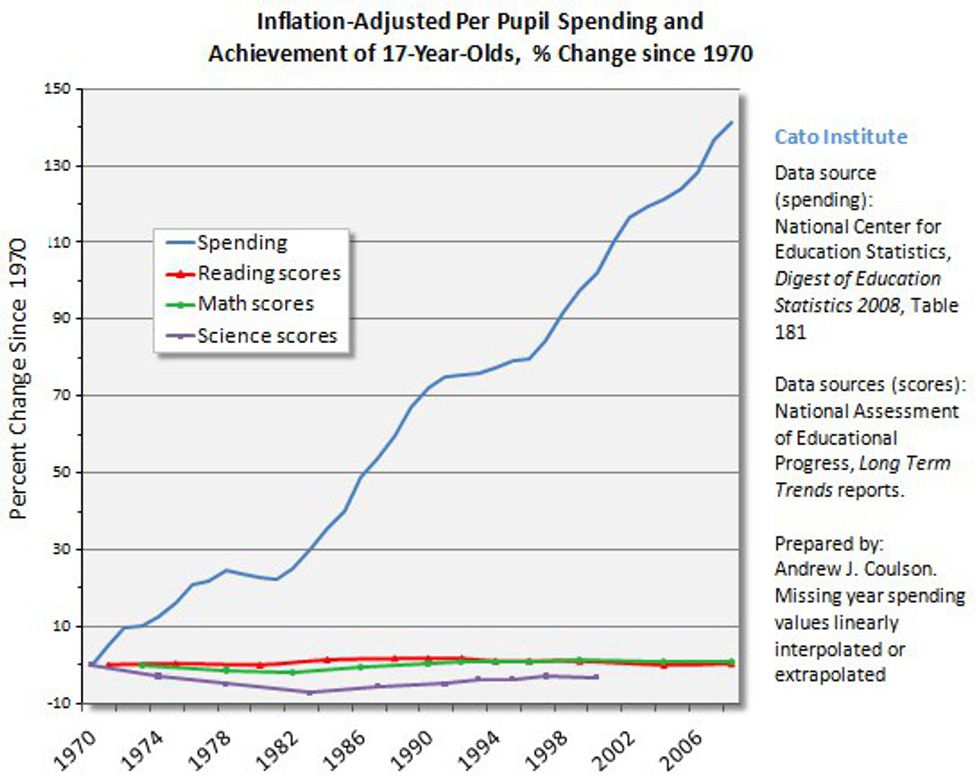
Have a look at the above graph. As government spending skyrockets to two-and-a-half times what it was in 1970, test scores remain the same. You must be careful not to misinterpret this observation - this isn’t necessarily because the money isn’t being used on anything, nor is it because the things it’s being spent on are completely ineffectual - it’s hard for even the government to waste that much money. Instead, the situation is as follows: government resources being poured into schools aren't being added to the private resources people already spent on schooling, they’re replacing the private resources that were formerly spent thereon. While there used to be an abundance of private schools, the government has opened more and more public schools and hired more and more public school teachers. As a result, there are fewer privately schooled students as a percentage of all students than there ever have been in the history of the United States, and that percentage is projected to decline even further.
Now, the additional public schoolteachers that are continually being hired are beholden to the government and therefore obliged to consent to its expansion, so increasing their numbers provides a base of dependents while also, through them, influencing children’s attitudes. Once schools are completely dependent on government funds, the government has total control over them, and, by extension, the majority of the next generation.
These days, governments in several states are even giving out publicly funded tuition vouchers to parents who wish to enroll their children in private schools. This obvious power grab means even private schools aren’t safe - if the government doesn’t like what private schools are teaching, it can refuse vouchers to parents and the private school will lose revenue. In short, the government doesn’t have to directly fund something to take control of it, and we may very well see a similar situation with colleges.
Regardless of your opinion of the scope of the government's power, it’s pretty clear that the government has a tendency to spend a ton of money to get no better results. That 140 percent increase we saw in government spending didn't correspond to a 140 percent increase in public school enrollment. Rather, public school enrollment increased by a mere 6.5 percent over the same period. Now, if the government is so grossly careless and inefficient with people’s money, why do people continue to support increases in government spending? I believe that the central reason is that the public is uninformed. We’ve already established that the government spends 13 years teaching the overwhelming majority of the population, so it's no surprise that people haven't been shown the statistics and aren't encouraged to look into these things themselves.
I've surely glossed over tons of points here - entire books could be (and have been) written on the subject and it's impossible for me to enumerate and substantiate all of their arguments here. If you’re looking for more statistics (always and forever the best way to find things out), I recommend checking out the National Center for Education Statistics’ “120 Years of American Education: A Statistical Portrait.”
Finally, on an unrelated note, I’d recommend checking out some articles from my colleagues - they do great work. I’ve linked some of last week’s articles below - give them a read!
Money Tips Every Broke College Student Should Know
What Makes America the Greatest Country in the World?