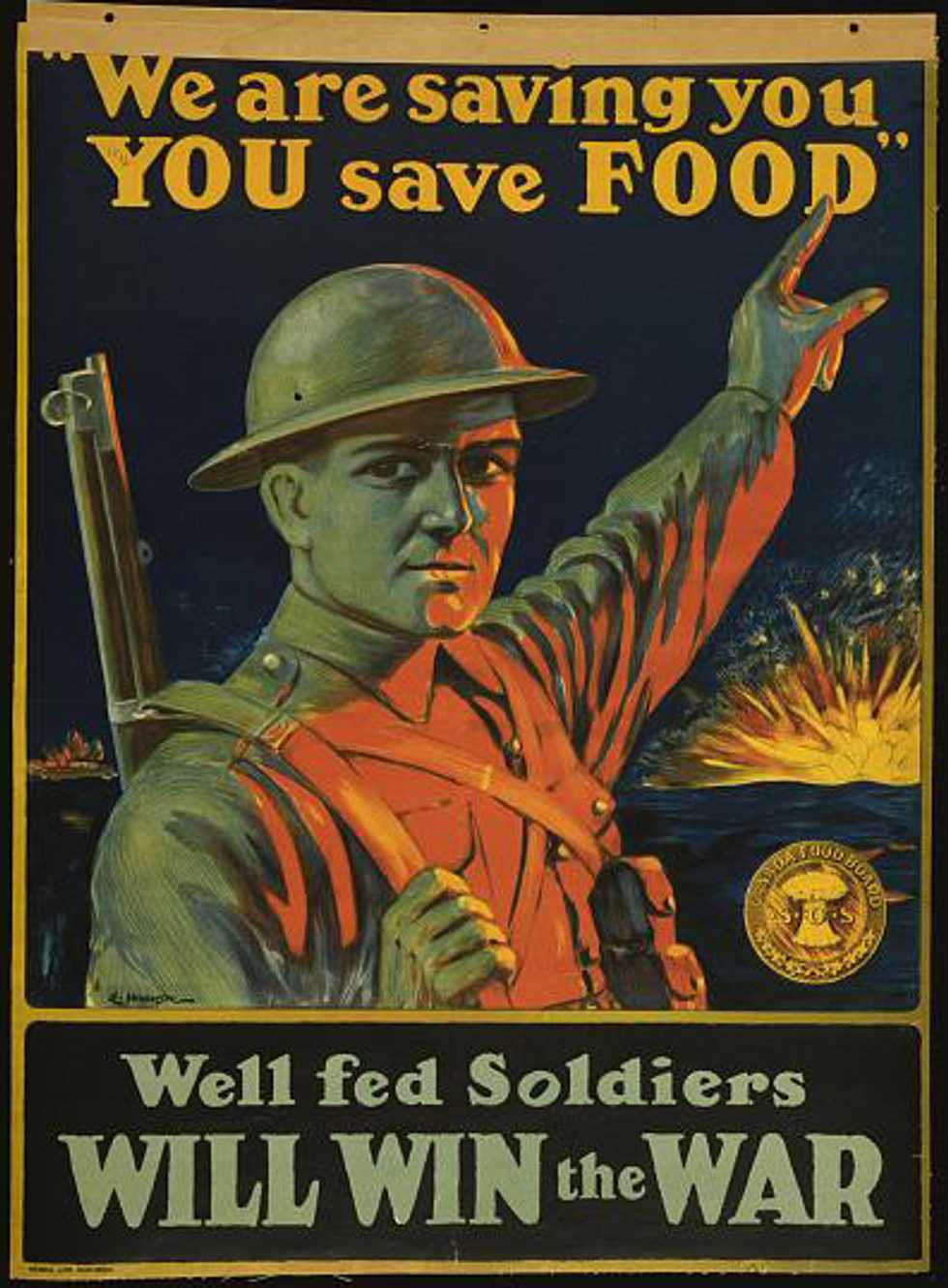
During both the first and second World Wars an economic stress was placed on countries because men were leaving their jobs to serve in their respected militaries.One specific case of economic hardship was in regards to food and cultivation.All over the world, farms were being turned into battlefields, trade routes were being destroyed and thus the exportation and importation of goods decreased. Both the United States and British governments created a plan, through rationing, to encourage their populations to support the war by rationing their food.Through political posters, these governments were able to persuade its citizens that rationing was the patriotic thing to do.Ethos, Logos, and Pathos, the three categories of rhetoric, which the Greek philosophers Plato and Aristotle studied, can be defended in their effect through the political food ration posters of the World Wars.
During the beginning of World War One, in many countries in Europe, not only were men leaving their jobs as farmers to fight, but also their farms were being turned into battlegrounds.As written in the article Food Will Win The War , as reviewed by Erika Janik, in addition to being turned into battlefields, many trade routes were disrupted.Britain had previously been receiving imports from Australia, Romania, Argentina, and Germany and limitations were placed on the importation of these goods, thus putting a strain on resources in countries depending on Europe, like North and South America (Janik, 19). And vice versa, the Mid-West region of the United States provided resources for Europe like wheat. A ration system was created during World War 1 in both the United Sates and in Britain.By 1919, before rationing had become a law, Magnus Swenson, the State Council Defense Chairman for Wisconsin, was encouraging his state’s residents to be more conservative with their food consumption.Mr. Swenson promoted “meatless” and“wheatless” days and throughout the city of Madison, the state’s capitol, posters could be found stating,
“Old King Corn is American Born;A mighty fine food is He.He makes good Bread or cakes instead;So we don’t need wheat, you see?” (Janik, 17)
The state of Wisconsin was a forerunner in food conservation during WWI.Woodrow Wilson, who was placed as the head of the newly established U.S. Food Administration in 1919, implemented many of Magnus Swenson’s ideas.It is known that Mr. Swenson was also the first person to propose the idea that women and food [the kitchen] were the “first line of defense.” (Janik, 19).The United States and British governments were promoting a rhetoric of patriotism through the actions of food consciousness. Milk, eggs, wheat and meat are some examples of the common foodstuffs that were put on ration at this time.The practice of food rationing was promoted through home vegetable gardens, canning and preserving, and finding alternative recipes, all of which were encouraged by both governments.
Propaganda is a political form of rhetoric.The posters that were first seen during WWI appeared again in the Second World War. The rhetoric implied in these posters was strategically planned, there was a clear, set approach which the government used to support their campaign.The types of posters this campaign, which was created by the United States government, can be split into four categories; patriotic, sentimental, humor, and realistic ( Mahaney). These posters were successful during both wars because they relied heavily on using the emotions of the consumer to persuade their point.Archibald MacLeish was the Director of the Office of Facts and Figures during the Second World War and he is quoted saying, “ The principal battleground of this war is not the South Pacific. It is not the Middle East.It is not England, nor Norway, nor the steps of Russia.It is the American opinion,” ( Mahaney, 1).
“Can all you can.Food thrift – your patriotic gift.”
A picture of a mother, father, and small child, carrying a rake, wheel barrow, and hoe with the quote above them, “Plant for victory.”
Another poster pictures a woman carrying an arms worth of preserved vegetables in mason jars, “Of course I can! I’m patriotic as can be- ration points won’t worry me!”
“Save the wheat and help the fleet!Eat less bread!”
“Food is a weapon, don’t waste it! Buy wisely, cook carefully, eat it all!”
“Dig for victory, grow your own vegetables.”
While the concept of growing your own food and preserving it is not only economical but healthy, along with this concept the opposite began to occur in the food world.Certain foods were either created through a combination of natural and artificial ingredientsor the presence of certain foods was increased during the Second World War.The Hormel Company introduced Spam in 1937.It is a by-product that was the result of the company having too much of a certain cut of meat.The war helped to reinforce the status of Spam as a patriotic food because it was a canned and preserved food.Molasses also had an increased presence in the 1940’s.Molasses was encouraged by the United States government to be used in recipes as a replacement for sugar.The United States government published special wartime cookbooks, like“The War Time Kitchen: Ration Book Cooking”.This cookbook promoted the use of alternative foods and was available for free to the public.The casserole, a one-pot dish, gained popularity during this time as well.
In his studies, Aristotle created three artistic proofs of rhetoric; they are Logos, Pathos, and Ethos.Logos stands for arguments and reasoning, pathos is the cause of emotions and ethos is the human character.Logos, as Aristotle saw it, stood for the logic of speech.He believed that an audience logically understands an issue in a certain way.The logo that was used in these particular political posters was the idea of frugality.The idea of conservation during war was not a foreign concept for Americans.The government managed to promote another slogan in their propaganda, which was that conservation would result in “victory”.
Aristotle argued that logos was not so much the actual logic of an argument as much the logic one uses to come to a decision.“Logos was the study of the arguments employed in practical decision making.” (Herrick, 79). Pathos, wrote Aristotle, is ‘“putting the audience in the right frame of mind’ in order to make good decisions.” (Herrick, 79).The psychology of a person’s emotions is their pathos.In times of war, these emotions are heightened for people.These political posters were successful because they focused on four types of approaches, which fed into the consumer’s natural ethos, logos, and pathos.The posters were patriotic, sentimental, humorous, or extremely blunt.The fear resonated within the consumer as a natural part of the emotional reasoning process according to Aristotle, and many of these political posters instilled the fear that without proper action and proper patriotism, the wrong side could win the war.Aristotle has broken fear into three parts.First is the fear of death or harm, second the fear of loss and third is the fear of deprivation of rights or freedoms (Herrick, 80). The later fear was the main fear the government could rely on during time of war.The word “victory” is constantly used on these political food ration posters.Victory is the act of defeating an opponent.While some would argue that emotions are irrational, Aristotle believed that in order to appeal to the emotional side of an argument, certain circumstances must presented in a worse case scenario result, in order for the audience to make a rational decision based on those circumstances.
The government holds a special type of ethos, especially during times of war.Ethos is a person’s credibility and to go against your government would ultimately be seen as UN patriotic.The government was using these posters as a way to tell the consumers that they had the power to win the war. They even appealed to children;
“Little Americans do your bit.Eat oatmeal- cornmeal mush – Hominy – other corn cereals and rice with milk.Save the wheat for the soldiers.Leave nothing on your plate.”
The United Sates Food Administration signed this poster.Ethos is seen as the sociology of good character (Herrick, 80). Americans trusted the United States government.The poster to the “little Americans” could have just stated, “eat your corn instead of wheat” but they added the part of saving it for the soldiers.It points out the ethos of both the “little American” and the USFA.By conserving wheat, they both care about the United States soldiers.
Of the three rhetorical settings that Aristotle refers to; deliberative, epideictic, and forensic, these posters would fall into the epideictic category.While each of Aristotle’s settings is oral, these political posters are placed in public spaces for public consumption.Epideictic speeches are often appeased to praise or blame.Aristotle believed that a talented Epideictic orator was not so much one who was good at engaging and entertaining an audience as one who was successful at “reinforcing public values,” (Herrick, 77).Examples of the reinforcement of these values could come from praising and honoring others.These posters praise those who participate in the patriotic act of food rationing.Epideictic oratory is meant to uphold the person who is most virtuous.Through the political posters, the virtue of supporting our troops is upheld.
The United States government, through the office of the US Food Administration published political posters during World War II.These posters were used to promote American ideals of patriotism through he food ration movement.Through thematic posters of patriotism, sentimentality, humor, and bluntness, these posters were successful in reinforcing the rhetoric of patriotism by being food conscious.
Works Cited
“Food Is A Weapon, Don’t Waste It!” National Archives and Records Administration (1943) : Web. 10/29/2015
Janik, Erika. “Food will win the war: Food Conservation in World War 1 Wisconsin.”The Wisconsin Magazine of History. (2010) : Web. 10/29/2015
Tscharbrun, Susan “Off the Wall and into a Drawer: Managing a Research Collection of Political Posters.” The American Archivist (2003): Web. 10/29/2015
United States Bureau of Home Economics. “A Cool Airy Place to Suit Hardy Vegetables and Fruit”. World War Two Poster Collection of Northwestern University Library (1942): Web. 10/29/2015
Witowski, Terrance. “World War II Poster Campaigns: Preaching Frugality to American Consumers.” Journal of Advertising (2003): Web. 10/29/2015
Yanker, Gary. “The Political Poster: A World Wide Phenomenon.” World Affairs Institute. Vol 133. (1970): Web. 10/29/2015