


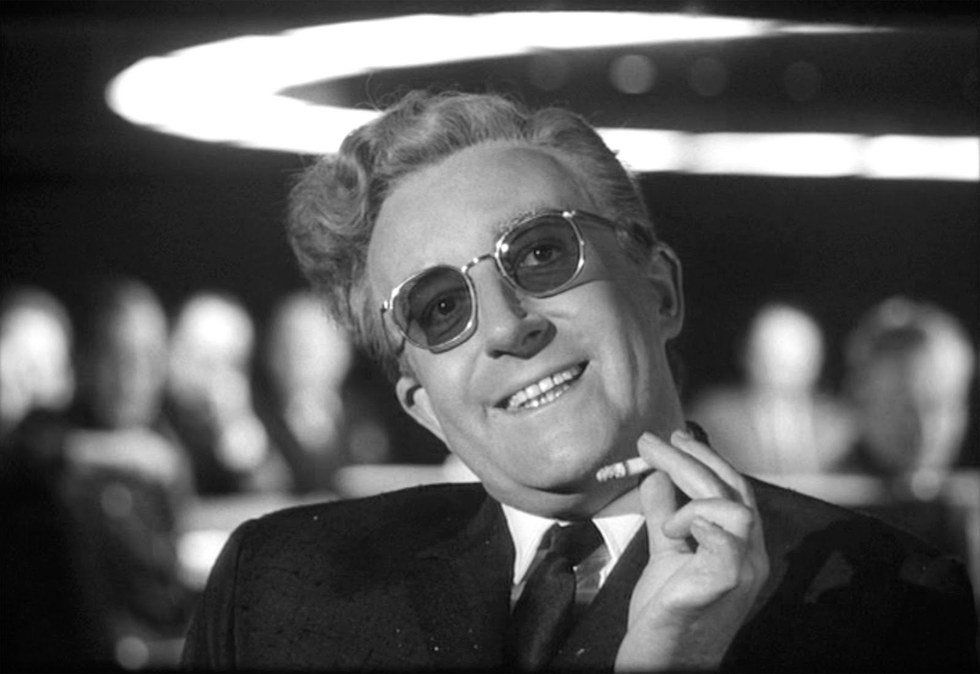
“Precious bodily fluids” is not a common phrase heard from classic filmography. But legendary director (and satirist) Stanley Kubrick deftly delivers a snarky black comedy with this gimmick front and center. Dr. Strangelove or: How I Learned to Stop Worrying and Love the Bomb is perhaps the most audacious (and most hilarious) political satire to ever hit the screens. It was based loosely off of the book Red Alert by Peter George, but takes the critique of nuclear warfare to a new level by using dark satire.
Kubrick is highly innovative with his use of minimalistic sets. Although the sets are simple, they are highly effective and convey the irony of the film. The War Room is especially striking, using the “Big Board”–as General Turgidson would call it–for a dramatic backdrop. For special effects, model planes are used to portray the bomber flying over Russia. The resulting shot is decent, but somewhat clunky. Because the film is black and white, cinematographer Gilbert Taylor uses intense low-key lighting and low angle head shots to create a dangerous, tense atmosphere. Even the music in Dr. Strangelove seems to mock the characters’ self-importance, especially the triumphant battle tune we hear in the bomber.
One cannot intelligently discuss Dr. Strangelove without mentioning the massive performances of Peter Sellers, who played three characters; Captain Mandrake (arguably the only character with any sense), President Muffley and Dr. Strangelove himself. These characters are so diverse in personality, motive and even accent, yet Sellers portrays them all wonderfully. Also notable is George C. Scott who plays the overzealous General Buck Turgidson. Scott’s physical performance is hilarious, yet manages not to overshadow the plot progression or dialogue. Speaking of dialogue, Strangelove features a razor sharp screenplay that is chock full of irony and bite. The characters take themselves far too seriously to realize the bitter comedy that they themselves are creating, and their ignorance is what makes this film so hilarious.
The main themes of Dr. Strangelove are the futility of nuclear deterrence, paranoia and the security dilemma. From the very beginning of the film, it is apparent that Kubrick has little tolerance for the irrationalities of many aspects of The Cold War. The obliviousness and stupidity of the characters highlights the pointlessness of a war in which both sides are willing to ignore a perilous reality in order to get ahead. This movie also touches on paranoia, a prevalent reality for 1950s America. General Jack Ripper’s obsession with communist floridization was actually a concern for many political activists during the Red Scare. General Turgidson also displays paranoia regarding infiltration of military secrets by the Russian ambassador. Kubrick seems to be parodying this nervousness, showing how often this paranoia can lead to rash and even insane conclusions.
Of all Kubrick’s films, Dr. Strangelove is arguably one of his most lighthearted, despite its dire subject matter. Kubrick, known for his perfectionism, seems to be having fun in the midst of the serious political subject matter. Dr. Strangelove is an innovative and culturally significant film, not only from a technical standpoint, but also because of its bold statement about The Cold War.

















