


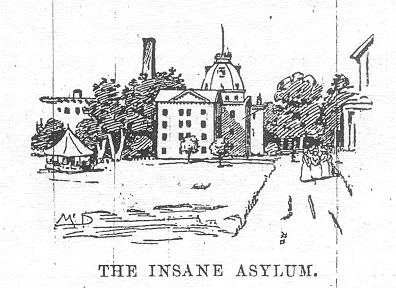
In 1887, journalist Nellie Bly feigned "insanity" and had herself committed to Blackwell’s Island Insane Asylum to expose the miserable and subhuman conditions of such an institution. When released, she published a book entitled "Ten Days in a Mad-House," and altered the standards for psychiatric institutions forever.
In 2013, I was admitted to a psychiatric hospital for the first time, for five days. I wrote furiously in my journal during my entire stay, noting the conditions of the hospital and my treatment there. When released, I tried to talk about what a miserable experience it had been. I tried to tell my care providers about the admissions psychiatrist who insisted that my depression must have been induced by some sort of problem with a boy, and the resident psychiatrist who, during my five days, spoke to me for a grand total of 45 seconds, but still saw it fit to play with my medication as though he knew exactly what I was experiencing based on our interaction. I tried to tell them about the nurses who didn’t know the names of any patients, and the psychiatric technicians who insisted that we were all there because of “attention seeking behaviors,” which were apparently to be avoided at all costs.
I tried to tell them how I—a frightened 16-year-old—wasn’t allowed to call my parents. I tried to tell them about the maintenance man who stared down patients with an unmistakably predatory, lewd grin. I tried to tell them that there was toothpaste on the walls that nobody ever cleaned up.
Though my friends believed every word I said when I was released from the hospital, my therapists and psychiatrist were skeptical. It was assumed that I was exaggerating and being too sensitive. This is undoubtedly because I am a crazy girl, and therefore cannot be trusted.
I, unlike Nellie Bly, cannot take off my metaphorical mask and reveal myself to be sane. I cannot reclaim my right to be taken seriously, because I never had that right to begin with. “Crazy people” do not have that right. This is why, despite the plethora of wonderful mental health professionals, there is also a slew of incompetent psychiatrists and invalidating therapists. This is why so many psychiatric hospitals are miserable experiences. Nobody listens when patients complain.
The voices of the mentally ill need to be heard. Our complaints and experiences are valid. Doctors, nurses, psychiatric technicians and therapists need to be trained to listen to the mentally ill, and to take us seriously, because the fact that nobody listens to us is exactly why so many of us fear or loathe psychiatric treatment.
The time has come for our voices to be heard.
















