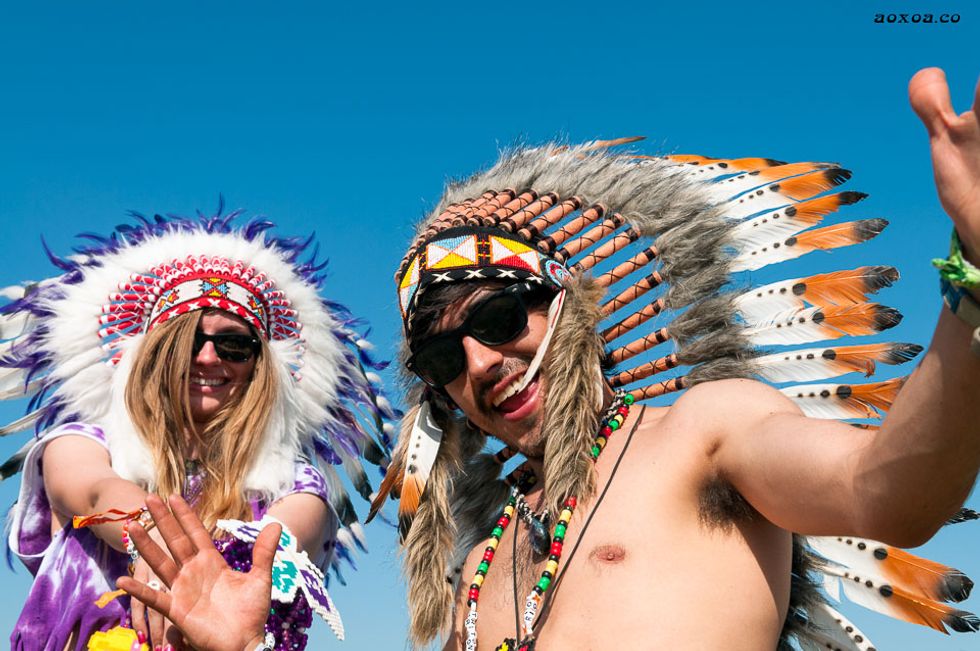
With the festival season in full swing, I'm sure many of you are busy planning out your outfits. Although this is one of my favorite parts of attending festivals, there is a fine line between fashion-forward and offensive. One of the biggest trends in festival fashion lately has been the wearing of Native American headdresses, or feathered war bonnets, which has caused quite a stir in the media, and sparked a great deal of outrage within Native American communities.
Many people have responded to this outrage with questions about why this is offensive, and are wondering why people are criticizing their "self-expression". The reason people are offended by festival goers wearing Native American headdresses, is because what festival goers call "self-expression" is actually cultural appropriation. For those of you who do not know, cultural appropriation is defined as the adoption of elements of one culture by members of a different cultural group, especially if the adoption is without the consent of the originating culture, and when the appropriating group has historically oppressed members of the originating culture. In traditional Native American culture, the headdress is only to be worn by the most powerful or influential members of the tribe. It is a sacred practice that is symbolic of the bravery and importance of the wearer. So, when someone decides to wear one to a music festival, they are being highly insensitive to Native American culture and tradition. They are essentially treating a sacred and symbolic practice as an accessory.
If this still does not clear it up for you, here are a few different perspectives that might make you think twice about wearing a headdress to a music festival.
“[Wearing a headdress] could be similar to if the [shtreimel] became hip. Or the headdress that the pope wears — if [kids] started wearing that, if that became a trend. I am sure any Catholic people might be disrespected. So for our people, it is the same way." - Cliff Matias, director of Redhawk Native American Council (MTV.com)
"Both feathers and face paint have purpose and often spiritual significance, depending on tribal protocol and individual interpretations. In Native cultures, both feathers and face paint are earned through actions and deeds that bring honor to both tribes and nations. Individuals [outside the community] who wear feathers or face paint were not given the rights or permissions to wear them. This is analogous to causally wearing a purple heart or a medal of honor that was not earned." - Dennis Zotigh, Cultural Specialist, National Museum of the American Indian (MTV.com)
“Cultural Appropriation occurs when a style leads to racist generalizations or stereotypes where it originated, but is deemed as high-fashion, cool or funny when the privileged take it for themselves" - Amanda Stenberg, actress
So, the next time you find yourself choosing outfits for a music festival, keep in mind the ways in which it can be offensive to other cultural groups. If you are unsure about something, it is far better to just leave it at home. Respect other cultures and their practices: they are not accessories. It's not fashion, it's just being flat out culturally insensitive. This does not only apply to those of you who are wearing Native American headdresses, there are several other trends that exemplify cultural appropriation. If you are looking for more clarification on what may be considered cultural appropriation, check this out: "Guide to Cultural Appropriation".