


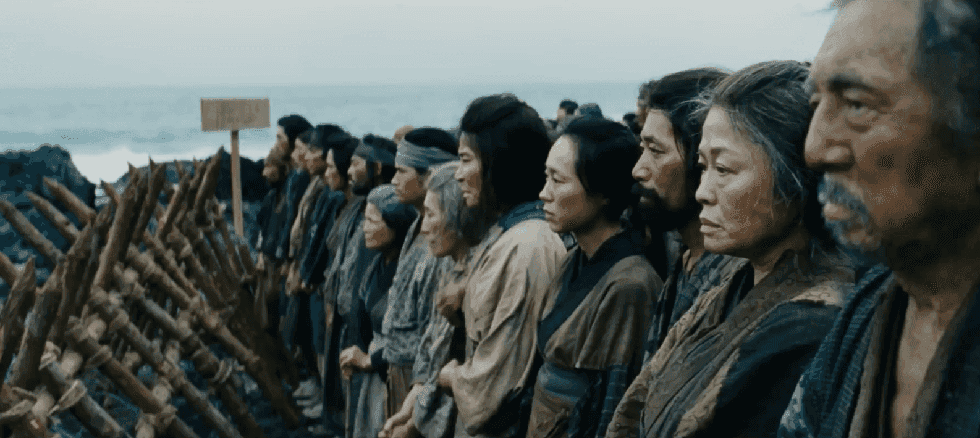
Martin Scorsese's "Silence" is a film that's been in the works for 28 years. As some of you know, my love for film begins and probably ends with Scorsese. I saw "Goodfellas" at the too-young age of 11 and was obsessed with his work ever since. I read a compilation of his interviews called "Scorsese On Scorsese" when I was 13, and I remember him mentioning "Silence" as he has multiple times throughout the years. With each new book on Scorsese, "Silence" is always the one that's next on the list. I never thought that I would eventually end up seeing it alone on a cold night in Madrid.
The point is that I knew about it for a long time as Scorsese's Holy Grail passion project. Andrew Garfield and Adam Driver play two priests in 17th century Portugal who learn that their former mentor, played by Liam Neeson, has possibly committed apostasy (publicly defected from the Catholic Church) in Japan during a period in which the government was trying to vanquish all Christianity from the country in an effort to homogenize Japan. Rodrigues (Garfield) and Garupe (Driver) refuse to believe that Ferreira (Neeson) would commit such a blasphemy and decide to investigate themselves while also doing missionary work.
The best thing I can say about the film is that it's a powerful, overwhelming experience. My mother is a very devout Orthodox Christian (which, in my view, is pretty close to Catholicism, but she disagrees), but I went to Catholic school and have always felt more part of that community, at least on some primal level if not on a practicing level. While the film opens with more basic questions that have been asked by believers and non-believers alike — that is, why would God allow suffering to happen if he's omnipotent? — the film progressively piles on and layers more troubling and mind-boggling questions.
For example, what place does a weak man have in this terrifying world? It's a question that is the central conundrum at the heart of my favorite film of last year, "Graduation," and is addressed much more directly here. Also who is more in the right: the Portuguese Jesuits or the Japanese government? Obviously, the Japanese in the film are torturing and murdering innocent Christians for their own political ends, but isn't it the liberal response to agree with the military official who tells Rodrigues that the missionaries have no business being there and need to respect their culture? But how does the pluralist respond to the Japanese summarily executing Christians? (In my view, and I think it's what the movie argues, they're both hypocrites.)
The really discomforting questions come in when the Japanese government realizes that murdering priests only emboldens the Japanese Catholics by giving them martyrs, the more brutal method is to threaten the deaths of civilians unless the missionaries publicly defect. Perhaps the most disturbing question asked in "Silence" isn't "Is there a God?" but rather it's "WWJD?"
The biggest problem with the film, then, has only to do with the casting of Andrew Garfield. I think he's a great actor, and I've been a fan of his since "The Social Network," but there's a certain heft missing from his performance. I don't think it has much to do with him as it does with the disjointedness between him as an actor and the part as it is written. Gael García Bernal was attached to the project at one point, and I imagine Rodrigues was the part he was offered. If that film had been made, along with Benicio Del Toro and Daniel Day-Lewis, it'd probably be on my top 10 list of favorite films of all time. I also had a problem with the fact they're speaking English with a Portuguese accent. They wouldn't sound foreign to themselves, would they? That being said, everyone in the Japanese cast, particularly Issey Ogata and Shinya Tsukamoto, is terrific.
Scorsese is 74 years old now and it's miraculous how on top of his game he still is. Remember, his last movie, "The Wolf of Wall Street," features a stockbroker blowing cocaine up a woman's rectum within its first two minutes. We now have a 2 hour 40 minute movie without tons of tracking shots or cursing, but it's still clearly his voice (he's got swishpans and jump-cuts, of course) asking these really heavy questions that had me deep in thought long after the movie ended. The answers to all the questions raised in "Silence" all contradict each other, and that's the hardest part. It's heart-breaking in the sense that Scorsese is screaming out into the world asking why there's so much brutality in the world and why we don't learn from our mistakes. The most depressing part of it all is that the only answer to these screams is silence.
















