"Our arrival was ominous: next to the village's moss-covered archway, a sun-bleached cow skull perched on top of a dreary wooden building seemed to be a warning to unwanted visitors. Walking down the only road through the village, the first person we encountered was equally unsettling: a scowling man with a cow skull necklace peered up at us from his front yard." This is what Colin Legerton and Jacob Rawson, authors of "Invisible China," wrote as their initial impression of Masan, a Wa village.
If that's not creepy enough, then consider this: historically the Wa were seen as barbarians. Why, might you ask? Well for one, their style in warfare included removing the heads of their enemies and keeping them as trophies. For this—and that during the late 19th century the first official account from the Wa did nothing to dispel the barbarian label—the Communists classified them as the most primitive ethnic group in China. Personally I think head trophies are pretty cool, but British troops in the 20th century thought otherwise. They reported that paths lined with human skulls, or "skull avenues," led into every Wa village. Not exactly a warm welcome (Legerton, Rawson 100).
To go along with the headhunting, or Latou, the Wa also practiced human sacrifice as part of their Animist religious beliefs. Today, however, they are predominantly Buddhist and a few are Christian.
But as we all know *insert annoyed student drone*, you can't judge a book by its cover. In fact, the Wa are not at all as scary as they seem. After saying hello to the scowling man, Legerton and Rawson were pleasantly surprised by his smile and invitation to his house later. The kindness only continued from there. In the following pages (until page 114, which is the end of the Wa chapter) of their novel "Invisible China," they tell of their adventure in Masan. From exchanging folk songs on an acoustic guitar to being welcomed to participate in their Women's Day celebration, the Wa gave the two Americans quite an unforgettable experience.
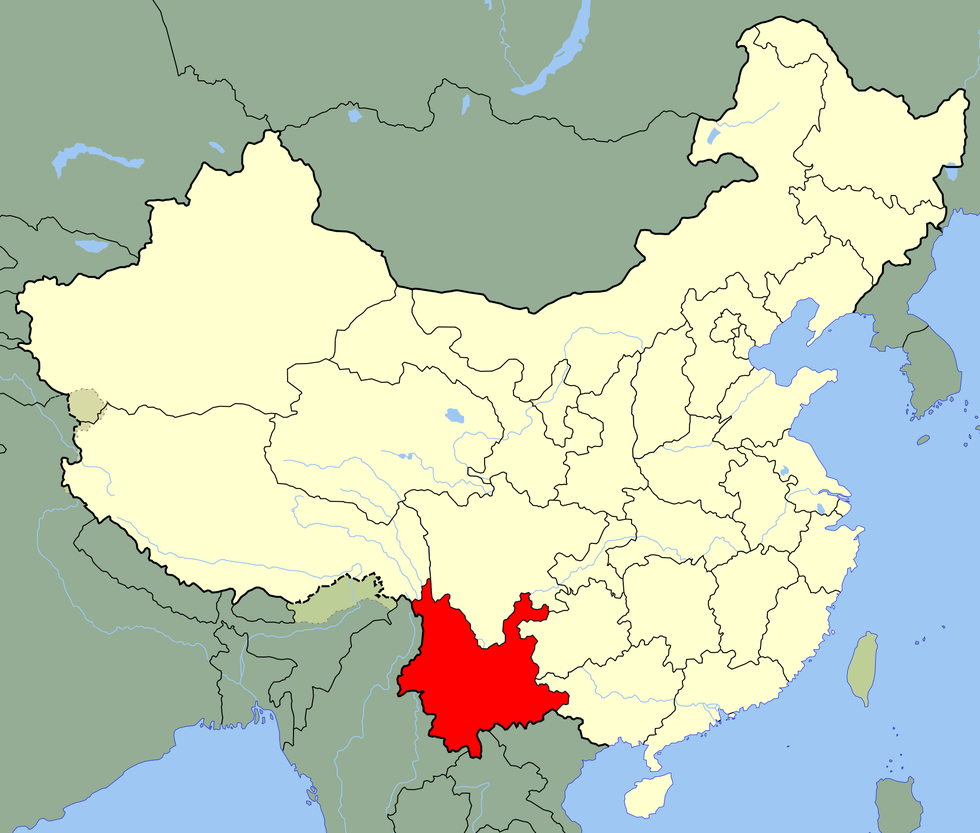
Now that we've gone over prejudices and reality, how about some actual background and facts? To start, the Wa people—also known as the K'awa, Kawa, Va, Vo, Wa Pwi and Wakut—primarily live the Yunnan Province located on China's southern border. Their name roughly translates to "mountain dwellers" in English. They are poor subsistence farmers of about one million strong and, according to historical records, are descendants from the Baipu people who lived before the Qin period (221 BC - 26 BC).
Thy build their houses with bamboo and straw or cinder blocks and bricks. The houses are typically two stories, the upper level being for family accommodation and the bottom level for livestock.
The Wa people eat two or three meals a day, which can consist of a variety of subsistence crops such as rice, pineapple, corn, banana and potatoes. Rice is complemented with kaoliang, buckwheat, maize and beans. Chiles are a favorite of the Wa people, both young and old, so much that a meal is considered incomplete without them. As far as meat goes, they primarily eat beef, chicken and pork, but will also eat rats and several kinds of insects.
In all Wa areas, drinking with guests is universally viewed as good etiquette. Legerton and Rawson experienced this tradition when they visited Masan. According to the two Americans, the ritual goes as so:
"One person picks up a cup full of alcohol, raises it to a friend, and yells 'Ah!' The friend returns the exclamation, pointing back with thumb and index finger extended at a right angle as the other downs the alcohol in a single gulp. The cup is then refilled and passed on to the recipient of the first ah who then chooses a new partner to continue the cycle." This can go on for quite some time.
Unfortunately, the Wa people are currently faced with two very pressing issues, one of them being that only one percent can read or write in their own language (according to The Summer Institute of Linguistics). It wasn't even until 1957 that they had writing for their language. Broadly speaking, their language is Mon-Khmer, but that branches out into a mind blowing amount of dialects.
Arguably worse than that, though, is the fact that the Wa are heavily involved in drugs. They control much of the region's drug trade and many grow opium poppy as a cash crop. According to "Drug Control: U.S. Heroin Program Encounters Many Obstacles in Southeast Asia" in 1995, over 85 percent of poppy cultivation in Southeast Asia occurred in Burma (Myanmar). Though they've traditionally used unrefined opium for medicinal reasons and have been growing opium poppy for centuries, rubber trees are now being used as a substitute cash crop to help steer the Wa away from opium.
Now, the United Wa State Army (UWSA) continues to produce opium and refine it into heroin then ship it to China and beyond. Profits from this are used to help the government maintain power and pay for military equipment and operations. Oddly enough, this happens despite their leader, Bao You-Xiang, promising to eradicate the drug.
Finding information about the Wa people was anything but easy. I'm sure many of you have never heard of them, and for those who have, consider me impressed. The only reason I found out about these people was through my class Tourism and Ethnicity in China. Even then, we only ever spoke about the Wa because we read "Invisible China." It just goes to show how much more diversity there is to this world.