


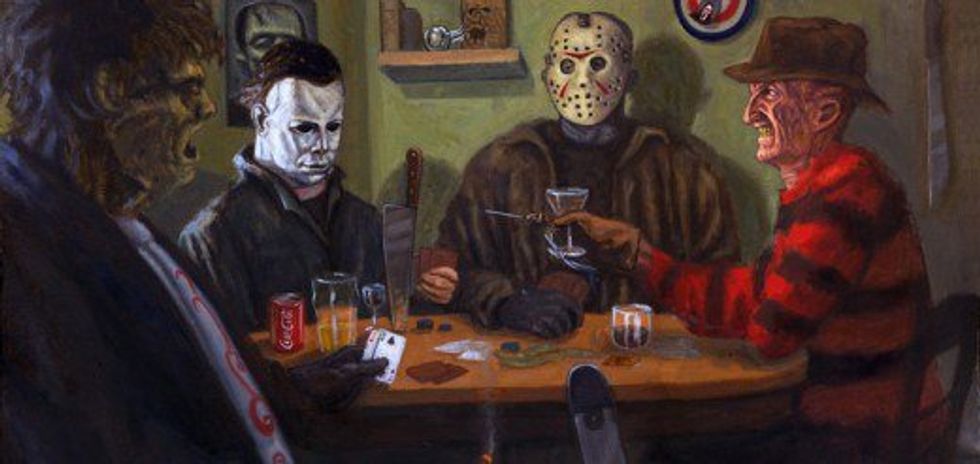
Over the years, I’ve given witness to a great number of terrifying and deeply unsettling movies, but of all the genres and sub-genres which exist in the realm of American horror cinema, there is no other style of film that I look back on more fondly, nor, for that matter, which retains as much notoriety, than the ”Slasher Flick.” These films, decades old or just released, serve as a guilty pleasure for many and stand as an omnipresent and ever popular figure in popular culture, but not always for the reasons you might think.
The term “slasher” would come into common use around the 1960s, and it mostly refers to the behavior of the film’s primary antagonist, usually a grotesque or deeply disturbed individual, who carries out acts of brutality, murder, and extreme violence against others, in the name of seeking a deep personal fulfillment or accomplishing some goal. This violence is typically carried out with some sharp cutting instrument, such as a knife or axe, but as evidenced by the success of such films as "The Texas Chainsaw Massacre" and "Friday the 13th," the term is more colloquial than anything else, as it seems that any old thing that might be lying around the tool shed will do the job.
The slasher genre is often credited to the work of such directors as Alfred Hitchcock and Michael Powell, who produced some of the first films which allowed the audience to witness a narrative told not only through the eyes of the antagonist, but through the eyes of his victims as well. What initially unsettled audiences so deeply about these types of films wasn’t the scary masks and sudden, jarring scenes of blood and violence, it was because slasher films introduced a powerful element of unease into an otherwise ordinary and peaceful world and robbed its audience of an overall feeling of safety, in the sense that the situations and individuals presented in the films came just a little too close to home.
Unlike other genres of horror, such as the psychological or the supernatural thriller, the situations presented to the audience were oddly plausible. No more was the terror derived from some obscure alien being crash landed on Earth from some distant planet or some shambling spectral phantom doomed to forever wander the halls of a dark and dreary house in the distant countryside. The villains found within the slasher genre were often real men of flesh and blood, and they, in many ways, appealed to deep subconscious fears of the individual, all while prompting them to question the odd satisfaction they felt at being such willing and candid voyeurs to these gruesome acts of carnage and violence.
This is, of course, nothing new. Horror films have always served as a form of commentary for a number of issues facing society as a whole. By personifying certain negatively stigmatized behaviors and atrocities into individuals which are deemed terrifying or who otherwise exist outside of the traditional social model, American horror films, such as slasher flicks, reinforce a series of social norms and behaviors into the audience, which ultimately are intended to guide and shape their behavior. People found satisfaction in a slasher film because it allowed them to experience the helplessness and terror of being a victim to some overpowering and malevolent force, all from the safety of an omnipotent or limited third person perspective.
Sometime in the 90s, however, this idea was flipped on its head. Where horror movies once put all of our greatest fears on display, the slasher film had slowly evolved into a medium which now served as a sort of cathartic relief for audiences to witness the identification and destruction of the negative or otherwise undesirable behaviors of society. Keep in mind that I grew up during a time when college-themed slasher flicks such as “Scream” and “I Know What You Did Last Summer” were wildly successful box office hits. This was when the shameless clichés and tropes first pioneered by their predecessors in the 80s would be allowed to run absolutely rampant and would come to define and shape the plot and structure of the modern slasher film.
However, these tropes far predate the medium of film, in that these stock characters, such as the Jock, the Whore, the Madonna, the Social Outcast, and the Stoner not only serve to stigmatize and condemn a series of negative and undesirable behavior, but the gruesome and oddly fitting ways in which they are dispatched serves as a metaphor for society’s need to purge itself of this behavior, and is very similar in method to burning an image in effigy.
All of the extremes in behavior, such as pride, lust, envy, and sloth, have a human counterpart which is represented in these films. In most cases, even the antagonist comes to represent the sin of wrath, in that his goals are often rooted in a desire for destruction or revenge against either a group of people or as many members of the majority as they can. Most theater goers look at the ways some of these characters meet their end not with shock or terror, but rather with a morbid form of satisfaction and curiosity. They harbor inside them a deep desire to condemn these individuals and what they come to represent, and secretly feel vindicated and fulfilled at witnessing their demise. Those characters exhibiting more admirable traits are allowed to survive and to live productive and successful lives.
That is, until the sequel…
















