If you’re not an English major and have already fulfilled your English distribution requirement, chances are you’ll never see the inside of a Norton Anthology of literature, much to your own personal loss.
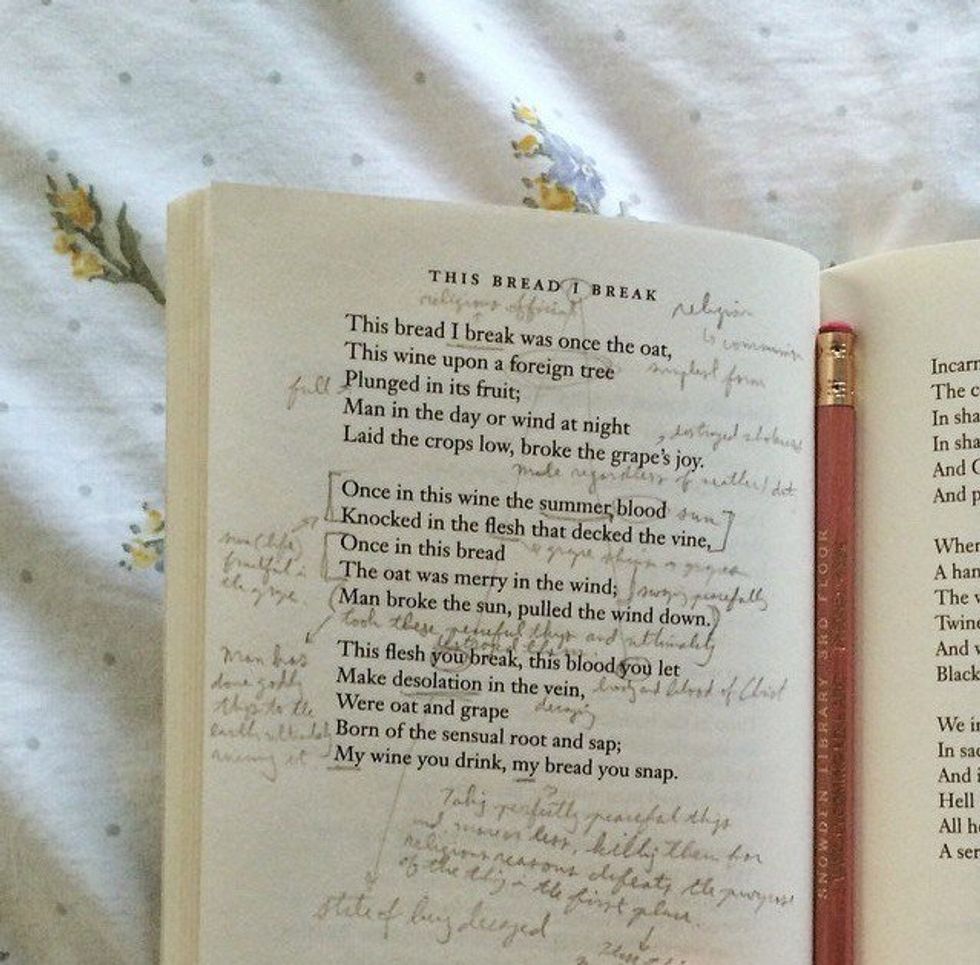
Being a poetry major, I’ve had the pleasure of lugging around 1,000-page textbooks with Post-It tabs jutting out of certain pages, like where Yeats’ “The Lake Isle of Innisfree” isn’t, how Ginsberg felt for the “best minds of [his] generation,” Langston Hughes’ pondering “what happens to a dream deferred,” and so many more. Although these pages were initially marked for quick reference and class notes, they eventually became just bookmarks -- where a poem, a mindset, a soul, a worldly understanding began. But it wasn’t always like that.
All through middle school, I detested reading. I had better things going on like puberty and being ignorant. Sure, as I grew older, I got into Vonnegut and other science fiction authors, but poetry was never at the forefront of my heart. So upon walking into my first literature class, I was already overwhelmed. I knew I enjoyed poetry, but I didn’t love it, so thumbing through my five-page British Literature II syllabus intimidated me because it was full of unfamiliar poets, but then there was good ol’ Robert Frost. Reassurance. High school ruined him for me.
“’The Road Not Taken’ is about making life choices, so make sure you make the right ones. Drugs are bad. Cool?”
But as we moved through the poems and the professor described the meanings of specific lines and stanzas, I began to make my own analytical connections in the form of arrows, circles, and highlighted phrases, which then drove me to explore poems past the ones printed during syllabus week. Being in a literature class gave me not only a greater appreciation for poetry but also a new lens, so to speak, through which to observe the world. I had always thought creatively, but poetry allowed me to see the subtle nuances of the everyday, things that most overlook because they’re looking at their damned phones or have their big headphones blaring something barely comprehensible.
At this time, I had been writing terrible emo poetry for a few years, wholly under the impression that it was good, content with creating scenes entirely in my head, which isn’t how poetry should be written. I’ve learned that. The most difficult subject to write about is real life because it’s concrete. You don’t have to create completely new meanings for things, because they’ve already been defined, albeit some more deeply than others. The challenge is uncovering that meaning and making it your own, not necessarily by changing it, but by improving it. I can’t say that one literature class has changed my entire outlook on the world, the universe, and its possibilities, but poetry simply has.
Because of poetry, I am capable of experiencing so much more. I don’t see things simply anymore. Things are not as they are to me anymore; there’s more beneath the paint, paneling, asphalt, and sidewalk blocks. A corner café is more than its ceramic saucers and pour-overs; a bus stop is more than a bench and a prison cell of overbearing advertisements; the world is more than a space rock that’s content with drowning and the sun slowly scorching it.
People, life is more than we think it is.
I overheard a conversation in passing that went something like this:
“Did you read for class?”
“Yeah, didn’t take long. They were just poems.”
Just poems. A poem is not wide, but it is deep. It’s like a $1.25 cup of coffee in any well-staffed diner. Sure, the mug isn’t big, but the coffee's good and you seldom see the bottom when waitresses are constantly sweeping the room, carrying carafes in both hands, keeping you from accepting an end.
Even when the poem ends, the poem has only just begun.