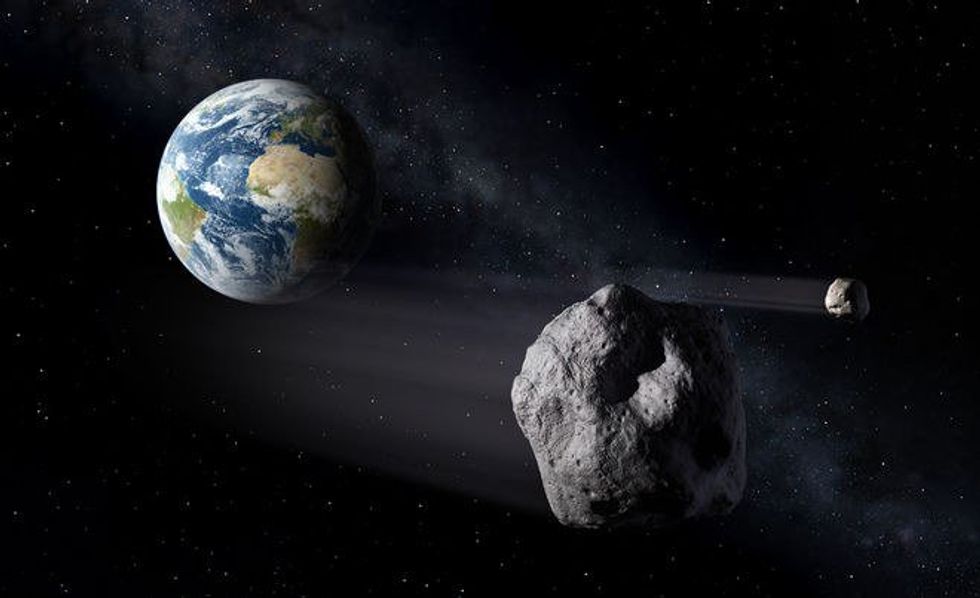
There’s a new moon in town, and not in the sense that it’s in the first lunar phase and invisible. No, you heard right—there are now two moons in our orbit. Right now. Up in space. Two moons. And it’s been that way for about one hundred years.
It’s only now that NASA has deemed the second moon officially here to stay since asteroids are known to pass through Earth’s orbit now and again. The mini moon, also known as Asteroid 2016 HO3, was first discovered on April 27 of this year, by the Pan-STARRS 1 asteroid survey telescope in Haleakala, Hawaii, run by University of Hawaii's Institute for Astronomy and funded by NASA's Planetary Defense Coordination Office. NASA estimates that the asteroid is between 120 and 300 ft—for a little perspective, the largest known dinosaur, the Argentinosaurus huinculensis, was 130 feet long. It might not be that massive by moon standards, but by human standards… wow.
Asteroid 2016 HO3 orbits the Sun for 365.93 days, only slightly longer than Earth’s 365.24 day-long orbit. Its elliptical and tilted orbit sometimes causes it to be closer to the Sun and moving faster than Earth, while other times, it’s farther out and slower. Either way, it doesn’t stray very far from Earth (in planetary values, of course).
The mini moon’s orbit is set in a unique back and forth pattern that keeps it at a distance which allows it to be a “quasi-satellite” for Earth, but not close enough to be an accepted satellite, like the moon. As Paul Chodas, manager of NASA’s Center for Near-Earth Object (NEO) Studies at the Jet Propulsion Laboratory, puts it, “The asteroid‘s loops around Earth drift a little ahead or behind from year to year, but when they drift too far forward or backward, Earth’s gravity is just strong enough to reverse the drift and hold onto the asteroid so that it never wanders farther away than about 100 times the distance of the moon…In effect, this small asteroid is caught in a little dance with Earth.”
This dance is expected to last for, at least, a few more centuries.