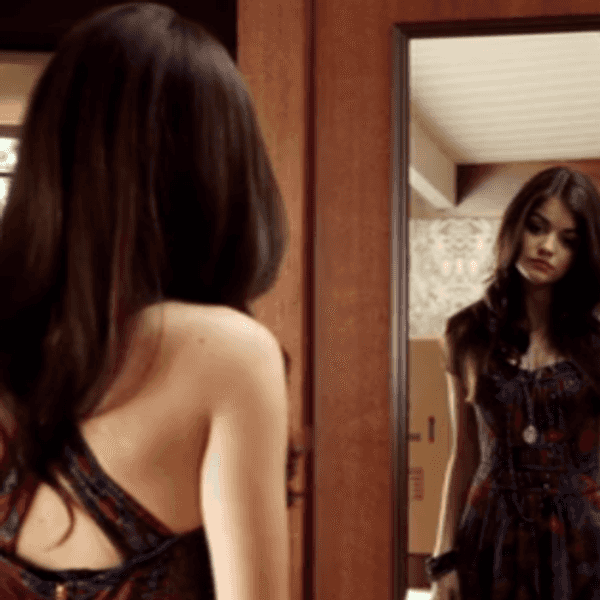

We are a society that prioritizes beauty. We shake off compliments on intelligence, athleticism, and other talents, striving to be called "beautiful." Consequently, we are a society of insecurity. Appearance is everything, and self esteem becomes nothing.
This is because from a young age, children are conditioned to associate beauty with excellence. Even as infants, mothers tuck back their babies' blankets and we coo over how cute the child is. Little girls bounce around in frilly dresses and we tell them how pretty they look. Entering school, children turn to their peers with the same conditioned, appearance-based judgments.
Lisa Bloom, a legal analyst for NBC News, wrote a book called, "Think: Straight Talk for Women to Stay Smart in a Dumbed-Down World," in which she reveals that "15 to 18 percent of girls under 12 now wear [makeup] regularly," and "25 percent of young American women would rather win America's Next Top Model than the Nobel Peace Prize." ABC News reports that almost half of all girls aged 3 to 6 worry about being fat.
I nanny children every summer, and last year, my heart was broken when my then six-year-old informed me she didn't want to wear her bikini to the pool because she was too fat. She is one of the skinniest kids in her grade, and was the opposite of fat, but that wasn't the point. At six years of age, why is she already so critical of her body? When I was six, the happiest nights were when my father let me wear my fluffy tutu to the ice cream store, where I could lick up my rainbow sherbet ice cream cone with zero concern for how it would affect my body.
As I grew older, I became increasingly self-conscious of myself, and unfortunately, this is the norm. Anorexia is the "third most common chronic illness among adolescents," according to the National Association of Anorexia Nervosa and Associated Disorders, and depression linked to appearance-based insecurities is overwhelming today's youth.
In 2014, the American Society of Plastic Surgeons reported that 15.6 million cosmetic plastic surgeries (for self-enhancement) were performed, which is a three-percent increase since 2013. Surveys across top college campuses reveal that even some of the brightest, most successful women would rather be hot than smart.
With the focus on beauty becoming more and more debilitating and overwhelming, increasing numbers of organizations are starting to deal with this. Most of their campaigns revolve around the idea that "everyone is beautiful," but that is fundamentally flawed in that it still appeals to the idea that beauty should be a priority.
Erin Tatum, in an article published by Everyday Feminism, touches on this ideology. "In an effort to compensate for impossible physical expectations," she writes, "there has also been an emphasis on inner beauty [...] On one hand it is important to remember that beauty exists beyond physical desirability, [...] yet again, there is a nagging insistence that we always have to find beauty in everything and that there has to be something analogous to beauty in every situation to make a person whole, especially in regard to women." Beauty is, decidedly, omnipresent.
Tatum reassures that the desire to be beautiful, in and of itself, is not necessarily bad. But she urges us to "critically examine the social reflex to analyze and interpret women's appearance."
There is more to women than beauty, and there should be an increased focus to take it off the pedestal we have lifted it up to for so long. Don't call her pretty, because she is so many other things.