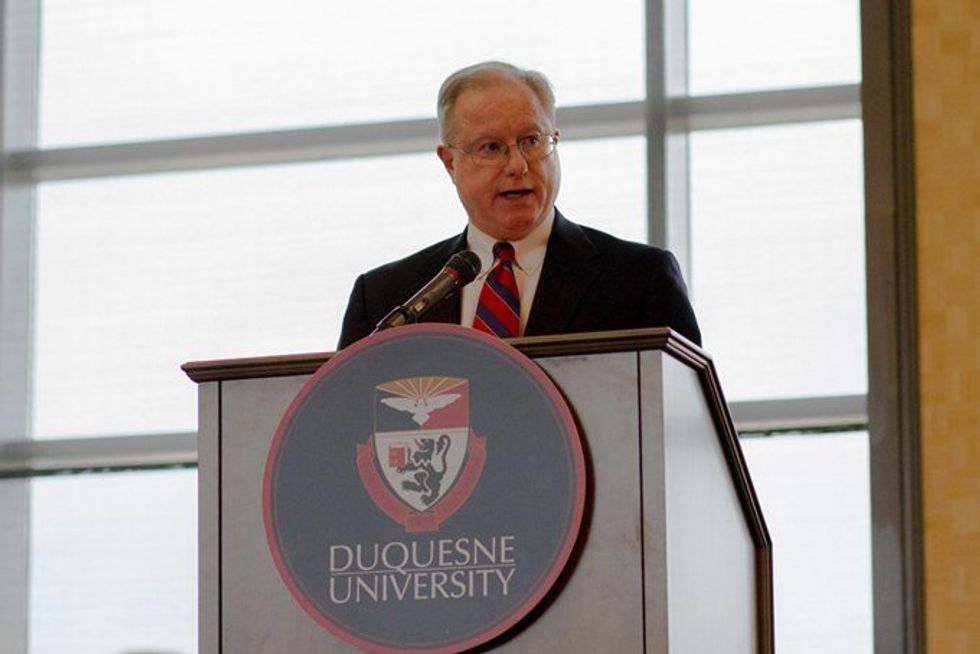
Many students don't know what a University President does. A University President's job is to be a leader. They are to be the champion of the students, and the head of the faculty. They should lead with intelligence, poise, and a vision of where the school needs to go in the future. It is not the job of the University President to belittle a large percentage of his student body.
When asked why he thought junior and senior students move off campus at his Town Hall address to faculty Tuesday afternoon, President Dougherty said, "We know why they move off-campus. They flaunt the state liquor laws and live a libertine lifestyle that is not allowed on campus." He went on to say, "We are aware of the mardi gras that goes on [off-campus] every weekend."
The Merriam Webster Dictionary defines a libertine as a "person who leads an immoral life and is mainly interested in sexual pleasure." Unfortunately for President Dougherty, not only were his words recorded, but they were shared again and again on Facebook with the thoughts of many of the students he is charged to oversee. These students weren't trying to live 'libertine' lifestyles. They didn't feel the need to have their own 'mardi gras' off-campus every weekend. As a matter of fact, when asked, most students say that their main reason for moving off-campus comes down to one main problem: money. Zach Redpath, a graduate of the class of 2015, said, "I didn't move off campus to have copious amounts of sex and drink myself stupid. I did it to save money. Including bills, rent, and groceries, I saved roughly 600 dollars a month for every month I lived off campus. This taught me more responsibility, because I had to manage my usage of the aforementioned more closely and remember that I was not protected by sign in procedures, but rather I lived in the Hill District." Nursing student Brooke Benton expanded on the idea of responsibility. "[I moved off-campus because] living off-campus has it's own responsibilities such as rent, utilities, grocery shopping etc. that we commuters have to learn on our own....Once we graduate and we step out into the real world, there isn't going to be someone to hold our hand. I think that is something you should learn in college, not after you graduate."
Students discussing money and responsibility? This doesn't sound at all like the libertine world of sex and debauchery that President Dougherty described. These students are living, breathing people who are getting their educations and traversing the way to adulthood. Trying to save money and gain responsibility is a part of growing up. To leave the expensive, sheltering arm of on-campus living is a part of many student's journeys. When Duquesne room and board prices are so high, these students have legitimate concerns. Dougherty's claims have struck heavy with many of his students. Some of these students were downright angry by the President's words. Senior Alex Ivoska said, "To imply we [want to flaunt the liquor laws and live libertine lifestyles] is strictly libel, [and] to claim such an outrageous claim is beyond fathomable."
It seems that President Dougherty has forgotten that, even though he may be leaving the University in 2016, many of his students are still affected by everything he says or does. His words will reach far and wide, and they will leave a bitter taste in the mouth of many graduating students. Did President Dougherty misspeak, as so many of us have before? Or does he owe his student body a public apology? It seems to many Duquesne students that President Dougherty owes an apology. Graduate student Lauren Walker certainly thinks so, saying, "I'm pretty sure Dougherty owes every student who lived off campus or currently lives off campus a personal apology. He needs to look at the university's outdated visitation policies as well as [students wanting] to save some money and have a little freedom." What do you think? Are you offended by the president's words? Are you a student off-campus who is just trying to save money? Do you need a public apology?
As the final word, senior student Emily A. Keith summed it up with a poignant, "Shame on you, Duquesne."