

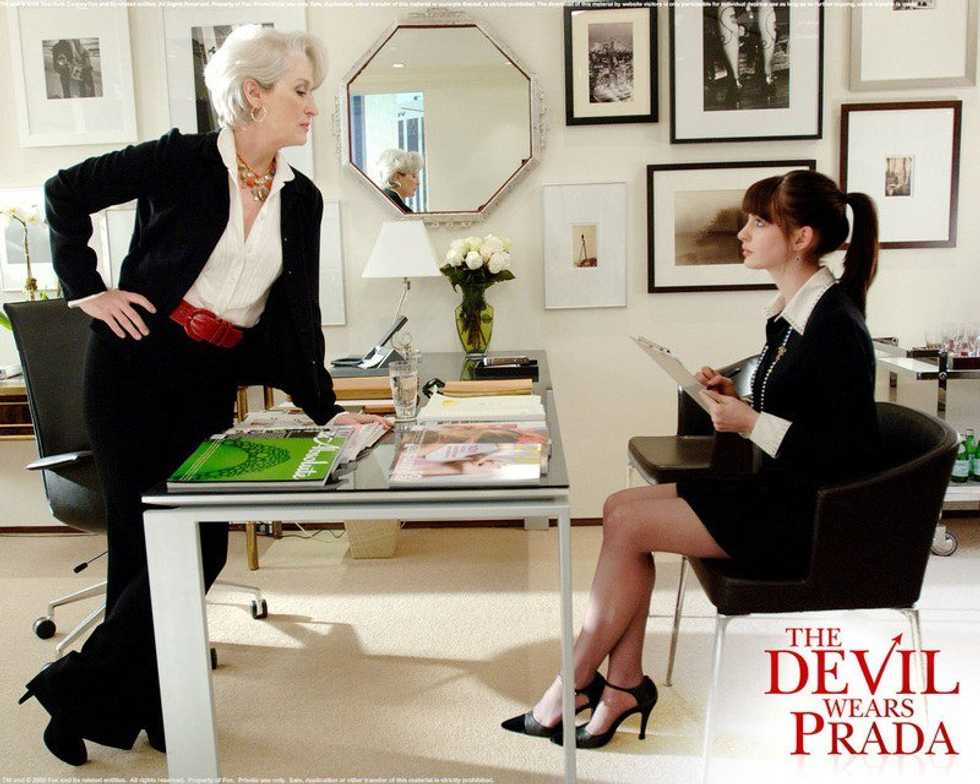
The 2006 film, "The Devil Wears Prada," is one of the most modern movies that depict the difference between high-class and working-class people in society. Anne Hathaway, who is Andy, and Meryl Streep, who plays Miranda, are the main characters in the movie, both representing the class system under capitalism.
Adorno and Horkheimer write in their piece, “The Culture Industry,” “Everybody must behave (as if spontaneously) in accordance with his previously determined and indexed level and choose the category of mass product turned out for his type.” In layman’s terms, they are writing that one must stay within their socioeconomic class, and anyone who tries to climb out will not be able to have their cake and eat it, too. "The Devil Wears Prada," embodies this idea of keeping people in their predetermined socioeconomic classes, as high-class people are not viewed positively, and as Andy tries to enter their world, her own falls apart.
Andy represents the working class, which is clear in the opening sequence of shots in the film. She is living in an average-sized apartment but is juxtaposed to high-class, beautiful women who are the opposite of Andy. Andy is dress is comprised of no flashy or brand-name clothes and frizzy hair, but the series of women juxtaposed to her have every detail of their designer outfit picked out. Miranda is the main high-class representation in the movie, donning brand-name clothes, hair and makeup done perfectly, a limousine driver, her own office, and is looking for a second assistant at her job. The mis-en scene of the first minutes of the film lets the audience see where each character stands in the class system because of their clothes and lifestyle in which they live.
The interaction between characters lets the viewer know what each character is like. The high-class character’s personality, which we first see is Emily Charleton, Miranda’s first assistant. She is snotty and insulting to Andy when she realizes that Andy is applying for the assistant position. As Emily gets a text to tell her that Miranda will be early, the camera tracks into her face for a close-up to show the panic on her face, and we see Andy is confused as to why Emily is so worried.
The next shot is of a Lincoln limousine driving up to the curb of the building where they are. From this shot, because we do not know who is in the car yet, we can only tell whoever is in the car is of power and wealth. This scene is a Hollywood attempt to keep the working and lower classes in their places because it shows how stressful a high-class life is.
Emily, Nigel and the other employees of Runway all are running around frantic. They may have glamorous things and know celebrities of all sorts, but Hollywood shows the bad, stressful side of it, so the low classes won’t attempt to rise up to their socioeconomic positions.
Miranda and Andy have their interview soon after, and the class differences are obvious. Miranda is sitting in her all-white, personal office behind her desk, which separates her from Andy, who stands far away — stands out in her designer office. When they speak, Miranda doesn’t look at Andy, she looks down and away. Despite the class differences, the camera remains at eye-level for each character, no high angles or low angles. This is foreshadowing to Andy trying to rise out of her class, to be on the same level as Miranda. It also lets the audience believe that because Miranda is sitting, we want to look down at her, like Andy is, and will at the end of the film, as she stands now.
















